
System Outage Contingency Plan: CBSA commercial systems
Ottawa,
(Replaces version )
Commercial clients, or trade chain partners, of the Canada Border Services Agency (CBSA) should follow the procedures outlined in this plan during scheduled and unscheduled outages and processing delays.
Summary of updates
This replaces the previous version dated . The following changes have been made:
- Complete review for clarity and consistency
- Clarity on the requirements to submit electronic data
- Clarity added on various stakeholder roles
- Extensive definitions section added
- Charts are now separated into import and export for clarity
- Charts now separate for data transmission and arrival messaging transmission
- Section CBSA Assessment and Revenue Management (CARM) procedures updated to reflect the end of the transition measures
- Procedures for urgent shipments added
Acronyms and definitions
- ACI
- Advance commercial information
- API
- Application program interface
- ACROSS
- Accelerated Commercial Release Operations Support System
- BSO
- Border services officer
- Business hours:
-
- For compliance purposes: 8 am to 5 pm Eastern Time, Monday to Friday, except holidays
- Technical Commercial Client Unit (TCCU): 8 am to 5 pm Eastern Time, Monday to Friday (except holidays)
- CARM Technical Support Unit (CTSU): 7 am to 6 pm Eastern Time, Monday to Friday (except holidays)
- CAD
- Commercial Accounting Document
- CARM
- CBSA Assessment and Revenue Management, the official system of record for the collection of duties and taxes for commercial goods imported into Canada.
- CCP
- CARM Client Portal, importers and other trade chain partners that register their businesses in the CARM Client Portal can manage their accounts and access other online services from the CBSA.
- CARM portal outage
- CPP is not operational and/or available for use.
- CCD
- Cargo control document, a manifest or other control document that acts as the record of a shipment entering or exiting Canada, or moving within Canada.
- CERS
- The Canadian Export Reporting System is a free, web-based, self-service portal for submitting electronic export declarations and Summary Reporting Program monthly reports.
- CERS portal outage
- CERS portal is not operational and/or available for users. Electronic data cannot be submitted or retrieved.
- CFIA
- Canadian Food Inspection Agency
- Cybersecurity incident
-
Any unauthorized attempt, whether successful or not, to gain access to, modify, destroy, delete, or render unavailable any computer network or system resource. Cyber incidents should be reported to the Canadian Centre for Cyber Security.
Reporting a cyber incident helps the Cyber Centre keep Canada and Canadians safe online. Visit the Canadian Centre for Cyber Security website for more information or to Report a cyber incident.
- EDI
- Electronic data interchange
- EDI system outage
-
The CBSA is not able to process any of the electronic messages being received or sent through EDI. Trade chain partners still have the ability to transmit the data to the CBSA, where it is received and queued until such time the EDI processing of the data is back online.
- For inbound messages: The CBSA is not able to receive any new inbound EDI messages from trade chain partners
- For outbound messages: The CBSA is not able to send outbound messages to trade chain partners through EDI
- Electronic Longroom
- Email and digital stamping service offered at some CBSA offices. Commercial trade chain partners can use this service instead of submitting certain paper requests in person (consult Electronic Longroom service for details).
- eManifest portal outage
- The eManifest portal is temporarily unavailable. Users cannot submit or retrieve electronic data.
- FPOA
- First point of arrival in Canada, also known as port of report of goods.
- Full CBSA system outage
- All CBSA systems are not functioning. EDI, eManifest portal, CARM Client Portal, Canadian Export Reporting System portal, Commercial Accounting Document / Application Program Interface services, and CBSA internal systems.
- IID
- The Integrated Import Declaration provides commercial importers and customs brokers with a way to submit all import information and documents required to meet federal government import regulations, and obtain an admissibility decision electronically.
- LCPO
- Licence, certificate, permit or other relevant document.
- LTL
- Less than truckload, in highway mode.
- MOU
- Memorandum of Understanding, with respect to the export of cargo, means a carrier or customs service provider who has formally entered a legally non-binding written agreement with the CBSA and agrees to export only goods that have been or will be reported by the exporter in accordance with the regulations.
- PARS
- The Pre-Arrival Review System allows importers and customs brokers to submit pre- or post-arrival interim accounting documentation to the CBSA to obtain release of goods.
- Processing delay: EDI, eManifest Portal messages and CARM
- Delays in processing and responding to TCPs for a period of more than one (1) hour. Processing delays are to be treated as a system outage by trade chain partners, as well as the CBSA.
- RMD
- Release on minimum documentation, paper package that allows importers and customs brokers to submit paper interim accounting documentation to the CBSA for review and processing to obtain release of goods both pre- and post-arrival.
- RNS
- The Release Notification System includes the following 5 features: automatic release notification, arrival certification, delivery, status query and automatic status notification.
- Scheduled CBSA system outage
-
Outage scheduled for maintenance:
- a list of scheduled outages planned for the year is available
- bulletins are published for the trade community prior to the outage and identify an outage timeline
- scheduled outages are planned to minimize operational impacts
- TCP
- Trade chain partner, an enterprise that is directly involved in the importation, release, accounting, exportation or any cross-border movement of commercial goods.
- Unscheduled outage
- Any type of outage that is not "scheduled" as per this document's definition.
- Urgent shipments
-
- Perishable goods: Goods which are subject to speedy decay and spoilage, for example, live animals, fresh or frozen meat, fish, fruits and vegetables, flowers, dairy products, human plasma, etc.
- Precious goods: Goods which, for security reasons, require quick release when they arrive in Canada, for example, gold ingots, diamonds, original works of art, etc.
- Time sensitive goods: Goods that lose their value or principal utility if not used within an imminent time frame, for example, periodicals, newspapers
- Urgent goods:
- goods required to resume production or avoid a stoppage in production in a factory, plant or mill: that is, replacement parts
- goods required to repair grounded aircraft
1. Introduction
The Canada Border Services Agency System Outage Contingency Plan (SOCP) sets out the procedures for the importation and exportation of commercial goods in all modes of transportation during a CBSA systems outage or processing delay.
These procedures are operational and relate to movement and/or customs release of commercial goods. Post-release accounting and trade related procedures are not within the scope of the SOCP.
An outage is defined as a "temporary suspension of operations of the electronic systems." Please refer to the Definitions section for a description of various types of outages and scopes/impacts.
Note: It is important to note that the all procedures outlined in the plan apply only in the case of CBSA outages or processing delays. For trade chain partner (TCP) outages, refer to section 1.3.
1.1 Invocation and revocation of contingency procedures
Contingency measures are invoked through the issuance of a Commercial Client Bulletin when the following systems experience outages and processing delays: eManifest Portal, Canadian Export Reporting System (CERS) Portal, CARM Client Portal (CCP), Commercial Accounting Declaration (CAD)/Application Program Interface (API), and Electronic Data Interchange (EDI).
A Commercial Client Bulletin is used to confirm when a system outage or processing delay is over. Contingency procedures may continue to be used for 2 hours after the outage or processing delay end time, in order to provide time for trade chain partners to revert to regular processes. During this time TCPs can continue to present paper requests and these must be processed.
1.2 Communications protocol during CBSA system outages and processing delays
Commercial Client Bulletins are used to provide information and updates during outages and processing delays and to highlight or enhance contingency measures found in the System Outages Contingency Plan.
System status updates will be provided with the following frequency until resolved:
Unscheduled System Outage:
- Business hours (8 am to 5 pm Eastern time (ET, Monday to Friday) – every 2 hours
- After hours - Every 4 hours until 10 pm
- Bulletins will be sent between 10 pm and 8 am only to report new information
Unscheduled System Delay:
- Business hours (8 am to 5 pm (ET, Monday to Friday) – every 4 hours
- After hours – Every 4 hours until 10 pm
- Bulletins will be sent between 10 pm and 8 am only to report new information
External clients should assume that the outage or processing delay is still ongoing unless a "resolved" message has been provided.
The Technical Commercial Client Unit provides a toll free number to assist external TCPs with technical issues or problems relating to eManifest Portal, CERS Portal and EDI.
The toll free telephone number is 1-888-957-7224 within Canada and the United States, and +1-613-946-0762 for overseas TCPs.
The toll free number provides a broadcast message that indicates the status of eManifest Portal, CERS Portal and EDI services. Once a systems outage and/or processing delay has been reported, the TCCU will accordingly update the broadcast message.
A table outlining the services provided by the TCCU during business hours and after business hours on an emergency basis can be found at Technical Commercial Client Unit: How to direct your service inquiry.
The CARM Technical Support Unit provides a toll free number to assist external TCPs with technical issues or problems relating to CAD/API services during business hours.
The toll free telephone number is 1-800-461-9999 within Canada and the United States, and 1-204-983-3500 or 1-506-636-5064 for overseas TCPs.
1.3 Trade chain partner outages
TCPs will inform the Technical Commercial Client Unit by telephone (refer to section 1.2) of unscheduled outages of their own systems as soon as possible, provide periodic updates and advise the TCCU once resolved.
TCPs will inform TCCU and CSTU of scheduled outages of their own systems at least 24 hours in advance.
In case of an external client outage, full paper documentation must be presented with a clear explanation on the Release on minimum documentation (RMD) paper package.
CARM CAD/API TCPs will inform the CARM Technical Support Unit by telephone (refer to section 1.2) of unscheduled outages affecting their systems, as soon as possible. Similarly, they will contact CTSU to indicate, when the outage has been resolved.
When external TCPs, including third party service providers, experience systems outages, CBSA regional operations will accept paper release requests with an EDI Exception Lead Sheet that indicates a systems outage, as documented Memorandum D17-1-4: Release of commercial goods.
Note: The CBSA does not automatically issue Commercial Client Bulletins related to external client outages. Dissemination of a Bulletin will be assessed internally by CBSA, based on potential outage length and impacts to border operations.
If an external client is victim of a cybersecurity incident that impacts the company's ability to transmit transactions to the CBSA, the TCCU should be informed as quickly as possible. In addition, TCPs should report the incident to the Canadian Centre for Cyber Security (refer to Report a cyber incident).
2. Key principles and procedure overview during CBSA outages and processing delays
2.1 Key principles
- During outages and processing delays, the System Outage Contingency Plan allows a paper process to expedite the movement of goods. However, certain requirements may have not been met and it is the TCPs responsibility to meet those once the system outage or processing delay is resolved.
- Import: The importer must meet the accounting requirements as per the Customs Act, section 32
- Export: The exporter must meet the reporting requirements as per the Customs Act, section 95(1)
- Prior to a scheduled outage: TCPs must transmit data to the CBSA at least 2 hours prior to the start time of any scheduled outage to ensure that pre-arrival transmission timelines are met for shipments expected to arrive at the border during the outage.
- TCPs, including importers, are still required to electronically transmit all trade documents impacted by the outage or processing delay. It is therefore recommended that TCPs continue transmission of all electronic data during the outage or processing delay (if possible) for queuing and expediting the recovery process.
- During unscheduled and scheduled outages as well as processing delays, it is imperative that TCPs transmit the data only once, even in the absence of a response from the CBSA. Sending data multiple times could cause additional delays.
- TCPs that are unable or have opted not to transmit their trade documents via an alternate method of electronic communication will transmit their trade documents within 24 business hours of the system functionality being restored:
- trade documents include release, cargo, conveyance, house bills and export declarations
- trade documents will use the actual date and time of release for imports or the date and time of departure from the export reporting office closest to the place of exit of the goods for exports
- At importation, TCPs must present required paper documents, receive stamped copies and maintain records to demonstrate:
- The reporting requirements in the Customs Act, section 12(1) have been satisfied.
- The authority for the carrier to deliver or move goods in bond to a sufferance warehouse under the Customs Act, section 31.
- The stamped copy does not override the requirement to transmit the EDI release request during or after the outage and/or processing delay is resolved. Transmission is still needed to meet requirements of the Customs Act, section 32.
Note: For details, refer to:
- section 2.2 (overview)
- section 3 (carrier import procedures)
- section 4 (export procedures)
- section 5 (import procedures)
- Regardless of the outage or processing delay condition, other government departments' (OGD) requirements must be met prior to release or at export.
- the CBSA does not consider the presentation of the 14-digit transaction number to be proof that Canadian Food Inspection Agency (CFIA) or any other OGD requirements have been met
- refer to section 5.1 for details on OGD paper release requests
- A commercial client bulletin is always issued to confirm the system outage or processing delay is resolved.
- After the outage or processing delay, once the EDI documentation including release requests have been processed by the CBSA, TCPs using this transmission method will receive an electronic message and/or release notification.
- No monetary penalties will be issued to TCPs for failure to transmit required data during a scheduled or an unscheduled outage or processing delay and for the 2 hours following system resumption.
2.2 CBSA outage and processing delay operational procedures and timeframe overview
2.2.1 Imports: Electronic data interchange and eManifest Portal instructions
- Prior to a scheduled outage
-
- Submit electronic data 2 hours prior to scheduled outages
- During an outage or processing delay
-
- If CBSA systems allow, TCPs will submit electronic data during an outage or processing delay, only once. Sending data multiple times could cause additional delays.
- TCPs must submit 2 copies of the paper documentation required to receive an authorization to move in bond or release for importations.
- Refer to section 5 for mode and systems oriented details.
Note: TCPs will complete and present documents required by other government departments.
- The client will receive one stamped copy of the documentation from the Border Services Officer (BSO), CBSA will retain the other copy for post-outage validation of the paper documentation.
- Where the goods are released, the BSO stamps each copy of the documentation.
- Where goods have been authorized to move in-bond, the BSO stamps the reverse side of the CCD.
Notes:
- TCPs must retain their stamped copies
- Upon submission of the contingency documents, more information may be requested or the goods may be examined
- Post outage and processing delay
-
- TCPs must revert to normal electronic procedures within 2 hours after the Commercial Client Bulletin confirmed the end of the outage or processing delay
- TCPs have up to 24 business hours to submit their electronic declarations after the outage or processing delay
- Any electronic declarations submitted during an outage or processing delay will receive an electronic acknowledgment and/or release notification once the documentation and release request have been processed
2.2.2 Exporters: Canada Export Reporting System instructions
- Prior to a scheduled outage
-
- Submit electronic data 2 hours prior to scheduled outages
- During an outage or processing delay
-
- If CBSA systems allow, TCPs will submit electronic data during an outage or processing delay, only once. Sending data multiple times could cause additional delays.
- TCPs must submit 2 copies of the completed BSF844: Exporter contingency form required to proceed with the exportation.
- Refer to section 4 for more details.
Note: TCPs will complete and present documents required by other government departments.
- The client will receive one stamped copy of the BSF844 from the BSO, and CBSA will retain the other copy for post-outage and processing delay validation of the paper documentation.
- A stamped copy of the BSF844 indicates that the CBSA has had an opportunity to review the form, and can be provided to an MOU carrier as proof of report.
Notes:
- TCPs must retain their stamped copies
- Upon submission of the contingency documents, more information may be requested or the goods may be examined
- Post outage and processing delay
-
- Paper contingency documents will be accepted for 2 hours following a system outage and processing delay.
- TCPs have up to 24 business hours to submit their electronic declarations after the outage and processing delay.
- Any electronic declarations submitted during an outage or processing delay will receive an electronic acknowledgment and/or release notification once the documentation and release request have been processed.
3. Carrier and freight forwarders pre-arrival and import reporting procedures
Carriers will need to provide a paper copy of the cargo control document (CCD) to the importer or their agent for release purposes or to the warehouse operator for inland movement.
For further information on pre-arrival and reporting procedural requirements for import, in bond, in-transit and Freight Remaining on Board cargo (FROB), refer to the D3: Transportation series relating to the particular mode of transportation. These include:
- Memorandum D3-2-1: Air pre-arrival and reporting requirements
- Memorandum D3-3-1: Freight forwarder pre-arrival and reporting requirements
- Memorandum D3-4-2: Highway pre-arrival and reporting requirements
- Memorandum D3-5-1: Marine pre-load/pre-arrival and reporting requirements
- Memorandum D3-6-6: Rail pre-arrival and reporting requirements
3.1 Highway mode
3.1.1 Primary Inspection Line
During an outage or processing delay, carriers must fulfill their legislative obligation under the Customs Act, section 12(1) to report goods to the CBSA by presenting 2 copies of each CCD, to the CBSA office at first point of arrival (FPOA).
Examples of valid CCDs are:
- A8A(B) : In Bond – Cargo Control Document or any document with similar format and specification instructions provided in Appendix B and C of Memorandum D3-1-1: Policy respecting the importation and transportation of goods
- print outs of ACI cargo transmittal from the CBSA portal or third party provider
- Stack Manifest (Less than truckload (LTL) shipments)
Note: Consult section 5.1, section 5.2 and section 5.3 for details on importers/brokers release procedures as well as section 5.4 for details on status query in highway mode.
3.1.2 Customs Self-Assessment: Highway carriers
When a system outage prevents BSOs from processing Customs Self-Assessment (CSA) shipments, CSA highway carriers must submit a lead sheet with the CSA service option, the carrier code and the importer business number. The driver must also present a valid driver's Commercial Driver Registration Program (CDRP) / Free and Secure Trade (FAST) card.
For CSA clearances, carriers follow current procedures using the 3 barcodes on a lead sheet and should indicate "CBSA system down at time of report."
For post-outage processing, a copy of the drivers CDRP or FAST card bar code must be submitted.
The BSO reviews the documentation and makes "authorize to deliver" decision for each shipment.
Note: Accounting procedures do not change for CSA shipments impacted by a system outage.
3.2 In bond cargo movement and liability change
3.2.1 Inland movement
Bonded carriers opting to transport goods in-bond to an inland sufferance warehouse must first get approval from the CBSA. Carriers or freight forwarders will present cargo control documents at the reporting CBSA office. CBSA will confirm if goods are admissible prior to authorizing any shipment to move in-bond.
It is the carrier's responsibility to notify the customs broker/importer of any change to the release office and sub-location code.
A list of sufferance warehouses can be found on Sufferance warehouse operators and sublocation codes web page.
3.2.2 Import deconsolidation
During outages and processing delays Freight Forwarders may perform deconsolidation by presenting paper house bills at the CBSA office where the goods are located. Email may be used to submit at offices that offer the Electronic Longroom service.
A list of sufferance warehouses can be found on Sufferance warehouse operators and sublocation codes web page.
3.3 Rail mode
Rail carriers are to submit a Form A1 Train Report Inward to the nearest FPOA to where the train crosses, ensuring that there is a Cargo Control Number (CCN) indicated for each shipment.
All unreleased rail cargo moves inland (refer to section 3.2.1) and is held until notification from the CBSA.
Note: Consult section 5, section 5.1 and section 5.2 for details on importers/brokers release procedures as well as section 5.4 for details on status query in rail mode.
3.4 Air mode
Air carriers are to present the flight number or Conveyance Reference Number (CRN) on paper for proof of report/arrival for conveyances.
Furthermore, they must provide the paper air waybill for each cargo on the conveyance.
CSA air carriers are to present a print out of the CSA air data elements (Service Option 521) to CBSA for stamping as proof of report and authorization to deliver.
Note: Consult section 5, section 5.1 and section 5.2 for details on importers/brokers release procedures as well as section 5.4 for details on status query in in air mode.
3.5 Marine mode
Carrier to submit 2 copies of the A6: General declaration and the A6A: Freight / cargo manifest to the CBSA office at the FPOA.
Note: Consult section 5, section 5.1 and section 5.2 for details on importers/brokers release procedures as well as section 5.4 for details on status query in marine mode.
4. Exporter reporting procedures during outages and processing delays
In the event of an outage or processing delay of the CERS Portal or G7 EDI reporting method, exporters and customs service providers (CSPs) who need to report to the CBSA must use a paper method.
For further information on reporting procedural requirements for exports refer to Memorandum D20-1-1: Exporter reporting.
During a CERS Portal or G7 EDI systems outage or processing delay, exporters or CSPs must fulfill their legislative obligation to report goods destined for export by presenting 2 identical copies of the BSF844: Exporter contingency form to the CBSA export reporting office that is closest to the place of exit of the goods. The BSO will assess the documentation and stamp both copies using a date/time stamp, if no examination is required.
After submitting a BSF844, the exporter must provide the generic code "ECD" to the exporting carrier. If the exporting carrier has signed a Memorandum of Understanding with the CBSA they must enter this generic code "ECD" on the associated waybill submission or in the Associated Transport Document Number field on the associated electronic cargo control document (for marine mode).
For procedures to follow post outage, refer to section 6.
Note: Email may be used to submit at offices that offer the Electronic Longroom service. Refer to Memorandum D20-1-1, section Export Electronic Longroom and System outage Contingency Plan for more details.
5. Import release requests by importers or brokers procedures during outages and processing delays
Customs brokers or importers may obtain release during outages and processing delays by presenting paper release requests at the CBSA office where the goods are located.
As outlined in Memorandum D17-1-4: Release of commercial goods, RMD paper release requests will be presented with an EDI Exception Lead Sheet with the "System Outage" box selected.
The CBSA stamped copy does not override the requirement to transmit the EDI release request during or after the outage is over. Transmission is still needed to meet requirements of Customs Act, section 32.
Notes:
- Instead of presenting a RMD paper package and sending electronic data, the importer/customs broker is allowed process and print C type CADs for submission to the CBSA
- Regarding release of goods subject to OGD requirements, refer to section 5.1
Email may be used to submit at offices that offer the Electronic Longroom service.
5.1 OGD requirements during outages and processing delays
During system outages and processing delays, other government departments' requirements must be met prior to release or export, as outlined in D19: Acts and Regulations of other government departments memorandums.
Any required OGD Licence, certificate, permit or other relevant document (LCPO) must also be presented to CBSA. These documents must be presented with paper packages, as per Memorandum D17-1-4: Release of commercial goods for RMDs or Memorandum D17-1-10: Coding of customs accounting documents for C type CADs.
5.1.1 Canadian Food Inspection Agency
Goods subject to CFIA approval will require an approved form CFIA5272 along with any other supporting documents. An electronically transmitted stamped version is considered acceptable for processing.
If the outage or processing delay prevents access to the Integrated Import Declaration (IID), the importer/broker may submit a paper declaration using form CFIA/ACIA 5272: Request for documentation review and emailing the import documents to cfia.niscimports-importscsni.acia@inspection.gc.ca.
In order to minimize delays, TCPs with CFIA-regulated transactions are encouraged to verify the status of the CFIA decision using the CFIA Shipment Tracker: Check the status of your imports instead of calling or emailing the National Import Service Center (NISC). Additional information can be find on CFIA National Import Service Center web page.
Note: Two-port process: For CFIA regulated shipments, the carriers must present a stamped form CFIA5272 which reflects the actual port of release.
5.1.2 Transport Canada
Vehicles subject to Transport Canada requirements will require Form 1 and Form 3 to be completed, signed and added to the release paper package.
5.2 Urgent shipments
Paper release packages for urgent shipments will be prioritized by CBSA. Importers/brokers must identify these release requests accordingly. This means adding "Urgent" followed by the nature of the urgency (refer to definition) in the "Remarks" section of the EDI Exception Lead Sheet. If available at the CBSA release office, put the paper package in the "Priority tray."
Email may be used to submit at offices that offer the Electronic Longroom service. The same language must be present in the subject of the email, along with the transaction number.
Note: Regarding release of goods subject to OGD requirements, refer to section 5.1.
5.3 First point of arrival release procedures: Highway
To avoid significant border wait times at highway entry points as a result of CBSA systems outages and processing delays, a streamlined release process is available for highway shipments clearing at the FPOA. This process is available only for highway clearances at the FPOA during CBSA systems outages and processing delays.
For release of highway shipments at the FPOA, the carrier will present 2 copies of the CCD, or equivalent (in other words, stack manifest (if approved), Pre-Arrival Release System (PARS) bar codes, print out of ACI EDI cargo transmittal, lead sheet indicating "System Outage" plus any OGD LCPO), as required.
A 14-digit transaction number is required for each shipment that is being cleared at the border. This number is obtained from the customs broker/importer. It is preferable that the transaction number be barcoded. Presentation of a transaction number for the purposes of obtaining release of the goods during a CBSA system outage or processing delay is a commitment from the customs broker/importer to provide interim accounting or final accounting documentation post outage and within the timeframes set out in Memorandum D17-1-5: Accounting for commercial goods.
5.4 Determining release status during an outage or processing delay: All modes
The Accelerated Commercial Release Operations Support System (ACROSS, CBSA internal system) must be operational for the options below to be used. Only release requests already acknowledge and processed in CBSA systems can be assessed by a BSO when the query is submitted.
Status requests are submitted to the CBSA office of release. A CBSA stamped copy will be returned to the client. Email may be used to submit at offices that offer the Electronic Longroom service.
5.4.1 Option 1: Cargo control document
The trade chain partner will present the paper CCD for the shipment, with a CBSA machine readable barcoded CCN or Transaction Number, at a CBSA office and indicate that they would like to know the release status. The BSO will verify the status in ACROSS. In the event it is released, the BSO will release-stamp the CCD and return it to the TCP as proof of release.
5.4.2 Option 2: Multiple Shipment Release Query form
To streamline the querying of release statuses during outages and processing delays that impact Release Notification System (RNS) notices, a Multiple Shipment Release Query form may be used. This form may be used as long as CBSA's ACROSS is still operational.
- The form must include a barcoded cargo control number or transaction number for each shipment.
- This form is to be submitted to the CBSA office of release. Email may be used to submit at offices that offer the Electronic Longroom service.
- The original CBSA stamped copy will be returned to the client.
When completed and stamped by the CBSA this form provides proof of release for only those transactions indicated as released per the above.
As per section 5.6, this form is acceptable proof of release for carriers and warehouse operators. When the outage or processing delay is resolved, release notices will be transmitted.
Note: Refer to Appendix A for an example of an acceptable form presentation.
5.5 CBSA Assessment and Revenue Management Client Portal procedures during outages and processing delays
This section applies to the processing of shipments dependent on the CARM Client Portal, including C type and Type 10 Commercial Accounting Documents, and Temporary Admission Permits (TAPs).
For the purpose of obtaining release and to account for commercial goods, CBSA has the option of allowing the use of a CBSA Administrative Business Number (BN15) when an importer is not registered in CARM. The process is not automatic and the BSO will determine if this exceptional process is warranted. If used, importers will be required to pay applicable duties and taxes at the time of release.
5.5.1 Commercial Accounting Document
When the CCP is not operational, the importer will fill out a BSF946: Exception Commercial Accounting Declaration and present the CAD package to the CBSA release office for processing, in accordance with the guidelines in Memorandum D17-1-10: Coding of customs accounting documents. The use of Form BSF946 requires the manual calculation of duties and taxes payable to the CBSA, and importers/brokers are expected to verify calculations before submitting to the CBSA.
If the importer has submitted a CAD online and the CARM Internal Portal (CIP) is operational, a copy of the CAD can be printed at the CBSA office and no contingency form is required. The importer can ask the CBSA office BSO or clerk to verify the status in the CIP before completing Form BSF946.
The BSO will process the CAD package in the CIP and release the goods using the CBSA release system. If the internal systems are also in an outage or processing delay (if the delay prevents manual data processing), the paper release package will be keyed in the CIP and release system by a BSO when the outage or processing delay is over.
Note: In the event the BSO is unable to generate a transaction number, "Outage – TBD" will be indicated on the contingency form and cargo control document.
Importers will obtain final copies of processed CADs from the CARM Client Portal after the outage or processing delay. If the amount owing calculated by the CARM system does not match what was manually collected during the outage or processing delay, additional duties and taxes may be owed or credited to the importer's account.
5.5.2 Temporary Admission Permit
When the CARM Client Portal is not operational, the importer will fill out a BSF865: Exception Temporary Admission Permit - Commercial and present the TAP package to the CBSA release office for processing, in accordance with the guidelines in Memorandum D8-1-4: Administrative procedures related to form BSF865: Temporary Admission Permit.
If the importer has submitted a TAP online and the CIP is operational, a copy of the TAP can be printed by the CBSA office and no contingency form is required. The importer can ask the CBSA office BSO or clerks to verify the status of the CAD in the CIP before completing Form BSF865.
The BSO will process the TAP package in the CIP, if operational. If the internal systems are also in an outage or processing delay (if the issue prevents manual data processing), the BSO will key the TAP package into the CIP when the outage is over.
Note: In the event the BSO is unable to generate a TAP number, "Outage – TBD" will be indicated on the contingency form and cargo control document.
Importers will obtain final copies of processed TAPs from the CARM Client Portal after the outage or processing delay.
5.5.3 Customs bonded warehouse entries
In order to expedite the processing of shipments destined to a customs bonded warehouse (CBW) during a CARM outage or processing delay, CBSA recommends that importers revert to the RMD process (EDI or paper) to obtain release. Once the outage or processing delay is over, the importer/CBW will present a Type 10 CAD in the CARM Client Portal.
In the event the client chooses to submit a paper CAD to obtain release during the outage, please revert to section 5.5.1. This process is not suggested during a processing delay.
5.6 Acceptable proof of release during an outage or processing delay
Acceptable proof of release includes a CBSA release-stamped CCD, Multiple Shipment Release Query form, or printed RNS message. Proof of release is acceptable in original or digital form if the CBSA stamp is clearly visible.
5.6.1 Sufferance and customs bonded warehouses
During outages and processing delays, licensed warehouses will ensure paper record keeping is used to record goods taken into and released from warehouses.
The warehouse operator will receive the paper CCD or equivalent from carrier to place goods in the warehouse.
Upon receiving acceptable proof of release (refer to section 5.6) the warehouse operator releases the shipment from their warehouse.
If the warehouse operator receives a "referred for exam" notice for a shipment that was previously manually released, the CBSA requests that, if the shipment is still in their warehouse, the warehouse operator holds the shipment for examination.
6. Post-outage and processing delays procedures
Upon system resumption, all Trade Chain Partners must electronically submit (within 24 business hours) all trade documents and notifications for shipments processed during the contingency period and correct any electronic messaging errors or rejects.
Important note: Failure to submit electronic trade documents within the 24 business hours timeframe following a systems outage or processing delay may result in monetary penalties for both imports and exports.
For shipments that were allowed to move against a paper request during an outage or processing delay, customs brokers may use a PARS service option when transmitting the release data when the system is functioning again.
6.1 Post-outage or processing delay message transmission for importations
Import TCPs must ensure all messages transmitted to the CBSA after an outage are submitted in the order listed below, to avoid receiving error or reject messages.
6.1.1 Post-outage and processing delay data transmission
Highway and rail
- Cargo
- Must be transmitted/captured in CBSA system before the conveyance is transmitted/captured.
- Conveyance
- Must be transmitted once all related cargo is captured in CBSA system. Must be transmitted/captured in CBSA system before close message is transmitted/captured.
Air and marine
- Cargo
- No specific order in which cargo and conveyance must be transmitted/captured.
- Conveyance
- No specific order in which cargo and conveyance must be transmitted/captured. Must be transmitted/captured in CBSA system before close message is transmitted/captured.
All modes
- House bills
- Must be transmitted/captured in CBSA system before close message is transmitted/captured. It will not reject if transmitted/captured before primary cargo is transmitted/captured.
- Close Message
- Must be transmitted/captured after all related house bills are transmitted/captured. It will not reject if transmitted/captured before primary cargo is transmitted/captured.
- Releases
- There is no order for releases to be transmitted, it can be transmitted/captured before or after cargo and conveyance.
6.1.2 Post-outage and processing delay arrival messaging transmission
- Highway conveyance arrival certification message (CACM)
- No EDI highway arrival is required.
- Air, marine and rail CACM
- EDI conveyance arrival must be transmitted once all related cargo and releases have been transmitted/captured.
- Cargo Warehouse Arrival Certification Message (WACM)
- For inland cargo, the arrival should be transmitted last.
6.2 Late accounting penalties
Late accounting penalties are automatically assessed when accounting documents are not received within prescribed time limits. Importers may submit a request for review if they are requesting relief due to a systems outage.
To submit a request for review of a late accounting penalty (appeal), please submit your request via the CARM Client Portal. Refer to Memorandum D22-1-1: Administrative Monetary Penalty System for more information on submitting an appeal. Relief will normally be granted if the late accounting penalty is the result of a system outage.
Should you have any questions concerning the review of late accounting penalties, please contact cbsa.external_appeals-appels_externes.asfc@cbsa-asfc.gc.ca.
Appendix A: Example of a Multiple Import Shipment Release Query form
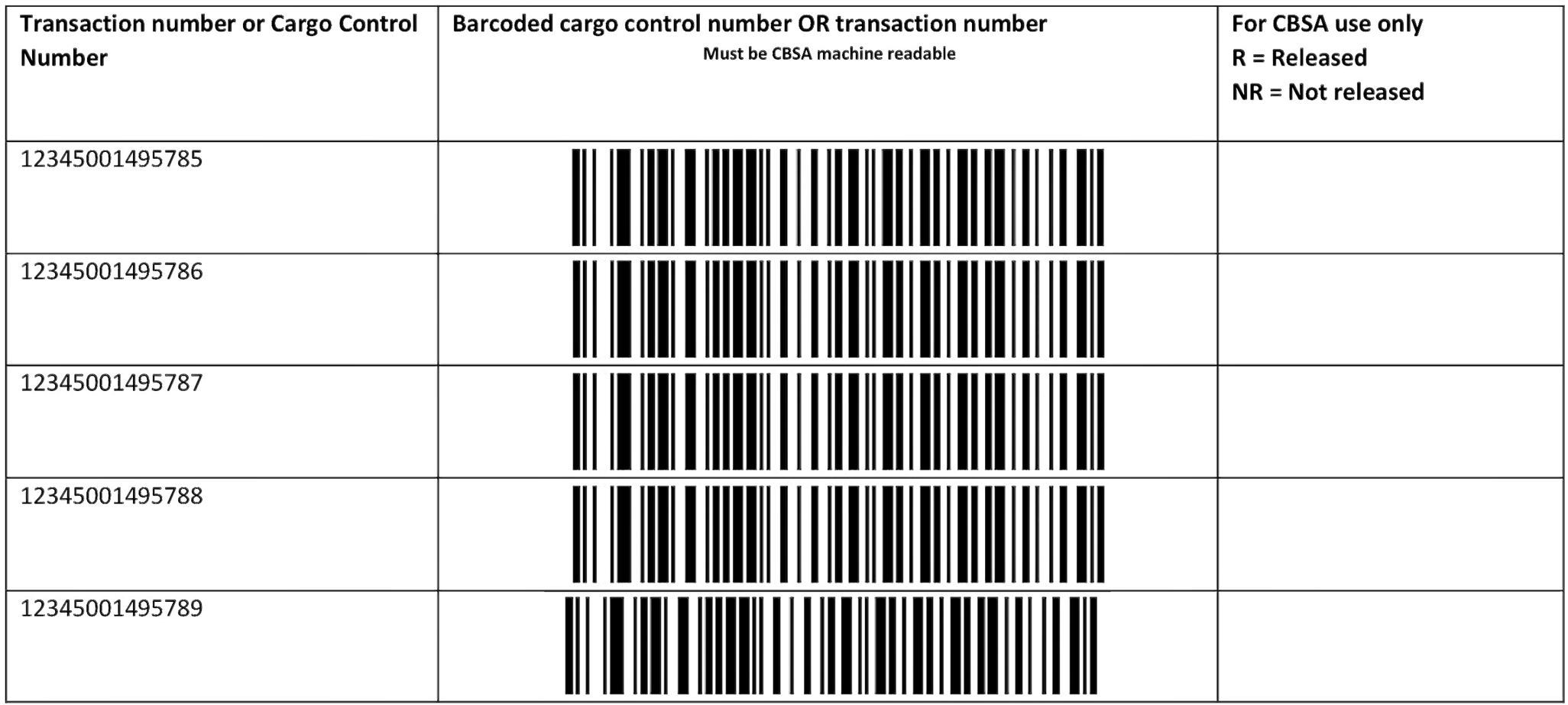
Image description
The table is divided into 3 columns. The first column is labelled "Transaction number or cargo control number," the second column is labelled "Barcode cargo control number or transaction number," with a note indicating "Must be CBSA machine readable," and a third column is labelled "For CBSA use only," with a legend explaining that "R" means released and "NR" means not released. Under Transaction number or CCN, there are 5 14-digit numbers. Under the barcode column, there are 5 different barcode images. The third column, "For CBSA use only," contains 5 empty cells.
Page details
- Date modified: