Canada Border Services Agency Quarterly Financial Report
For the quarter ended
Table of contents
- 1. Introduction
- 2. Highlights of Fiscal Quarter and Fiscal Year-to-Date (YTD) Results
- 3. Risks and Uncertainties
- 4. Significant Changes in Relation to Operations, Personnel and Programs
- 5. Approval by Senior Officials
- 6. Table 1: Statement of Authorities (Unaudited)
- 7. Table 2: Departmental Budgetary Expenditures by Standard Object (Unaudited)
1. Introduction
This Quarterly Financial Report (QFR) has been prepared as required by section 65.1 of the Financial Administration Act and in the form and manner prescribed by the Treasury Board. This quarterly report should be read in conjunction with the Main Estimates, Supplementary Estimates A, Supplementary Estimates B, Canada's Economic Action Plan (Budget ) and Canada's Economic Action Plan (Budget ).
A summary description of the Canada Border Services Agency (CBSA) program activities can be found in Part II of the Main Estimates, and a detailed description in Part III – Departmental Plan.
The QFR has not been subject to an external audit or review.
1.1 Basis of Presentation
This quarterly report has been prepared by management using an expenditure basis of accounting. The accompanying Statement of Authorities (Table 1) includes the department's spending authorities granted by Parliament, and those used by the department consistent with the Main Estimates and Supplementary Estimates (as applicable) for the - fiscal year. This quarterly report has been prepared using a special purpose financial reporting framework designed to meet financial information needs with respect to the use of spending authorities.
The authority of Parliament is required before money can be spent by the Government. Approvals are given in the form of annually approved limits through appropriation acts, or through legislation in the form of statutory spending authority for specific purposes.
When Parliament is dissolved for the purposes of a general election, section 30 of the Financial Administration Act authorizes the Governor General, under certain conditions, to issue a special warrant authorizing the Government to withdraw funds from the Consolidated Revenue Fund. A special warrant is deemed to be an appropriation for the fiscal year in which it is issued.
The Department uses the full accrual method of accounting to prepare and present its annual departmental financial statements that are part of the departmental results reporting process. However, the spending authorities voted by Parliament remain on an expenditure basis.
2. Highlights of Fiscal Quarter and Fiscal Year-to-Date (YTD) Results
This section highlights the significant items that contributed to the net increase or decrease in resources available for the year and actual expenditures as of the quarter ended .
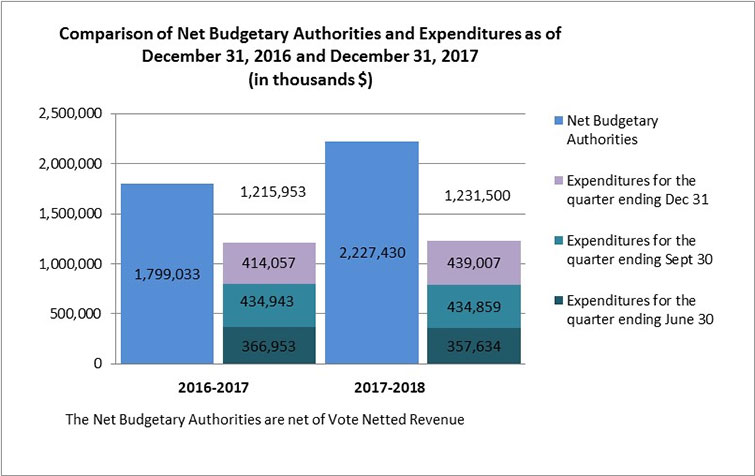
Graph 1: Comparison of Net Budgetary Authorities and Expenditures as of and (in thousands $)
2.1 Significant Changes to Authorities
For the period ending , as well as the same period ending , the authorities provided to the CBSA are comprised of the Main Estimates and Supplementary Estimates A, Supplementary Estimates B, Treasury Board Vote 30 for Paylist requirements, Treasury Board Vote 15 for collective bargaining reimbursement and any unused spending authorities carried forward from the .
The Statement of Authorities (Table 1) presents a net increase of $428.4 million or 23.8% in the Agency's total authorities of $2,227.4 million at compared to $1,799.0 million total authorities at the same quarter last year.
This net increase in the authorities available for use is the result of an increase in Vote 1 – Operating Expenditures of $329.9 million, an increase in Vote 5 – Capital of $99.1 million and a decrease in Budgetary Statutory Authorities of $0.6 million, as detailed below:
Vote 1 – Operating
The Agency’s Vote 1 Operating increased by $329.9 million or 23.3%, which is mainly attributed to the net effect of the following significant items:
Increases totaling $335.4 million are mainly attributed to:
- $12.6 million increase for the quarter ending as compared to the quarter ending for Treasury Board Vote 15 for collective bargaining reimbursement;
- $0.4 million increase for the quarter ending than the quarter ending for Treasury Board Vote 30 for Paylist requirements
- $8.9 million increase is described in the CBSA Supplementary Estimates (B) for -; and
- $313.5 million in increases as described in the CBSA Quarterly Financial Report for the quarter ended ;
Decreases totaling $5.5 million as described in the Quarterly Financial Report for the quarter ended .
Vote 5 - Capital
The Agency's Vote 5 Capital increased by $99.1 million or 50.7%, which is mainly attributed to the net effect of the following significant items:
Increases totaling $140.2 million are mainly attributed to:
- $140.2 million in increases as described in the Quarterly Financial Report for the quarter ended ;
Decreases totaling $41.1 million are mainly attributed to:
- $19.3 million decrease is described in the CBSA Supplementary Estimates (B) for -.
- $21.8 million as described in the Quarterly Financial Report for the quarter ended September 30, 2017 and
Budgetary Statutory Authorities
The Agency's Statutory Authority related to the employee benefit plan decreased by $0.6 million, or 0.4% from the previous year. The decrease is mainly due to the annual adjustment in the employee benefit plan rate set by the Treasury Board Secretariat.
2.2 Explanations of Significant Variances in Expenditures from Previous Year
As indicated in the Statement of Authorities (Table 1), the Agency's expenditures for the quarter ending at $439.0 million represents an increase of $24.9 million from the quarter ending at $414.1 million. The Agency's year-to-date expenditures total $1,231.5 million as compared to $1,216.0 million at the same time last year. The increase of $15.5 million or 1.3% in expenditures is primarily due to the following items:
- Increase of $25.6 million or 2.5% in Vote 1 Operating Expenditures year-to-date used at quarter end ($1,049.4 million versus $1,023.8 million at the same time last year) due to an increase in transportation and communications and increase in overtime statutory holiday pay and collective bargaining reimbursement.
- Decrease of $11.3 million in statutory and other spending;
- Increase of $1.3 million or 2.4% in Vote 5 Capital Expenditures year-to-date used at quarter end ($54.0 million versus $52.7 million same time last year) due to an increase in capital projects.
As indicated in the Departmental Budgetary Expenditures by Standard Object (Table 2), the changes by standard object are mainly attributed to the following offsetting factors:
- An increase of $13.9 million year-to-date used at quarter end due to an increase in facilities capital projects and traffic signage;
- A decrease of $12.7 million year-to-date used at quarter end in professional and special services due to a decrease in information technology consultants;
- An increase of $4.7 million year-to-date used at quarter end in the acquisition of machinery and equipment due to an increase of spending in image and video equipment and other equipment and parts.
- An increase of $3.5 million year-to-date used at quarter end in transportation and communications due to an increase in public servant and international core mandate travel, relocation in Canada and escort international travel.
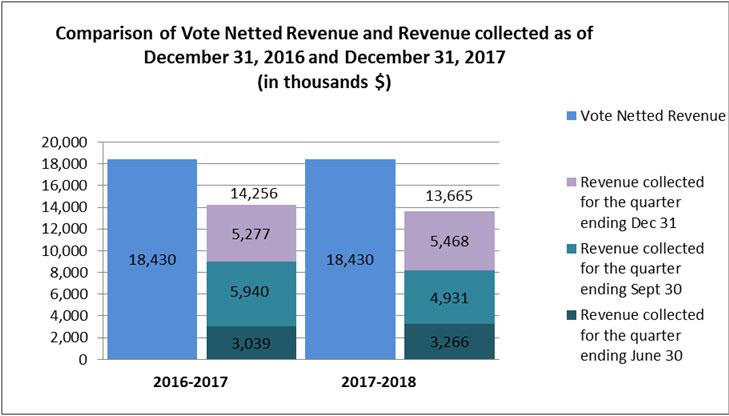
The planned revenue from the sales of services reflects the Agency's revenue respending authority. The year-to-date revenue from the sales of services decreased by $0.6 million or 4.1% due to decreases in the Remote Area Border Crossing Permit, the Detector Dog Learning Services and the NEXUS program.
Graph 2: Comparison of Vote Netted Revenue and Revenue collected as of and (in thousands $)
3. Risks and Uncertainties
The complexity of the operating environment of the CBSA can be seen in the broad scope of external drivers. Developments in geopolitical relations, in the global economy, in environmental matters, and in human and animal health cascade down into Canada's trade, immigration, tourism and refugee patterns, affecting volumes and introducing security and facilitation challenges. Continued growth in both global trade and the virtual economy has benefitted legitimate business and criminal enterprises alike, and presents more complexity in managing Canada's supply chain and physical borders.
Collective bargaining negotiations between the Government of Canada and bargaining agents continue to unfold. The outcome of these negotiations for the FB classification will impact the CBSA.
There has been a substantial number of asylum seekers entering Canada from the United States at CBSA's ports of entry (POE). The current volume of asylum claimants has impacted the operational and financial capacity of CBSA and its partners. The Agency is currently taking steps to manage the surge of asylum seekers crossing the border, including adjusting its financial capacity and operations to process claimants as quickly as possible without compromising the safety or security of Canadians.
Lastly, the CBSA operates in a rapidly changing border environment with increasingly complex security and immigration demands, changing traveler volumes, higher infrastructure costs and rising trade volumes, all of which contributed to a strain on the Agency's finances. To ensure it can continue to deliver in this context in a sustainable manner, the CBSA is undertaking a strategic exercise that will: examine its current resource base; fully align its operations to the priorities of the Government and Canadians; and, work to ensure the sustainability of those operations for years to come.
In considering these factors, the CBSA has embarked on various initiatives that will allow the organization to be even more efficient and effective in the way it does business through increased efforts to address threats early and facilitate trade and travel. To improve its ability to successfully deliver on its initiatives, the Agency regularly examines its enterprise risk landscape, updates it's Enterprise Risk Profile and takes appropriate action to mitigate its top risks and the associated financial impacts. The Agency's top risks and associated responses are communicated in its Departmental Plan.
4. Significant Changes in Relation to Operations, Personnel and Programs
4.1 Key Senior Personnel
The appointment of Jonathan Moor to the position of Vice-President of Comptrollership and CFO starting in who is replacing Christine Walker.
The appointment of Lisa Anawati to the position of Vice-President overseeing the CBSA Assessment and Revenue Management Project (CARM) effective .
4.2 Operations
The Agency continues to enhance border security and ensures the facilitation of legitimate travellers and goods with modernizations of and enhancements to security screening procedures, trusted traveler initiatives, immigration detentions, and infrastructure at our Ports of Entry across the country as per the Departmental Plan for -.
The CBSA also maintains a key role in delivering on the Government of Canada priorities such as supporting the increase in Canada’s immigration levels.
4.3 New Programs
The CBSA is implementing a New Federal Framework for the Legalization and Regulation of Cannabis a Health Canada led initiative to implement and administer the framework to legalize and strictly regulate cannabis.
The Agency continues to expand its law enforcement capacity to address drug impaired driving a Public Safety led initiative to implement and administer a new federal framework to address drug-impaired driving.
In addition, in recognition of an increasingly complex and rapidly changing border environment, a review of all areas of the Agency is underway with the aim to better position the CBSA to meet current demands and operational realities, and future expectations.
5. Approval by Senior Officials
Approved by:
John Ossowski
President
Ottawa, Canada
Date:
Jonathan Moor
Chief Financial Officer
Ottawa, Canada
Date:
6. Table 1: Statement of Authorities (Unaudited)
| Total available for use for the year ending Footnote * | Used during the quarter ended | Year-to-date used at quarter end | |
|---|---|---|---|
| Vote 1 - Operating Expenditures | 1,747,488 | 373,774 | 1,049,425 |
| Vote 5 - Capital Expenditures | 294,862 | 22,561 | 53,960 |
| Statutory Authority - Contributions to employee benefit plans | 185,080 | 42,669 | 128,006 |
| Statutory Authority - Refunds of amounts credited to revenues in previous years | 0 | 0 | 44 |
| Statutory Authority - Spending of proceeds from the disposal of surplus Crown assets | 0 | 3 | 65 |
| Total budgetary authorities | 2,227,430 | 439,007 | 1,231,500 |
| Non-budgetary authorities | 0 | 0 | 0 |
| Total authorities | 2,227,430 | 439,007 | 1,231,500 |
Note: Numbers may not add and may not agree with details provided elsewhere due to rounding.
Table 1: Statement of Authorities (Unaudited)
| Total available for use for the year ending Footnote * | Used during the quarter ended | Year-to-date used at quarter end | |
|---|---|---|---|
| Vote 1 - Operating Expenditures | 1,417,575 | 342,263 | 1,023,819 |
| Vote 5 - Capital Expenditures | 195,726 | 25,522 | 52,683 |
| Statutory Authority - Contributions to employee benefit plans | 185,732 | 46,178 | 138,534 |
| Statutory Authority - Refunds of amounts credited to revenues in previous years | 0 | 0 | 15 |
| Statutory Authority - Spending of proceeds from the disposal of surplus Crown assets | 0 | 94 | 902 |
| Total budgetary authorities | 1,799,033 | 414,057 | 1,215,953 |
| Non-budgetary authorities | 0 | 0 | 0 |
| Total authorities | 1,799,033 | 414,057 | 1,215,953 |
Note: Numbers may not add and may not agree with details provided elsewhere due to rounding.
7. Table 2: Departmental Budgetary Expenditures by Standard Object (Unaudited)
| Planned expenditures for the year ending Footnote * | Expended during the quarter ended | Year-to-date used at quarter end | |
| Expenditures | |||
|---|---|---|---|
| Personnel | 1,369,248 | 319,407 | 978,151 |
| Transportation and communications | 78,692 | 12,038 | 28,450 |
| Information | 5,250 | 112 | 329 |
| Professional and special services | 392,484 | 83,247 | 165,814 |
| Rentals | 12,792 | 2,412 | 4,959 |
| Repair and maintenance | 35,384 | 4,076 | 11,593 |
| Utilities, materials and supplies | 23,361 | 2,462 | 7,650 |
| Acquisition of land, buildings and works | 127,964 | 11,293 | 25,310 |
| Acquisition of machinery and equipment | 165,348 | 9,161 | 17,834 |
| Transfer payments | 0 | 0 | 0 |
| Other subsidies and payments | 35,337 | 267 | 5,031 |
| Total gross budgetary expenditures | 2,245,860 | 444,475 | 1,245,121 |
| Less revenues netted against expenditures | |||
| Sales of Services | 18,430 | 5,468 | 13,665 |
| Other Revenue | 0 | 0 | -44 |
| Total revenues netted against expenditures | 18,430 | 5,468 | 13,621 |
| Total net budgetary expenditures | 2,227,430 | 439,007 | 1,231,500 |
Note: Numbers may not add and may not agree with details provided elsewhere due to rounding.
Table 2: Departmental Budgetary Expenditures by Standard Object (Unaudited)
| Planned expenditures for the year ending Footnote * | Expended during the quarter ended | Year-to-date used at quarter end | |
| Expenditures | |||
|---|---|---|---|
| Personnel | 1,275,537 | 323,665 | 975,236 |
| Transportation and communications | 49,477 | 8,678 | 25,101 |
| Information | 2,406 | 76 | 372 |
| Professional and special services | 237,158 | 66,109 | 178,508 |
| Rentals | 9,431 | 1,489 | 3,882 |
| Repair and maintenance | 25,251 | 3,693 | 11,742 |
| Utilities, materials and supplies | 17,535 | 2,337 | 6,856 |
| Acquisition of land, buildings and works | 97,312 | 7,161 | 11,399 |
| Acquisition of machinery and equipment | 80,300 | 4,878 | 13,111 |
| Transfer payments | 0 | 0 | 0 |
| Other subsidies and payments | 23,056 | 1,248 | 3,987 |
| Total gross budgetary expenditures | 1,817,463 | 419,334 | 1,230,194 |
| Less revenues netted against expenditures | |||
| Sales of Services | 18,430 | 5,277 | 14,256 |
| Other Revenue | 0 | 0 | -15 |
| Total revenues netted against expenditures | 18,430 | 5,277 | 14,241 |
| Total net budgetary expenditures | 1,799,033 | 414,057 | 1,215,953 |
Note: Numbers may not add and may not agree with details provided elsewhere due to rounding.
- Date modified: