Administration of the Export and Import Permits Act (Importations)
Memorandum D19-10-2
Note to reader
Canada Border Services Agency is currently reviewing this D-memo. It will be updated in the context of the CBSA Assessment Revenue Management (CARM) initiative and made available to stakeholders as soon as possible. Find out about CARM.
Ottawa,
ISSN 2369-2391
This document is also available in PDF (475 Kb) [help with PDF files]
In brief
This memorandum has been updated to:
- reflect the Canada-United States-Mexico Agreement (CUSMA), which came into force on , replacing the North American Free Trade Agreement (NAFTA)
- reflect the Canada-European Union Comprehensive Economic and Trade Agreement (CETA), which entered into force provisionally on
- reflect the Canada-United Kingdom Trade Continuity Agreement (Canada-UK TCA), which entered into force on
- include the Steel Import Monitoring Program. Effective , item 80 (Carbon Steel Products) and item 81 (Specialty Steel Products) of the Import Control List (ICL), which may be imported under the authority of General Import Permit No. 80 – Carbon Steel (GIP No. 80) and General Import Permit No. 81 – Specialty Steel Products (GIP No. 81), respectively, have been re-added to the ICL, following their deemed removal on . The Harmonized System (HS) codes associated with each of these items have also been amended
- include the Aluminum Import Monitoring Program. Effective , the Governor in Council has added certain aluminum products to the Import Control List (ICL) as item 83 and the Minister of Foreign Affairs has issued General Import Permit No. 83 – Aluminum Products for importing certain aluminum products
The Canada Border Services Agency (CBSA) assists Global Affairs Canada (GAC) with the administration of the Export and Import Permits Act (EIPA). This memorandum outlines the requirements and permit procedures for the importation of goods included on the Import Control List (ICL).
The EIPA gives authority to the Governor in Council to establish various control lists, including an ICL, and make regulations pertaining to the administration of the Act. Furthermore, the EIPA grants power to the designated Minister to issue import permits and, under certain conditions, to alter, suspend, cancel, and reinstate any permit issued under the Act.
Legislation
- Customs Act — Section 101
- Customs Tariff
- Export and Import Permits Act – Subsections 5(1) and 10(1), and Sections 14, 24, and 25
- General Import Permit No. 1 — Dairy Products for Personal Use
- General Import Permit No. 2 — Chickens and Chicken Products for Personal Use
- General Import Permit No. 3 — Wheat and Wheat Products and Barley and Barley Products for Personal Use
- General Import Permit No. 6 — Roses for Personal Use
- General Import Permit No. 7 — Turkeys and Turkey Products for Personal Use
- General Import Permit No. 8 — Eggs for Personal Use
- General Import Permit No. 13 — Beef and Veal for Personal Use
- General Import Permit No. 14 — Margarine for Personal Use
- General Import Permit No. 20 — Wheat and Wheat Products and Barley and Barley Products
- General Import Permit No. 80 — Carbon Steel
- General Import Permit No. 81 — Specialty Steel Products
- General Import Permit No. 83 — Aluminium Products
- General Import Permit No. 100 — Eligible Agriculture Goods
- General Import Permit No. 108 — CWC Toxic Chemicals and Precursors
- General Import Permit No. 193 — Roses
- Import Control List
Guidelines and general information
Definitions
1. For the purpose of the administration of the Export and Import Permits Act, the following definitions will apply:
- Area Control List
- list of countries established under section 4
- broker
- to arrange or negotiate a transaction that relates to the movement of goods or technology included in a Brokering Control List from a foreign country to another foreign country, including a transaction referred to in subsection (1.1)
- Import Control List
- a list of goods established under section 5
- Minister
- such member of the Queen’s Privy Council for Canada as is designated by the Governor in Council as the Minister for the purposes of this Act
- permit
- an import permit issued pursuant to subsection 8(1) of the Act
- resident of Canada
- in the case of a natural person, a person who ordinarily resides in Canada and, in the case of a corporation, a corporation having its head office in Canada or operating a branch office in Canada
Import Controls
2. Goods included on the ICL, entering Canada for commercial or personal use, including goods entering temporarily or entered into a bonded or sufferance warehouse must be imported under the authority of a permit.
3. Under the EIPA, there are two types of import permits: General Import Permits (GIPs) and Specific Import Permits.
4. Importations of certain agricultural goods included on the ICL are controlled under the EIPA by way of tariff rate quotas (TRQs). TRQ agricultural goods can be imported at lower rates of duty under the “within access commitment” tariff items until the quota quantities are reached.
General import permits
5. GIPs allow for the importation of certain eligible goods included on the ICL, subject to the terms and conditions described in the permit, without having to obtain a specific import permit. The applicable GIP constitutes the permit authorizing the importation of goods.
6. The CBSA must be satisfied that the importation of goods does, in fact, meet the terms and conditions of the applicable GIP.
7. For commercial shipments, the applicable GIP number must be provided on the release documentation (e.g., cargo control document, invoice or electronic data interchange (EDI) transmission).
8. GIPs apply to all residents of Canada. For more information on goods that can be imported under the authority of GIPs and any quantity or value restrictions, residents should refer to Appendix A.
Specific import permits
9. Importers must obtain specific import permits issued by GAC, subject to terms and conditions, for the importation of certain agricultural goods included on the ICL and for the importation of textiles and clothing, where the importer is claiming a preferential rate of duty. In the case of a sufferance warehouse, import permits must be obtained before the time of release.
10. If TRQ agricultural goods are entered into a bonded warehouse, importers should refer to Memorandum D7-4-4, Customs Bonded Warehouses for directions on the process for entering agricultural goods in a customs bonded house.
11. Goods included on the ICL that are imported under temporary entry provisions (e.g., E29B, Temporary Admission Permit or a Temporary Admission (ATA) Carnet) are subject to the specific import permit requirements under the EIPA.
TRQ controlled goods
Agricultural goods
12. For all agricultural goods listed on the ICL, a specific import permit or applicable General Import Permit must be provided in field 26 of Form B3-3 or in the special authority field of the KI30 record for CADEX participants. First come, first served, TRQ agricultural goods imported after the quota quantity is reached are classified under the “over access commitment” tariff items and subject to higher rates of duty.
13. Quantities or values separate from the within access commitment may be imported under the authority of GIP No. 100. However, the over access commitment rates of duty will apply. Importers should refer to Memorandum D10-18-1, Tariff rate quotas for detailed information on tariff classification, and to Memorandum D19-1-1, Food, plants, animals and related products for detailed information regarding quantity restrictions and additional import requirements imposed by the Canadian Food Inspection Agency.
14. For commercial importations of wheat, wheat products, barley, and barley products, GIP No. 20 may be used until the quota quantities are reached. GIP No. 100 must be used for any other importations of these products and after the quota quantities are reached. Importers should refer to Memorandum D10-18-6, First-come, first-served agricultural tariff rate quotas.
15. The GIPs for personal importations of TRQ agricultural goods by residents of Canada, as well as the eligible quantities that may be imported at within access commitment rates of duty, are listed in Appendix A. GIP No. 3 allows for the importation of wheat, wheat products, barley, and barley products for personal use at the lower within access commitment rates of duty until the quota quantities are reached. GIP No. 100 allows for the importation of unlimited quantities for certain TRQ agricultural goods for personal use at the higher over access commitment rates of duty. Residents of Canada should note that the eligible quantities or values for GIPs specifically for personal use apply to each person regardless of the fact that a family may be travelling together in the same conveyance or live in the same household.
Textiles and clothing
16. Importations of textiles and clothing are only subject to specific import permit requirements, when the goods are eligible for the tariff preference level (TPL) mechanisms under Canada’s free trade agreements, or when the goods are subject to origin quotas under CETA or the Canada-UK TCA.
17. In order for importers to take advantage of a reduced rate of duty for TPL qualifying goods, importers must make a claim under the specific FTA preferential tariff treatment and associated Order-in-Council. Importers should refer to Memorandum D11-4-22, Tariff Preference Levels, for detailed information on documentation requirements regarding TPLs.
18. With respect to the CETA and Canada-UK TCA, products subject to an origin quota can qualify for preferential tariff treatment. Importers should refer to Memorandum D11-4-37 Origin quotas and alternatives to the product-specific rules of origin under the Canada European Union Comprehensive Economic and Trade Agreement and the Canada-United Kingdom Trade Continuity Agreement.
19. In order to receive TPL or origin quota preferential access, the importer must possess an appropriate specific import permit specifying TPL or origin quota entitlement for the goods. This permit must be available for presentation to the CBSA upon request.
Goods subject to monitoring
Steel products
20. Importations of steel products identified in items 80 and 81 of the ICL, may be imported under the authority of GIP No. 80 - Carbon Steel (for goods classified under headings 7206-7217, 7225-7229, 7302, and 7304-7306 of the Harmonized System) and GIP No. 81 - Specialty Steel Products (for goods classified under headings 7218-7224, 7301, 7308, 7312-7313, and 7317 of the Harmonized System).
21. Importers must provide the applicable GIP number on the release documentation (e.g., description of goods field on the invoice) or in the description free text field when release requests are transmitted to the CBSA using EDI. There is no limit on the quantity of products identified in items 80 and 81 of the ICL that may be imported into Canada.
22. Steel products identified in items 80 and 81 of the ICL are eligible for Customs Self-Assessment (CSA) clearance and, as such, can be exempt from the requirements under section 2 of the applicable GIP at the time of CSA clearance. Importers who are not clearing the goods under CSA, but who are instead using an existing customs release process (e.g., Release on Minimum Documentation (RMD) or Pre-arrival Review Systems (PARS)), must meet the requirements under section 2 of the applicable GIP as outlined in paragraph 5 to 8 above.
23. To import shipments that include Steel products listed in item 80 and/or 81 of the ICL, customs brokers and importers are required to cite "GIP80” or “GIP81” in the “commodity description” field.
24. For release of Steel products using the Single Window Initiative (SWI) Integrated Import Declaration (IID), the GIP information (either ‘GIP80’ or ‘GIP81’) must be entered in the following IID fields: Permit Type, Reference Number, and Document Reference Number.
25. Shipments of steel products that are classified under tariff item 9813.00.00 or 9814.00.00 (Canadian goods returned) do not require import permits.
Aluminum products
26. Importations of aluminum products identified in item 83 of the ICL, may be imported under the authority of GIP No. 83 - Aluminum Products.
27. Importers must provide the applicable GIP number on the release documentation (e.g., description of goods field on the invoice) or in the description free text field when release requests are transmitted to the CBSA using EDI. There is no limit on the quantity of aluminum products identified in item 83 of the ICL that may be imported into Canada.
28. Aluminum products identified in item 83 of the ICL are eligible for Customs Self-Assessment (CSA) clearance and, as such, can be exempt from the requirements under section 2 of the applicable GIP at the time of CSA clearance. Importers who are not clearing the goods under CSA, but who are instead using an existing customs release process (e.g., RMD or PARS), must meet the requirements under section 2 of the applicable GIP as outlined in paragraphs 5 to 8 above.
29. To import shipments that include aluminum products listed in item 83 of the ICL, customs brokers and importers are required to cite "GIP83-OIC19-1224" in the “commodity description” field.
30. For SWI IID users this field is found in SG117.IMD with qualifier 8 (e.g. IMD++8+:::GIP83 Aluminum Foil).
31. Shipments of aluminum products that are classified under tariff item 9813.00.00 or 9814.00.00 (Canadian goods returned) do not require import permits.
Permit procedures
32. Importers can submit applications for specific import permits to GAC, or to licensed customs brokers approved by that Department. Completed applications can be submitted by licensed customs brokers on-line via the New Export-Import Controls System (NEICS) of GAC or by fax at 613-996-3205.
33. When an Application for a Specific Import Permit (Form EXT 1466) is completed, the CBSA’s transaction number must be shown in field 2. In the event that an importer does not have a transaction number, the CBSA will assign a transaction number to the shipment when release is requested. A specific import permit becomes valid when the permit information has been transmitted electronically by GAC to the CBSA office, where goods are to be released.
34. All IID submissions for specific import permits that include one or more commodities regulated by GAC must be submitted no more than 30 days in advance of arrival in Canada. Any submissions (whether they reference an existing permit or are applications for a new permit) will be rejected if they are submitted more than 30 days in advance of arrival. All IID submissions that invoke only GIPs may be received more than 30 days in advance of arrival.
35. Except for agricultural goods subject to TRQs and for safeguards, EXCAPS (GAC / Customs Automated Permit System) provides for the electronic transmission of permit information directly from GAC to the CBSA. This eliminates the requirement for importers to present paper permits to the CBSA (except at non-terminal offices) when obtaining release of goods controlled under the EIPA. In all cases, GAC will issue a transaction record (Appendix B) to the importer or broker to serve as a receipt showing that the permit has been issued. Importers using non-terminal offices or who have goods documented on a Form E29B, Temporary Admission Permit or an ATA Carnet will be required to present a copy of the transaction record at the time of release.
36. In the event that EXCAPS is not available to transmit permit data to the Accelerated Commercial Release Operations Support System (ACROSS), importers and brokers may submit a paper copy of the transaction record to the CBSA to release their goods. If ACROSS is not available, importers and brokers may submit paper release documents with a copy of the transaction record to release their goods. Importers and brokers will be advised to use the above contingency procedures by their local CBSA office or via the electronic data interchange (EDI) information line at 1-888-957-7224 or through an EDI information bulletin.
37. The CBSA, may conduct a post release verification with regards to the content of the permit.
38. The import permit procedures and relevant responsibilities are provided in Appendix C.
39. Once an electronic permit has been used for the release of goods, the information will be transmitted to GAC.
Amendments to permits
40. Necessary amendments to specific import permits may be authorized by GAC. For example, permits may be amended to address issues related to product classification, quantity, product substitution, validity period and cancellation.
41. Amendments to permits for TRQ goods must be made prior to final accounting, and in the case of non-TRQ goods, prior to release of the goods. For further information on amendments to permits, importers should contact GAC (the address and telephone numbers are provided in paragraph 50).
CBSA role
42. All Goods (except agricultural TRQ goods) will be detained by the CBSA and the release request rejected when the following applies:
- There is no specific import permit available
- The goods are not as described on the permit
- The importer’s name on the import declaration does not correspond to the name on the specific import permit
- The permit is not yet in force or has expired
- The quantity or value reported does not correspond to those on the permit or
- The country of origin does not correspond to the one on the permit
43. Under the above circumstances, the goods are not to be released until the appropriate corrections are made to either the release information or the permit.
TRQ specific permits
44. The availability of TRQ specific import permits is not a condition of release. The CBSA will release any shipment of TRQ agricultural goods even in the absence of a specific import permit issued under section 8.3 of the EIPA. When a specific import permit has not been obtained by the date of final accounting under subsection 32(1), (3) or (5) of the Customs Act, the portion of the goods imported without such a permit (all or part of a shipment) will be deemed to have been imported under the authority of GIP No. 100 – Eligible Agricultural Goods. These goods will be classified under the appropriate “over access commitment” tariff item and will be subject to higher rates of duties.
45. In situations where TRQ permit information has been matched to release information in ACROSS and is reviewed as part of the release review process, any discrepancies in the quantity or description will be referred to the CBSA’s Trade Compliance Division after releasing the shipment.
Disposal of goods
46. When goods have been abandoned or forfeited as a result of failure to comply with the EIPA requirements, GAC will determine how to dispose of the goods.
47. Residents of Canada importing perishable agricultural goods from the United States who decide not to pay the applicable over access commitment rate of duty on imports in excess of the personal allowable GIP quantities or values are encouraged to return the excess goods to the United States. In some regions, it may be possible to abandon any goods at the CBSA office, if disposal bins are available.
Penalty information
48. Every person who contravenes any of the provisions of EIPA or its regulations is guilty of an offence and is liable to: (a) on summary conviction, to a fine not exceeding $250,000 or to imprisonment for a term not exceeding 12 months, or to both; or (b) on conviction upon indictment, to a fine in an amount that is in the discretion of the court or to imprisonment for a term not exceeding ten years, or to both.
49. The Administrative Monetary Penalty System (AMPS) authorizes the CBSA to impose monetary penalties for non-compliance with Customs Act, Customs Tariff and the regulations under these Acts, as well as contraventions of the terms and conditions of licensing agreements and undertakings. Please refer to the Memorandum D22-1-1, Administrative Monetary Penalty System for details.
Additional information
50. For more information on goods subject to import controls and for questions concerning the issuance of import permits or related to completing import permit applications, importers should contact:
Global Affairs Canada
125 Sussex Dr
Ottawa ON K1A 0G2
Telephone: 343-203-6820 or 1-877-808-8838
Non-supply managed trade controls (for textiles, clothing, beef, veal, wheat, wheat products, barley, barley products, steel and aluminum)
Email: TIN@international.gc.ca
Supply-managed trade controls (for dairy products, poultry and poultry products, eggs and egg products)
Email: TIC@international.gc.ca
51. The importation of food, plants, animals (FPA) and related products may also be regulated by other government departments. Information on these requirements are not included in this memorandum.
52. For more information regarding the CBSA’s programs and services, please contact the Border Information Service (BIS) line. Within Canada, you can call BIS toll-free at 1-800-461-9999. From outside Canada, please call 204-983-3500 or 506-636-5064 (long-distance charges will apply). Agents are available Monday to Friday (08:00 – 16:00 local time, except holidays). TTY is also available within Canada at 1-866-335-3237.
Appendix A: General imports permits and within access commitment information for importations of agricultural goods subject to import controls and steel and aluminium goods
The ICL may be broken down into two basic groupings. The following chart depicts these groups with corresponding item numbers, general product descriptions, and relevant general import permit (GIP) numbers. This chart is provided as a guide for reference purposes only.
| Group number | Description | ICL item number | GIP no. | Quantity/value |
|---|---|---|---|---|
| 1. Agricultural products | Chicken and chicken products | 94, 96-104 | 2 | 10 kg |
| Turkey and turkey products | 105-113 | 7 | One turkey; turkey products - 10 kg | |
| Beef (fresh or frozen) and veal (that does not originate in Chile, a CUSMA country or an EU country or other CETA beneficiary) | 114-116 | 13 | 10 kg (no TRQ restriction for CUSMA, CETA, Canada-UK TCA or Chile) | |
| Dairy products | 117-134, 141-160 | 1 | $20 total dairy | |
| Eggs for consumption | 95, 135-139 | 8 | 2 dozen | |
| Margarine | 140 | 14 | 3 kg (12 kg with prescription) | |
| Wheat, barley and their products | 161-191 | 3, 20 | No quantity restrictions | |
| Tariff rate quota goods classified under heading No. 98.04 or 98.26 | 192 | 1, 2, 3, 7, 8, 13, 14 | ||
| Roses (imported from Israel or another CIFTA beneficiary) | 193 | 6 | 2 dozen | |
| 2. Steel and aluminum | Carbon steel products | 80 | 80 | |
| Specialty steel products | 81 | 81 | ||
| Aluminum products | 83 | 83 |
- Note 1: In the case of agricultural goods, quantities or values above the within access commitment may be imported under the authority of GIP No. 100. However, the over access commitment rates of duty will apply
- Note 2: Importers should refer to Memorandum D10-18-1, Tariff rate quotas, for detailed information on tariff classification
- Note 3: Importers should refer to Memorandum D19-1-1, Food, plants, animals and related products, for detailed information on agricultural restrictions
- Note 4: Importers should refer to Memorandum D19-13-2, Importing and exporting firearms, weapons and devices, for information on importing firearms, firearms-related goods, prohibited weapons, prohibited devices and ammunition
Appendix B: Transaction record (Sample)
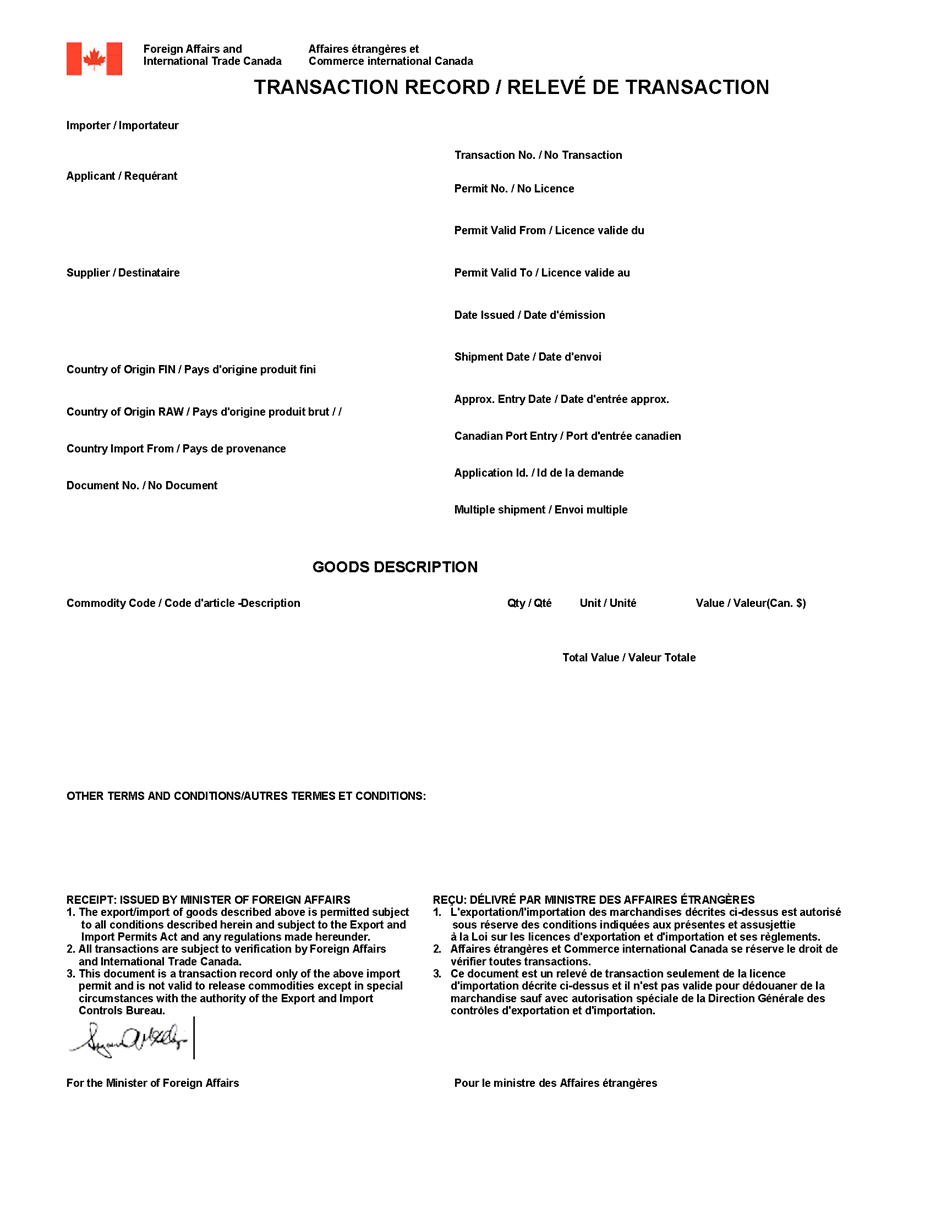
Text version: Foreign Affairs and International Trade Canada: Transaction record
Transaction record
- Importer
- Applicant
- Supplier
- Country of origin FIN
- Country of origin RAW
- Country import from
- Document no.
- Transaction no.
- Permit no.
- Permit valid from
- Permit valid to
- Date issued
- Shipment date
- Approx. entry date
- Canadian port entry
- Application id.
- Multiple shipment
Goods description
- Commodity code — description
- Commodity code
- Qty
- Unit
- Value (Can. $)
- Total value
Other terms and conditions
Receipt: Issued by minister of foreign affairs
- The export/import of goods described above is permitted subject to all conditions described herein and subject to the Export and Import Permits Act and any regulations made hereunder
- All transactions are subject to verification by Foreign Affairs and International Trade Canada
- This document is a transaction record only of the above import permit and is not valid to release commodities except in special circumstances with the authority of the Export and Import Controls Bureau
For the minister of foreign affairs
Appendix C: Import permit procedures
The following section outlines the permit procedure and the responsibilities of the importer, Global Affairs Canada (GAC), and the CBSA.Note 1Note 2
- Step 1
- Importer applies for permit using the NEICS or using Form EXT 1466 – Application for Import/Export Permit if you do not have access to NEICS
- Step 2
- Importer must include a CBSA-issued transaction number in permit application
- Step 3
- GAC records the following data in the NEICS:
- Non-routed permit applications submitted using NEICS will be processed within 15 minutes of the time of application provided there is no problem with the application
- Permit applications redirected for review will be processed within four (4) business hours unless clarification from applicant is required
- Applications submitted by fax or mail will be processed promptly within the NEICS
- Step 4
- GAC reviews all fields found on the application request, based on the agreement and the sector
- Step 5
- GAC approves or rejects the application request
- Step 6
- GAC issues transaction record to importer and transmit data to the CBSA’s ACROSS for approved permits
- Step 7
- Importer presents release package to the CBSA or transmit release data
- Step 8
- The CBSA verifies:
- The transaction number
- The effective and expiry dates of permit
- That the importer’s name on release request corresponds to the one on permit
- The permit quantity, value shipped, and description with invoice and
- That the country of origin on the release request corresponds to the one on the permit
- Step 9
- CBSA releases goods
- Step 10
- Once the permit has been used, the CBSA transmits the information to GAC
- Step 11
- If necessary, the CBSA takes enforcement action
References
- Issuing office:
-
- Program and Policy Management Division
- Commercial Programs Directorate
- Commercial and Trade Branch
- Headquarters file:
- Legislative references:
-
- Customs Act — Section 101
- Customs Tariff
- Export and Import Permits Act – Subsections 5(1) and 10(1), and Sections 14, 24, and 25
- General Import Permit No. 1 — Dairy Products for Personal Use
- General Import Permit No. 2 — Chickens and Chicken Products for Personal Use
- General Import Permit No. 3 — Wheat and Wheat Products and Barley and Barley Products for Personal Use
- General Import Permit No. 6 — Roses for Personal Use
- General Import Permit No. 7 — Turkeys and Turkey Products for Personal Use
- General Import Permit No. 8 — Eggs for Personal Use
- General Import Permit No. 13 — Beef and Veal for Personal Use
- General Import Permit No. 14 — Margarine for Personal Use
- General Import Permit No. 20 — Wheat and Wheat Products and Barley and Barley Products
- General Import Permit No. 80 — Carbon Steel
- General Import Permit No. 81 — Specialty Steel Products
- General Import Permit No. 83 — Aluminium Products
- General Import Permit No. 100 — Eligible Agriculture Goods
- General Import Permit No. 108 — CWC Toxic Chemicals and Precursors
- General Import Permit No. 193 — Roses
- Import Control List
- Other references:
- Superseded memorandum D:
- D19-10-2 dated
- Date modified: