Importation of Tires
Memorandum D19-12-2
ISSN 2369-2391
Ottawa,
This document is also available in PDF (633 KB) [help with PDF files]
In Brief
This memorandum has been updated to remove references to the legacy OGD release service options (SO463 and SO471), which were decommissioned on .
Legislation
Customs Act - Section 101
Plant Protection Act - Section 7(1)
Motor Vehicle Tire Safety Regulations
Guidelines and General Information
1.0 Introduction
1. The Canada Border Services Agency (CBSA) assists Transport Canada (TC) with the administration of the Motor Vehicle Safety Act and the Motor Vehicle Tire Safety Regulations. The CBSA also assists the Canadian Food Inspection Agency (CFIA) with the administration of the Plant Protection Act and the Health of Animals Act and the associated regulations. This memorandum outlines and explains the criteria that must be met in order to import new and used tires into Canada.
2.0 Importation of Tires
2. The import requirements under the Motor Vehicle Safety Act and the Motor Vehicle Tire Safety Regulations are provided by tire type in Appendix A.
3. The requirements outlined in Appendix A apply only to businesses that import tires for resale. When importing tires for personal or corporate fleet use, the only requirement is that the tires must meet Canadian, United States (US) or Japanese safety standards and are marked with one of the symbols outlined in Appendix B.
4. The release requirements provided in Appendix A apply to importations of new and used tires and not to tires mounted on a vehicle or a vehicle's spare tire.
5. TC has waived the customs release requirements for the importation of tires for importers that are enrolled in the Customs Self-Assessment (CSA) Program. These importers will not be required to forward documents for the importation of tires to TC as they understand their obligations and make their records available to TC.
2.1 Tire Symbols
6. Symbols on tires serve as the manufacturer's certification that all applicable safety standards have been met at the time of manufacture. These symbols are located on the sidewall of the tire.
- (a) National Safety Mark or NSM: symbol used by manufacturers as certification that all Canadian safety standards have been met.
- (b) DOT: symbol used by manufacturers as certification that all US safety standards have been met.
- (c) DOT-R: symbol used by the US industry as certification that all US safety standards have been met prior to being retreaded, remolded, or recapped.
- (d) JIS: symbol used by manufacturers as certification that all applicable Japanese safety standards have been met.
2.2 Non-complying Tires
7. In cases where tires do not comply with the release requirements outlined in Appendix A, CBSA will either deny entry or detain the shipment unless the importer can provide an authorization letter issued by Transport Canada.
8. Importers may request an authorization to import non-complying tire for exhibition, demonstration, evaluation or testing purposes by completing a Schedule 4 declaration found in the Motor Vehicle Tire Safety Regulations and submitting it to Transport Canada's Motor Vehicle Regulation Enforcement. For contact information, see the Additional Information section below.
9. Detained tires will be subject to the Storage of Goods Regulations – please refer to the Memorandum D4-1-5, Storage of Goods for details.
3.0 Electronic Submission of Release Data to the CBSA
10. As of , electronic release requests must be provided to the CBSA by submitting the Single Window Integrated Import Declaration (IID), using service option 911.
11. In cases of system outages, please refer to the System Outage Contingency Plan on the CBSA website.
12. To view the list of regulated HS codes for the importation of tires, please refer to the Data Element Matching Criteria Tables Transport Canada on the CBSA’s website.
13. The data elements which are required in your electronic release package are:
- (a) Manufactures name;
- (b) Name, telephone number, postal code and email address of the importing company
- (c) Brand name;
- (d) Tire type/size, class and the quantity of tires of that size designation and type imported;
- (e) Tire compliance indicator;
- (f) Import reason code.
14. These requirements apply to importation of the following tire types:
- (a) new on-road passenger vehicles, trucks, motorcycle, trailer or multi-purpose vehicles; and,
- (b) used truck tires imported for retreading from countries other than the US.
15. The Single Window Initiative (SWI) IID Electronic Commerce Client Requirements Document (ECCRD) provides technical and system requirements information. Please refer to Appendix B of the ECCRD for a list of the required data elements.
16. For more information on the SWI, please refer to the CBSA website.
4.0 Penalty Information
17. Any corporation that imports tires that do not comply with the safety standards made pursuant to paragraph 17(1) of the Motor Vehicle Safety Act is guilty of an offense and is liable:
- (a) on summary conviction, to a fine not exceeding $200,000; or
- (b) on indictment, to a fine not exceeding $2 million.
18. Any person who imports tires which do not comply with the safety standards made pursuant to paragraph 17(2) of the Motor Vehicle Safety Act is guilty of an offense and is liable
- (a) on summary conviction, to a fine not exceeding $4,000 or to imprisonment for a term not exceeding six months, or to both; or
- (b) on indictment, to a fine not exceeding $20,000 or to imprisonment for a term not exceeding two year, or to both.
5.0 Canadian Food Inspection Agency (CFIA) Requirements
19. Imported used tires arriving in Canada are frequently found contaminated with soil, related matter and organic material (soil). Soil is a high-risk pathway for pests that can cause serious and irreparable harm to Canada's agricultural and environmental resources. Any amount of soil from any country is considered extremely high risk.
20. All used vehicle tires (this includes retreaded tires) must be clean and free of soil.
21. Tire shipments found to be contaminated with soil will be refused entry at the first point of arrival and ordered removed from Canada under the authority of the Plant Protection Act and the Health of Animals Act and the associated regulations. Any costs associated with the removal will be at the expense of the importer.
6.0 Additional Information
22. For additional information regarding the importation of new and used tires, the importer should contact:
Transport Canada
Motor Vehicle Safety Directorate
Ottawa, ON K1A 0N5
Telephone: 613-998-8616
1-800-333-0371
Fax: 613-998-4831
Email: mvs-sa@tc.gc.ca
23. For information about the CFIA requirements, contact the National Import Service Center (NISC):
7:00 a.m. to 3:00 a.m. (Eastern Time)
Telephone and EDI: 1-800-835-4486 (Canada or U.S.A.)
1-289-247-4099 (local calls and all other countries)
Facsimile: 1-613-773-9999
24. You can access BIS free of charge throughout Canada by calling 1-800-461-9999. If you are calling from outside Canada, you can access BIS by calling 204-983-3500 or 506-636-5064 (long distance charges will apply). To speak directly to an agent, please call during regular business hours from Monday to Friday (except holidays), 8:00 to 16:00 local time. The BIS website can be found on the CBSA website.
Appendix A - Importation Requirements for Tires
| Type of Tires | Country of Export | Release Requirements for Commercial Importers |
|---|---|---|
New on-road |
All countries | When submitting a release package electronically using ACROSS service option 911, completion of all required data fields will be accepted as the declaration that the tires being imported meet all the requirements established under the Canadian Motor Vehicle Safety Standards (CMVSS). Entry documentation in your paper release package must contain the manufacturer's or its duly authorized representative written or stamped declaration that the tire conforms to the standards prescribed for a tire of that class by sections 3 to 5 of the Motor Vehicle Tire Safety Regulations at the time the tire was manufactured. If no written or stamped declaration of compliance is provided at the time of entry (or time of release for CADEX participants), deny entry. |
| US | When submitting a release package electronically using ACROSS service option 911, completion of all required data fields will be accepted as the declaration that the tires being imported meet all the requirements established under chapter 301 Motor Vehicle Safety of Title 49 United States Code, "Transportation". When submitting a paper release package, the importer must provide a written or stamped declaration that the tire was manufactured for sale in the US and conforms on the day of its manufacture to the requirements established under chapter 301 Motor Vehicle Safety of Title 49 United States Code, "Transportation". If the US DOT symbol is not present, and if no written or stamped declaration of compliance is provided at the time of entry (or time of release for CADEX participants), deny entry. |
|
Used on-road |
US | When submitting a release package electronically using ACROSS service option 911, completion of all required data fields will be accepted as the declaration that the tires being imported meet all the requirements established under chapter 301 Motor Vehicle Safety of Title 49 United States Code, "Transportation". When submitting a paper release package, the importer must provide a written or stamped declaration that the tire was manufactured for sale in the US and conforms on the day of its manufacture to the requirements established under chapter 301 Motor Vehicle Safety of Title 49 United States Code, "Transportation". If the US DOT symbol is not present, and if no written or stamped declaration of compliance is provided at the time of entry (or time of release for CADEX participants), deny entry. |
| Other countries | Not Admissible. Deny entry. | |
Used on-road |
USA | When submitting a release package electronically using ACROSS service option 911, completion of all required data fields will be accepted as the declaration that the tires being imported meet all the requirements established under chapter 301 Motor Vehicle Safety of Title 49 United States Code, "Transportation". When submitting a paper release package, the importer must provide a written or stamped declaration that the tire was manufactured for sale in the US and conforms on the day of its manufacture to the requirements established under chapter 301 Motor Vehicle Safety of Title 49 United States Code, "Transportation". If the US DOT symbol is not present, and if no written or stamped declaration of compliance is provided at the time of entry (or time of release for CADEX participants), deny entry. |
| Other countries | Tire bears the Canadian National Safety Mark (NSM), the US DOT symbol or the Japanese JIS symbol on the sidewall (see Appendix B); and Tire is designed to fit on a rim that has a rim diameter greater than 406.4 mm Tire has load range of not less than D or a ply rating of not less than 8. If the above criteria is not met, deny entry. |
|
| New and Used off-road All types (e.g., earth mover tires, racing slicks, farm tractor tires) |
All countries | Designation for off-road use must be clearly and permanently marked on the sidewalls; i.e., off-road use only, not for highway service (NHS), for racing only, farm equipment; or Tire is of an obvious off-road design. If tires are not permanently marked as being an off-road tire or are not an obvious off-road design, deny entry. |
Retreaded, Remolded, or Recapped on-road |
All countries | When submitting a release package electronically using ACROSS service option 911, completion of all required data fields will be accepted as the declaration that the tires being imported meet all the requirements established under the CMVSS. Entry documentation in your paper release package must contain the manufacturer's or its duly authorized representative written or stamped declaration that the tire conforms to the standards prescribed for a tire of that class by sections 3 to 5 of the Motor Vehicle Tire Safety Regulations at the time the tire was manufactured. If no written or stamped declaration of compliance is provided at the time of entry (or time of release for CADEX participants), deny entry. |
| US | When submitting a release package electronically using ACROSS service option 911, completion of all required data fields will be accepted as the declaration that the tires being imported meet all the requirements established under chapter 301 Motor Vehicle Safety of Title 49 United States Code, "Transportation". When submitting a paper release package, the importer must provide a written or stamped declaration that the tire was manufactured for sale in the United States and conforms on the day of its manufacture to the requirements established under chapter 301 Motor Vehicle Safety of Title 49 United States Code, "Transportation". If the US DOT-R symbol is not present, and if no written or stamped declaration of compliance is provided at the time of entry (or time of release for CADEX participants), deny entry. |
|
| Retreaded, Remolded, or Recapped off-road | All countries | Designation for off-road use; i.e., off-road use only, not for highway service (NHS), for racing only, or farm equipment, must be clearly and permanently marked on sidewall of each tire; or The tire is of an obvious off-road design; e.g., earth mover tires, racing slicks, or farm tractor tires. If tire is not permanently marked as being an off-road tire or is not an obvious off-road design, deny entry. |
| Scrap | All countries | Admissible for scrap rubber if at the time of entry the tires are rendered permanently unserviceable and irreparable either through slashing or puncturing the sidewall, or by otherwise permanently damaging the tires so that they cannot contain air. If the tires are not rendered permanently irreparable, deny entry. |
| Exemptions | All countries | Under Section 7(1)(a) of the Motor Vehicle Safety Act, tires entered for exhibition, demonstration, evaluation or testing are admissible if a letter from TC authorizing temporary import is provided by the importer at the time of entry. |
Appendix B - Tire Symbols
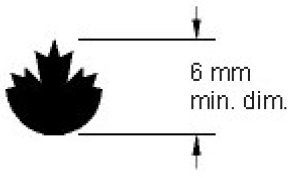
Tire symbols NSM, DOT, and JIS will appear on the outside of the sidewall between the widest portion of the tire (see profile below) and the bead. Tire symbol DOT-R will appear on the outside of the sidewall between the bead and the tread.
The sidewall is the portion of the tire between the tread and the bead. The tread is the portion of a tire that comes into contact with the road. The bead is the part of a tire that is shaped to fit the rim.
1) National Safety Mark
2) DOT

3) DOT-R

4) JIS

References
- Issuing office:
- Commercial Programs Policy and Management Division
Commercial Programs Directorate
Programs Branch - Headquarters file:
- Legislative references:
-
Customs Act
Plant Protection Act
Health of Animals Act
Motor Vehicle Safety Act
Motor Vehicle Tire Safety Regulations - Other references:
- D4-1-5
- Superseded memorandum D:
- D19-12-2 dated
- Date modified: