
Memorandum D10-14-29 - Tariff Classification of Gloves
ISSN 2369-2391
Ottawa,
This document is also available in PDF (589 KB)
Plain language summary
Target audience: Importers of commercial goods
Key content: This memorandum explains the Canada Border Services Agency's administrative policy regarding the tariff classification of gloves. Throughout this Memorandum, a reference to gloves includes a reference to mittens and mitts.
Keywords: Policy, tariff classification, gloves, mittens, mitts, constituent materials, outer surface, plastic, rubber, textile, specifically designed for use in sport.
On this page
- Updates made to this D-memo
- Definitions
- Guidelines
- Gloves are classified according to the constituent material or materials which form the outer surface or exterior shell
- How to determine the constituent materials
- Gloves with an exterior surface composed of a single material
- Gloves with an exterior surface composed of two or more materials
- Gloves composed of a combination of plastic or rubber and textile
- Gloves dipped in plastics or rubber ("dipped gloves")
- Gloves used in sporting activities (i.e. sports requisites)
- Gloves composed of leather and/or furskin
- Glove linings
- Additional information
- References
- Contact us
Updates made to this D-memo
This D-memo has been updated to:
- reflect accessibility and plain language considerations
- reflect changes made to the Canadian Customs Tariff
- make reference to current Canadian International Trade Tribunal (CITT) jurisprudence and clarify policy
Definitions
For the purpose of this memorandum, the following definitions have been adapted from the Explanatory Notes:
- Gloves
- Articles covering the palm and back of the hand and/or wrist and forearm (entirely or partially). They include:
- gloves with an individual sheath for each of the fingers and the thumb;
- mittens only partially covering the fingers and/or thumb (e.g., bicycle gloves);
- mitts only having a separate section for the thumb;
- fingerless gloves not covering the fingers and thumb, and
- gloves with an attached gauntlet that also covers part of the arm (e.g., to the wrist, beyond the wrist to the forearm, or even past the elbow).
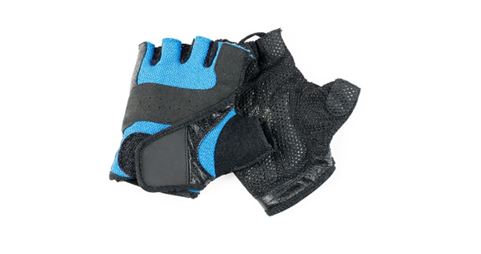
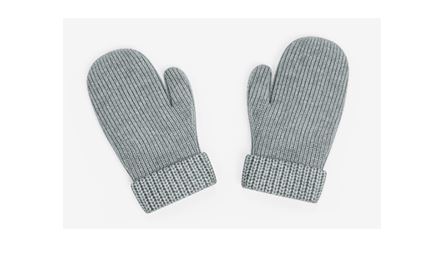
Images description
Image 1: Photo of a pair of black and blue bicycle gloves not covering the fingers and thumb, featuring mesh on the palm area.
Image 2: Photo of a pair of uniformly medium grey mittens, knitted with ribbed cuffs.
- Outer Surface (i.e., exterior shell)
- The outer surface material of a glove covering the palm of the hand, the back of the hand and, where applicable, the fingers (including fourchettes) and the wrist, the forearm, and the upper arm.
- Fourchettes
- A narrow, forked strip of material joining the front and back sections of the fingers of a glove.
- Lining
- The inside constituent material(s) of a glove.
Guidelines
Gloves are classified based on the constituent material or materials which form the outer surface or exterior shell.
1. In decisions AP-2009-046 (Igloo Vikski Inc.), which was upheld by the Supreme Court of Canada, and AP-2009-045 (Sher-Wood Hockey Inc.), the CITT provided direction on the tariff classification of gloves. In both decisions, the CITT classified the gloves using only the constituent material or materials of the outer surface (shell) of the gloves, despite the addition of tufting, padding or other materials (e.g., plastics) in other areas.
How to determine the constituent materials
2. In order to properly identify the constituent materials:
- The importer must be able to provide the exact composition of the outer surface (exterior shell) of a glove. This is generally obtained through detailed product literature from the manufacturer, or an independent laboratory analysis.
- The Canada Border Services Agency (CBSA) may conduct a laboratory analysis to determine the exact composition of the glove (i.e., for Advance Rulings or trade compliance verification purposes).
Gloves with an exterior surface composed of a single material
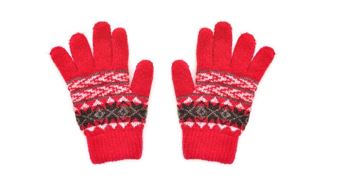
Image description
Photo of a pair of knitted gloves, for protection against the cold, red with decorative white and black patterns on the palm and back areas.
3. Gloves with an exterior composed of a single material are classified according to the outer surface material.
Gloves with an exterior surface composed of two or more materials
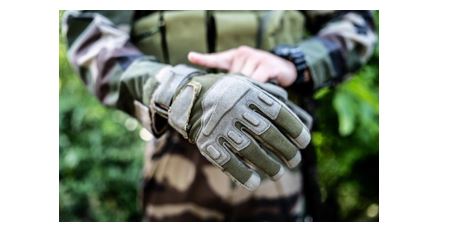
Images descriptions
Image 1: Photo of a torso and hands of a person wearing military style right hand rifle glove, with reinforcement on the knuckle and first phalanx of the finger area, with tightening straps at the wrist, green and grey in colour, of various materials.
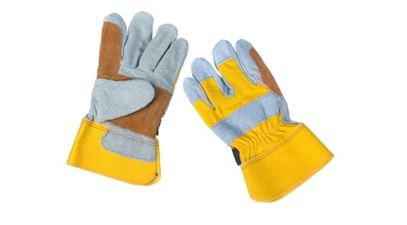
Image 2: Photo of a pair of all-purpose working gloves with parts of various constituent materials (reinforced grey suede fingers, reinforced brown leather palm and index finger, yellow textile cuffs and remaining parts).
4. The outer surface of most gloves is composed of more than one material, and as a result classification may fall into different headings of the Customs Tariff. In order to properly classify these types of gloves (as a whole), all constituent materials must be properly identified, and individually classified by application of the General Rules for the Interpretation of the Harmonized System (GIRs).
5. In some cases, tariff classification cannot be achieved by applying GIR 1 alone. For gloves with an exterior surface made up of two or more materials, GIR 2(b) could apply. GIR 2(b) states that any reference in a heading to goods of a given material shall be taken to include a reference to goods consisting wholly or partly of that material. However this Rule does not broaden the scope of a heading to cover goods which cannot meet the description in the heading. The gloves should still have the character of goods of the kind described in the heading for them to be classified under that heading according to GIR 2(b). In other words, the addition of another material or substance does not deprive the goods of the character of goods of the kind mentioned in the heading.
6. After considering GIR 1 then GIR 2, if the gloves are determined to be classifiable under more than one heading, then tariff classification is directed to GIR 3.
7. GIR 3(a) states that the heading which provides the most specific description of the good is to be preferred to a heading which provides a more general description. However, when two or more headings only refer to part of the materials contained in the good, those headings are to be regarded as equally specific and tariff classification of the good shall be determined by GIR 3(b) or GIR 3(c).
8. GIR 3(b) states that a composite good consisting of different materials is to be classified as if it consisted of the material which gives it its essential character.
- For some gloves, the material forming the greatest outer surface area might provide the essential character, resulting in classification according to that material.
- For other gloves composed of two or more materials, the determination of the essential character may rely on other factors, such as the role of the constituent materials.
9. It is often difficult to determine the "essential character" for the purposes of GIR 3(b) for gloves whose outer surface is composed of multiple material constituents. In cases where this determination is not possible, classification should be directed toward GIR 3(c). According to this Rule, when goods cannot be classified by Rule 3(a) or 3(b), they are to be classified in the heading which occurs last in numerical order among those which equally merit consideration.
- For example, if a glove is partly made up of a knitted or crocheted fabric and partly of a woven fabric and neither part provides the glove its essential character, tariff classification would be determined according to GIR 3(c). The glove would therefore be classified under heading 62.16 as gloves, other than knitted or crocheted.
Gloves composed of a combination of plastic or rubber and textile
10. To determine the tariff classification of the constituent materials for a glove with an exterior material made from a combination of plastics, or rubber, and a textile, please refer to the Notes to Section XI and the pertinent chapters and headings (e.g., Chapters 56, 59, and headings 40.15 and 60.01).
- For example, to classify knitted or crocheted gloves in sub-heading 6116.10 "impregnated, coated, covered or laminated with plastics (…)", the fabric it is made of must meet the criteria enunciated by Note 2 to Chapter 59.
11. If the textile combination is excluded from Chapter 56 or 59 or heading 60.01 as a result of the application of the pertinent Notes, the gloves would fall under heading 39.26 or heading 40.15.
12. Conversely, in VGI Village Green Imports (AP-2010-046), the CITT excluded certain gloves (oven mitts) made of rubber (of chapter 40) with parts of textile fabric from heading 40.15: the CITT determined that the goods did not meet the criteria set out in the Notes because the rubber component was not the constituent material giving the goods their essential character. To determine the essential character, the CITT relied on the function of an "oven mitt" and the following information:
- thickness
- handling function
- the surface area covered by each material
- the respective weight of each material
Classification was determined in accordance with GIR 1 in heading 61.16.
13. For specific guidance on the tariff classification of textiles combined with cellular plastics, please refer to Memorandum D10-14-59 - Tariff Classification of Textile Fabric or Material Combined With Plates, Sheets or Strips of Cellular Plastic, and Garments Made up of Such Fabric.
14. When gloves are for use in a noxious atmosphere, please refer to Memorandum D10-15-26 - Goods to be employed in a Noxious Atmosphere which provides direction on the interpretation and application of the expression "to be employed in a noxious atmosphere" and the pertinent tariff classification.
Gloves dipped in plastics or rubber ("dipped gloves")
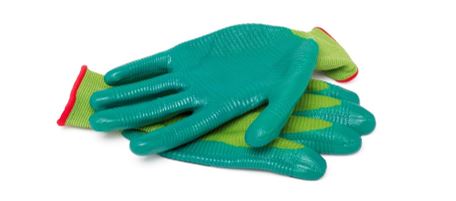
Image description
Photo of a pair of dipped gloves that may be used for work or gardening. There is rubber covering the front and sides of the hand and fingertips, with textile on the back of the hand and wrist. They are green and yellow in colour with a thin red border on the cuffs.
15. For clarification, Legal Note 11 to Section XI states:
"For the purposes of this Section, the expression 'impregnated' includes 'dipped'."
16. "Dipped gloves" differ from gloves made up of a coated textile fabric of Chapter 56 or 59 or heading 60.01. They are finished textile gloves that are subsequently dipped in plastics or rubber, whereas gloves made up of a fabric of Chapter 56 or 59 or heading 60.01 are gloves made from a textile that has been coated prior to being made into a glove. For "dipped gloves", the extent to which the exterior surface is covered by coating may vary, for example, from the entire glove to as little as only the fingertips. This has no bearing on the tariff classification of the glove.
17. Subheading 6116.10 covers "Gloves, mittens and mitts, knitted or crocheted – Impregnated, coated or covered with plastics or rubber". This subheading covers pre-existing gloves of textile materials of Chapter 60, which are subsequently covered, dipped, etc., in plastics or rubber, regardless of the extent of the area covered by the plastics or rubber.
Gloves used in sporting activities (i.e., sports requisites)

Images descriptions
Image 1: Photo of red padded hockey gloves with thin white lines
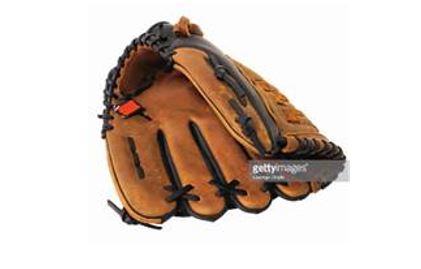
Image 2: Photo of a left handed baseball glove made of brown leather and black leather lacing
18. Legal Note 1(w) to Chapter 95 specifically excludes gloves, mittens and mitts and directs tariff classification according to their constituent material. Sports gloves are classified by their constituent material.
19. Subheading 4203.21 provides for leather gloves, mittens and mitts, specially designed for use in sports. According to Subheading Explanatory Note to subheading 4203.21, this subheading includes gloves, mittens and mitts having functional design features which make them particularly suitable for use in sports, such as to protect the hands or assist the holding of equipment.
Gloves of leather and/or furskin

Image description
Photo of brown suede mittens with white furskin or faux-fur cuffs.
20. The Explanatory Notes to heading 42.03 provide that this heading covers for leather gloves combined with either furskin or faux-fur (artificial fur), irrespective of the proportions of these constituents.
21. Heading 43.03 provides for gloves made up wholly of furskin.
22. Heading 43.04 provides for gloves made up wholly of artificial fur. Artificial fur of heading 43.04 excludes long pile fabrics of heading 58.01 (woven pile fabrics) and heading 60.01 (knitted pile fabrics) which are both classified as textile fabrics.
23. Gloves of imitation leather, which is often difficult to distinguish from real leather, are not classified as gloves of leather or composition leather of heading 42.03. Imitation leather is based on materials such as plastics (Chapter 39), rubber (Chapter 40), paper or paperboard (Chapter 48) or coated textile fabrics (Chapter 59). Gloves made from those materials are classified in their appropriate Chapter and heading.
Glove linings
24. Removable glove linings presented separately are to be considered "parts" of clothing accessories. The glove parts should be evidently for use as linings. For example, they may be fitted with snaps or fasteners to secure them to the gloves.
25. Textile glove linings are classified under either tariff item 6117.90.90 for knit fabric linings or 6217.90.00 for all other textile fabric linings.
26. In the case of a combination of two or more materials (e.g., textile and non-textile), the same classification rules apply as for the outer surface materials of a glove.
Additional information
27. Procedures for obtaining an advance ruling to confirm the tariff classification of goods are outlined in Memorandum D11-11-3: Advance Rulings for Tariff Classification.
References
Consult these resources for further information.
- AP-2009-046 Igloo Vikski and 2016 SCC 38
- AP-2009-045 Sher-Wood Hockey Inc.
- AP-2010-046 VGI Village Green Imports
Applicable legislation
Related D memoranda
- D10-13-1: Tariff Classification of Goods
- D10-14-59: Tariff classification of Textile Fabric or Material Combined With Plates, Sheets or Strip of Cellular Plastic, and Garments Made up of Such Fabrics
- D10-15-26: Goods to be employed in a noxious atmosphere
- D11-11-3: Advance Rulings for Tariff Classification
Superseded D memoranda
D10-14-29 Tariff Classification of Gloves dated
Issuing office
Tariff Classification, Origin and Valuation Division
Trade Programs Directorate
Commercial and Trade Branch
Contact us
Page details
- Date modified: