
Overview: Ministerial transition 2024
CBSA overview
Mandate
The CBSA provides integrated border services that support national security and public safety priorities and facilitates the free flow of persons and goods, including animals and plants.
Vision
An integrated border agency that is recognized for service excellence in ensuring Canada's security and prosperity.
Snapshot of Volumes (January 1 to )
Traveller
- 80.5 million travellers processed
- 1200 ports of entry
- 3,5 million travellers used Advanced Declaration
- 1,9 million NEXUS members
Commerce and Trade
- 23 million commercial releases
- 110.5 million courier shipments (up to September 30)
- 4.5 million commercial trucks processed
- $32.5 billion duties and taxes assessed
Immigration and Asylum
- 725,000 work and study permits issued
- 195,000 Permanent Residents landed
- 52,131 refugee claims processed
- 104,201 security screening of asylum claimants
Intelligence and Enforcement
- 16,450 firearms and weapons seized
- 24,426 drug seizures
- 4,929 persons detained and 16,320 in alternative to detention (Fiscal year 2023 to 2024)
- 14,000 removals
Border integrity: Immigration, Asylum and Travellers
What we do
- Facilitate the flow of legitimate travellers (citizens, permanent residents and visitors) across the border
- Deny entry to foreign nationals who are inadmissible due to committing crime, national security reasons, connections to organized crime, war crimes, or any other inadmissibility under the Immigration and Refugee Protection Act
- Screen travellers for immigration status and admissibility
- Process regular and irregular asylum seekers at Ports of Entry
- Work with Immigration, Refugees, and Citizenship Canada to implement immigration policy set by the Minister of Immigration Refugees and Citizenship
Priorities
- Contingency planning in the event of a northbound surge
- Managing border wait times in busy holiday period
- Continuing national rollout of streamlined asylum processing method for faster refugee processing times for low risk/needs and eligible claimants
- Supporting increasingly digitally-enabled border experience with tools and technology to increase security and facilitate processing of travellers
- Continuing to manage volume of 33,000 access to information and privacy requests from persons seeking immigration records from the system the CBSA shares with IRCC
Border integrity: Intelligence and Enforcement
What we do
- Collect intelligence and conduct analysis to inform risk assessment and targeting of potentially inadmissible people and goods
- Work with law enforcement partners to find and remove inadmissible foreign nationals from Canada
- Deter and counter terrorism, human trafficking and money laundering
- Administer immigration detention, including alternatives to detention
Priorities
- Developing capacity to detain high-risk individuals, as provinces ended agreement to house immigration detainees in provincial facilities
- Increasing rate of removals in face of record high levels of regular and irregular asylum, challenges xacerbated by certain countries' recalcitrance to provide travel documents to enable the removal of their citizens
- Detecting and disrupting criminal activity: contraband, irregular migration, threats to national security and trade fraud
- Detecting and countering transnational criminal organizations engaged in human trafficking, money laundering and proceeds of crime
- Combatting the illegal importation of opioid precursor chemicals is a key priority, while also focusing on the export of illicit opioids from Canada
- Investigating and pursuing prosecution of those who commit criminal offences against Canada's border legislation
- Using data and developing new analytic tools to interdict existing and detect emerging threats
Border integrity: Commercial and Trade
What we do
- Target, identify and intercept contraband such as firearms, drugs, and other illicit goods
- Facilitate the flow of legitimate goods across the border, supporting trade and commerce
- Implement trade agreements and changes in tariffs (for example, electric vehicles)
- Investigate foreign companies and countries for unfair trade practices and administers anti-dumping and countervailing duties to protect Canadian industry and jobs
- Examine goods, including food, animal and plants, for threats to human health, agriculture and the environment, such as African swine fever and invasive alien species
- Collect duties and taxes on legitimate imports
Priorities
- Identifying efficiencies, tools and resource requirements to address increasing trade volumes and changing landscape, to support supply chain resiliency and new service demands on CBSA's facilities. 228% increase in volumes since 2014 to 2015 is driven by e-commerce and is challenging enforcement and revenue collection
- Deploying imaging technology to counter increasingly sophisticated concealment methods
- Operationalizing and administering new tariffs in response to potential trade measures aimed at Canada, if necessary
- Improving the CBSA's administration of the import prohibition on goods made with forced labour
- Working with law enforcement and industry to target and intercept stolen vehicles in ports and rail yards
- Introducing new measures to ensure that border officers can access the spaces and facilities required to examine goods destined for export, consistent with existing requirements for imported goods
- Continuing to enhance the CBSA Assessment and Revenue Management (CARM) system that provides Canadian businesses an online self-service tool and simplified assessment and collection of duties and taxes
Advancing reconciliation
The Canada – United States border physically divides many Indigenous communities and traditional lands, posing challenges to cross-border movement, traditional practices, economies, and familial and cultural ties.
What we do
- Guided by the CBSA's Indigenous Framework and Strategy, we work collaboratively and proactively with other government departments and Indigenous partners to address border crossing issues and barriers
- Facilitate the repatriation and rematriation of cultural, ceremonial and sacred items. Assist Indigenous delegation members attending events outside of Canada and travelling with cultural and sacred items
Priorities
- The Minister of Public Safety is the co-convenor for the Jay Treaty Border Alliance–Collaboration Initiative High Table which provides direction on work to support First Nations border mobility, including: border crossing experience; right of entry; entry of goods; identification and travel documents; and, safety and security
- Pursue legislative amendments to the Immigration and Refugee Protection Act, in line with Action Plan Measure 52 of the United Nations Declaration on the Rights of Indigenous Peoples Act (UNDA) Action Plan, to address complex border crossing and migration challenges faced by Indigenous peoples divided by Canada's international borders, with Immigration, Refugees and Citizenship Canada
- Continue the Border Collaboration Initiative, a co-developed strategy with the Mohawk Council of Akwesasne to improve the border crossing experience at Cornwall
- Since , temporary measures are in place to help Indigenous people in the United States reunite with their families in Canada. Eligible Indigenous people whose family members live in Canada can now work or study in Canada with some requirements waived and extend their stay for up to three years
International cooperation
The agency depends on international partners for access to information, facilities and tools abroad to interdict inadmissible people and goods early and to disrupt illicit border-related activity:
- Five Country Ministerial: annual meeting of the security and immigration ministers of the Five Eyes: Australia, Canada, New Zealand, the United Kingdom, and the United States
- Border Five: forum for Five Eyes agency heads to influence border management discussions and promote their common interest; Canada taking Chair in 2026
- World Customs Organization: Canada among 185 members representing 98-percent of global trade, focused on customs matters with various technical, policy and decision-making bodies
- United States: unique and close relationship with its U.S. counterparts at the Customs and Border Protection within the Department of Homeland Security
Placemat
Canada Border Services Agency [Protection – Service – Integrity]
Our mandate: Providing integrated border services that support national security and public safety priorities while facilitating the free flow of legitimate travellers, goods and trade across Canada's border.
What we do:
- Administers over 100 acts, regulations and international agreements on behalf of federal partners, provinces and territories
- Over 18,000 employees, including over 8,500 officers who provide services at 1,200 points across Canada and 38 international locations
CBSA service locations
- 207 Airports
- 117 Land Border Crossings
- 26 Rail Offices
- 9 Ferry Terminals
- 405 Small Vessel Reporting Sites
- 973 Warehouses
- 213 Commercial Vessel Clearance Facilities
- 50 CBSA Inland Offices
- 3 Immigration Holding Centres
- 3 Mail Processing Centres
Our global footprint
- The International Network helps to "push the border out" by supporting capacity building initiatives worldwide
- In 2024, international Liaison officers intercepted 9,100 people based on concerns over the validity of their travel documents
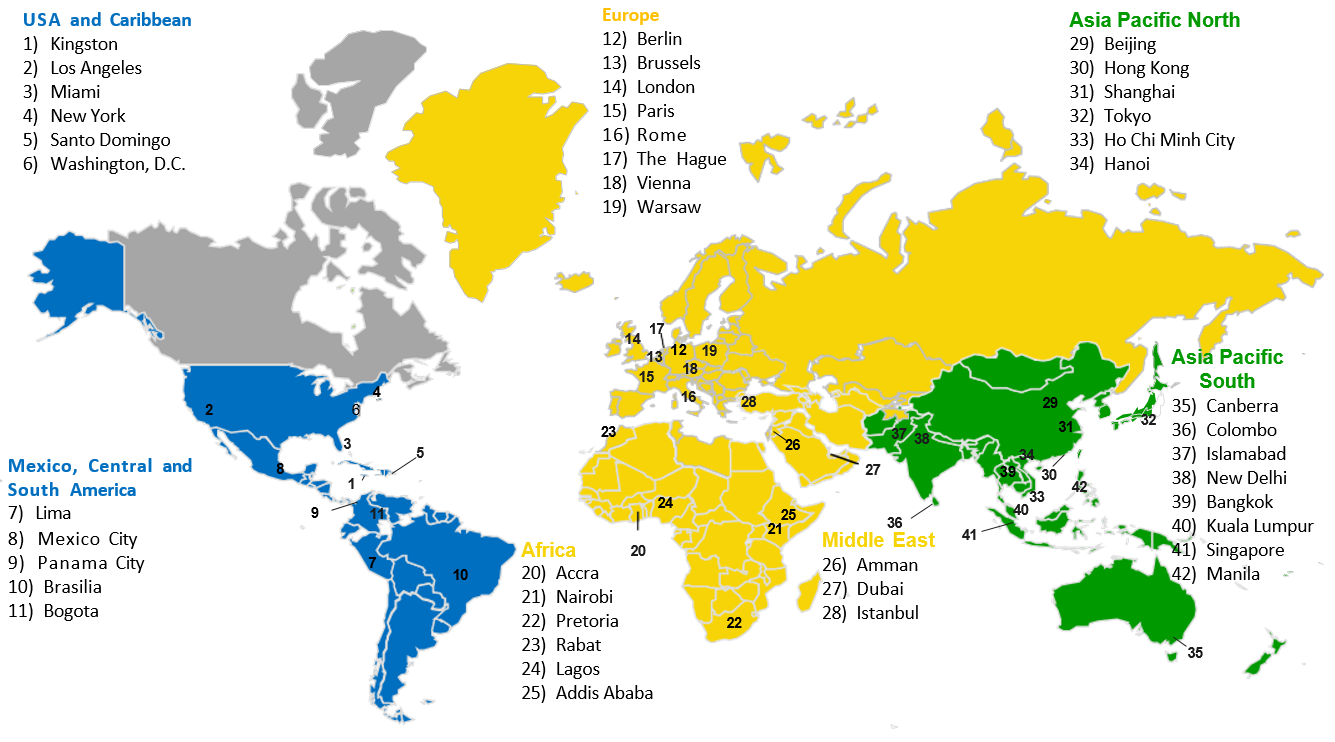
Figure 1 - Text version
USA and Caribbean
- 1) Kingston
- 2) Los Angeles
- 3) Miami
- 4) New York
- 5) Santo Domingo
- 6) Washington, D.C.
Mexico, Central and South America
- 7) Lima
- 8) Mexico City
- 9) Panama City
- 10) Brasilia
- 11) Bogota
Europe
- 12) Berlin
- 13) Brussels
- 14) London
- 15) Paris
- 16) Rome
- 17) The Hague
- 18) Vienna
- 19) Warsaw
Africa
- 20) Accra
- 21) Nairobi
- 22) Pretoria
- 23) Rabat
- 24) Lagos
- 25) Addis Abada
Middle East
- 26) Amman
- 27) Dubai
- 28) Istanbul
Asia Pacific North
- 29) Beijing
- 30) Hong Kong
- 31) Shanghai
- 32) Tokyo
- 33) Ho Chi Minh City
- 34) Hanoi
Asia Pacific South
- 35) Canberra
- 36) Colombo
- 37) Islamabad
- 38) New Delhi
- 39) Bangkok
- 40) Kuala Lumpur
- 41) Singapore
- 42) Manila
Average CBSA processing times
- Land Border – Primary: 72 seconds
- Air Port of Entry – Primary Inspection Kiosks: 154 seconds
- Work Permits: 14 minutes (air) / 43 min (land)
- Study Permits: 10 minutes (air) / 31 minutes (land)
- Refugee Claim: 6 hours
- Seizures: 52 minutes (air) / 1 hour and 23 minutes (land)
- Commercial – Primary: 26 seconds
- Commercial – Secondary: Up to 4 hours and 50 minutes
Welcoming travellers into Canada and promoting economic prosperity
In 2024, the CBSA welcomed over 80.5 million travellers to Canada. The CBSA is managing high volumes of travellers and commercial goods. The significant rise in e-commerce volumes is driven by lasting changes in consumer behaviour.
Keeping Canadians safe
The CBSA plays an integral role in ensuring the safety and security of Canadians as Canada's first line of defence at 1,200 ports of entry and works diligently to protect Canada from border-related threats. While the Agency aims to keep out all contraband, it continues to focus particularly on illegal drugs and firearms.
2024 Highlights (From January 1, 2024 to )
Traveller Facilitation
Travellers facilitated: 80,500,000 total:
- Highway: 45,100,000
- Air: 31,750,000
- Marine: 3,350,000
- Rail: 300,000
Key Milestones:
- 29,647,859 travellers used Primary Inspection Kiosk
- 3,927,416 travellers used Advance Declaration
- 1.9 million NEXUS members
- 83 additional Primary Inspection Kiosks across Canada
Commerce and Trade
Commercial Volumes:
- Highway: 4,481,521 trucks
- Air: 3,024,325 shipments
- Marine: 1,625,786 containers
- Rail: 1,591,801 cars
Key Milestones:
- Successful launch of the CBSA Assessment and Revenue Management (CARM) system
- Duties and Taxes Assessed: $32,5 billion
- Commercial Releases: 25 million
- Courier shipments: 110,5 million
- Protected CAN industry from unfair trade practices
- ~$136.4 million in SIMA duties assessed and ~31,000 CAN jobs protected
Immigration and Asylum
Refugee Claimants:
- 56,830 refugee claimants processed by CBSA, including:
- 40,974 at airports
- 13,883 at land ports of entry
- 1,236 between ports of entry
- 32 at marine ports of entry
- 705 at CBSA Inland Offices
Immigration Services:
- 475,000 work permits issued
- 250,000 study permits issued
- 195,000 Permanent Residents landed
- 61,852 NEXUS interviews administered
Intelligence and Enforcement
Seizures:
- 15,600 firearms and prohibited weapons
- 24,426 illegal drug seizures
- 154,842 cannabis seizures
- 1,656 tobacco seizures
- 58 child pornography seizures
Enforcement Milestones:
- 14,000 removals of inadmissible persons
- 9,100 international intercepts involving document validity concerns
- 5,246 immigration detentions
- 2,495 penalties for food, plant and animal import violations
- 26 missing children reunited with their loved ones in partnership with Our Missing Children Program
Page details
- Date modified: