
CBSA questions and answers: Standing Committee on Public Safety and National Security: Mandate and Priorities of the Minister of Public Safety (October 9, 2025)
What is the CBSA's plan to hire 1,000 officers
The CBSA recruits and trains from 400 to 500 new Border Services Officers per year to offset attrition and support new Government of Canada priorities.
Once funding is allocated, CBSA has a plan to hire 1000 additional people, of which about 80% will be uniformed officers.
This plan will sustain regular attrition, satisfy in-flight initiatives, and fully deliver the 1,000 new CBSA personnel, including border officers, intelligence officers, investigators, and security screening officers, within 3.5 to 4 years.
Additional background:
Not all new employees would have to be trained at Rigaud through the Officer Induction Training Program. We have operational staff across many key functions: intelligence, targeting, recourse, trade investigations, security screening, among others, and we have estimated that approximately 800 of the 1000 personnel would either be new Border Officer recruits or would be deployed or promoted out of the Border Service Officer cadre requiring replacement with new fully trained recruits.
Our Officer induction training program is 18 weeks. 4 weeks of distance learning and 14 weeks of in residence training at the Rigaud main campus.
Through ongoing recruiting efforts, we have a pool of 300 vetted and qualified candidates that we can invite to begin training in the next unfilled cohort.
We continue to hire students, 400 new and returning students per year, who have become an essential feeder group to our indeterminate officer core.
So far this fiscal year, we have graduated 167 Border Services Officers, we have 69 in training now, and 144 remaining to begin and complete the Officer Induction Training Program for a total of 380. 210 are committed as attrition replacement to sustain the front-line, 175 are committed for in-flight funded initiatives and 18 will be added to support this initiative, to complete training by early April.
1. Officer Trainee Entrance Exam (OTEE)
The candidate must pass an online exam that assesses their reasoning skills, writing skills, analytical thinking and client orientation. They will have 135 minutes to complete 117 multiple-choice questions where 60% correct in each competency is required to be successful. If they have passed the OTEE in a previous selection process, they do not need to retake the exam.
Interview
If successful at the OTEE, the candidate will attend an MS Teams video interview that consists of situational questions and role-playing scenarios. Previous knowledge of the CBSA is not required. Proof of a valid full driver's license without restrictions will be requested and verified prior to the interview.
- Candidates are assessed on the competencies below and must demonstrate each of these to the level required in the assessment to be considered successful.
- dealing with difficult situations
- decisiveness
- effective interactive communication
- judgment
- personal integrity
- values and ethics
2. Validation of Prerequisites
If successful at the interview, the candidate will be required to provide proof of the following before they can complete the psychological assessment (MMPI):
- Canadian citizenship or permanent residency
- High school diploma or employer-approved alternative (note: the CBSA does not consider an acceptable combination of education, training, and/or experience as an alternative. The NORP is currently using the GCT2 as the PSC approved testing equivalent)
3. Psychological Assessment (MMPI)
A psychologist will evaluate the candidate's ability to handle stress and suitability to carry a duty firearm.
- The MMPI will consist of two parts on separate days
- First, a written exam (2-4 hours total)
- followed by an in-person interview
If deemed unsuitable, the candidate is removed from the selection process. Only a determination of "suitable" or "not suitable" will be provided. A signed consent form before the assessment explains that beyond this result, no feedback, test scores, or other information can be provided.
4. Physical Abilities Test (PAT)
The PAT replaces the PARE from previous selection processes and is performed during the Officer Induction Training Program (OITP) in-residence training.
Candidates will be invited to a mandatory PAT information session once they have been found suitable at the psychological assessment.
5. Firearms Safety Courses
To ensure candidates can safely handle a firearm during training and on the job, they must complete the Canadian Firearms Safety Course (CFSC) and the Canadian Restricted Firearms Safety Course (CRFSC).
Once the candidate reaches this step in the selection process, they are given 3 months to complete both courses. Failure to do so may result in their removal from the selection process.
Although a Possession and Acquisition License (PAL) is not required, it is accepted as proof that both courses have been completed.
6. Medical Exam (Category III)
Candidates will receive an invitation from CBSA with a form to complete which will be provided to Health Canada (HC). HC will then contact the candidate directly to schedule the appointment to determine if the candidate is medically fit to train and work as a BSO through the completion of a confidential health questionnaire and medical exam by a doctor.
7. Second Language Evaluations (SLE)
If the candidate applied for a bilingual position (English and French only), they must complete the SLEs and achieve the intermediate level (BBB).
The CBSA only accepts results for SLEs administered by the PSC.
8. Security Clearance
Candidates need an Enhanced Reliability Status plus Secret Clearance to train and work as a BSO. CBSA Security relies on external partners to complete the security screening.
The CBSA will email the candidate results after they complete the telephone integrity interview.
All candidates must go through this process, even if they have security clearance from another government department or law enforcement agency.
If the candidate is successful at the CBSA Officer trainee selection process, they placed in our pre-qualified pool of OITP ready candidates and can be invited om the next unfilled cohort.
OITP Phase 1 – Online Training
When candidates are selected for OITP, they will receive an invitation and will be assigned to their work location/POE. While the CBSA does our best to post candidates in their preferred region (1st, 2nd, 3rd choices), they may be posted elsewhere based on POE staffing vacancies and the Agency's needs.
- The 3 to 9 month waiting period to be invited to participate at OITP is dependent on cohort availability
- Invitations are sent:
- approximately 6 to 12 months after they complete all the required assessments; and
- about 5 weeks before Phase 1 starts
They will complete four weeks of online training at home. Which is a mix of self-learning and instructor-led video sessions. It includes quizzes, activities, assignments, collaborative discussions, and forum postings.
OITP Phase 2 – Canada Border Services College
The candidate will then complete 14 weeks of training at the Canada Border Services College in Rigaud, Quebec.
They will learn about:
- the primary inspection process
- the secondary inspection process
- customs
- immigration
- food, plant and animal
- policies, procedures and laws that we administer and enforce
- seizures, detentions, personal searches and arrests
- how to determine the admissibility of persons and goods
- defensive tactics
- duty firearms
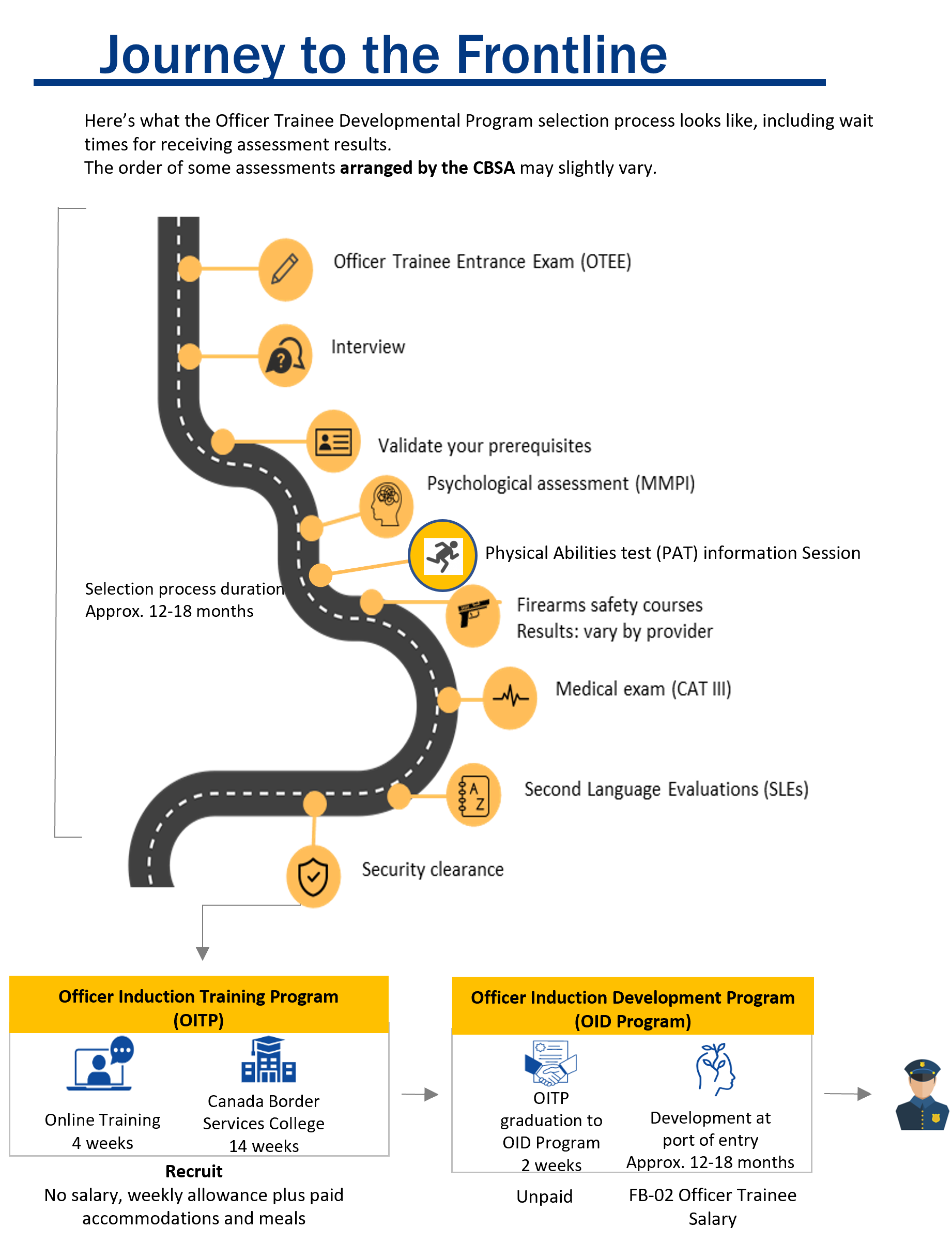
Figure 1 - Text version
Journey to the frontline
Here's what the Officer Trainee Development Program selection process looks like, including wait times for receiving assessment results
The order of some assessments arranged by the CBSA may slightly vary.
Selection process duration approx. 12 to 18 months (Stages 1 to 9)
Stages:
- Officer Trainee Entrance Exam (OTEE)
- Interview
- Validation of Prerequisites
- Psychological Assessment (MMPI)
- Physical Abilities Test (PAT) information Session
- Firearms Safety Courses Results: vary by provider
- Medical Exam (Category III)
- Second Language Evaluations (SLE)
- Security Clearance
- Officer Induction Training Program (OTIP)
- Recruit – No salary, weekly allowance plus paid accommodations and meals
- Online Training – 4 weeks
- Canada Border Service College – 14 weeks
- Recruit – No salary, weekly allowance plus paid accommodations and meals
- Officer Induction Development Program (OID Program)
- Unpaid - OITP graduation to OID Program – 2 weeks
- FB-02 Officer Trainee Salary - Development at port of entry – Approx. 12 to 18 months
- Graduate - FB-03 BSO Salary
What is CBSA's duty to accommodate
In , the Canada Border Services Agency (CBSA) completed arming its workforce at ports of entry and in intelligence and enforcement functions. CBSA officers perform a range of duties in support of the safety and security of Canada, and in most modes, carrying a duty firearm is a condition of their employment.
As a member of the core public administration, the CBSA addresses workplace issues in adherence to the Public Service Employment Act, the Federal Public Sector Labour Relations Act, and other relevant legislation. It develops related policies in alignment with collective agreements, jurisprudence, and Treasury Board Secretariat of Canada directives that apply across departments.
The Agency takes its responsibilities and obligations stemming from the Canadian Human Rights Act (CHRA), the Employment Equity Act, and the Accessible Canada Act very seriously. When someone can no longer be fully armed or meet the requirements of related job functions, the CBSA has a duty to accommodate them. The Agency also has a duty to spend taxpayer money wisely and to ensure that employees meet the essential requirements for positions which are classified, allocated, and funded on the assumption that they will be occupied by an armed officer supporting enforcement activities.
The duty to accommodate is a legal obligation to prevent or remove discriminatory impacts on employees based on protected grounds such as disability. It requires the CBSA to provide reasonable accommodations, which might include employment in a non-armed position.
The employer's obligation to accommodate stops when it becomes undue hardship, a threshold determined by factors including health, safety, and cost. The CBSA is not required to permanently exempt an employee from doing the essential duties of their position or create work that is not necessary. Additionally, accommodation measures are subject to periodic review.
An employee must cooperate with their employer's attempt to accommodate their needs, and rejecting a reasonable accommodation offer can bring employment to an end.
We are committed to working with employees requiring accommodations. The Accommodation page on Canada.ca provides additional information.
Please note that injury-on-duty leave is granted to border services officers in accordance with Article 37 of the Border Services (FB) Collective Agreement and the Treasury Board of Canada Secretariat's Injury-on-duty Leave Policy.
Will CBSA put officers at Valleyfield
Decisions relating to port infrastructure and supply chain fluidity are broader than CBSA – and rightly so. To that end, we work with Transport Canada, International Trade and others in the federal and provincial systems to determine how best to support trade goals.
In terms of ports, they provide data on their business modeling, source of their cargo and ability to make necessary investments in infrastructure for CBSA.
The Port of Valleyfield does not have a permanent CBSA officer presence. However, CBSA officers do currently travel to Valleyfield to provide services in line with the licenses that the port holds currently.
The Port of Valleyfield currently has a Commercial Vessel license, which allows them to import bulk goods and receive commercial vessels, not including international marine containers.
In addition, the Port of Valleyfield has a valid sufferance warehouse license, which allows CBSA officers to conduct examinations of commercial goods in their warehouse as needed.
On first port of arrival (FPOA)
The Canada Border Services Agency's resources are strategically allocated to respond to the threats and service needs at ports of entry, including shipping ports and rail yards.
Dedicated facilities for the examination of sea containers are already in operation in the country's five major seaports. These facilities have state-of-the-art tools and trained officers to enable the examination of imported goods and ensure that all requirements of program legislation are met, in order to protect the health, safety and security of Canadians.
Ensuring control of a commercial container port requires new infrastructure, Border Services Officers resources, detection technology/equipment and training to ensure the integrity of the program.
This includes radiation portals to screen all containers entering Canada. Following the events of , Canada and the United States signed the Container Security Initiative, which aims to detect and interdict terrorists, weapons of mass destruction, radiation threats, narcotics and other contraband arriving in marine containers as early as possible in the supply chain. U.S. Safe Ports Act mandates 100 percent screening by imaging and radiation detection for U.S.-bound marine containers.
As a result of this agreement, the CBSA screens all containers for radiation at its five marine ports, which represent 99% of all international container traffic into Canada.
Should Valleyfield seek to become a first port of arrival that can receive international marine containers, they would need to submit an application to the CBSA that includes a clear business case and meet all Government of Canada requirements, such as providing the CBSA with a Container Examination Facility.
What is the status of implementation of the border plan
The Border Plan for the CBSA includes 74 frontline human resources and up to 179 pieces of detection technology:
- 33 frontline Border Services Officers (BSOs)
- 9 Detector Dog Services teams
- 12 regional laboratory chemists
- 14 Intelligence resources
- 6 Targeting Officers
- Detection technology such as large and small-scale imaging devices and regional satellite labs
In 2025–2026, the CBSA is deploying:
- 22 detection technology devices, from handheld devices to large mobile imaging vehicles
- 33 Border Services Officers, who are starting in October at the CBSA College in Rigaud
In 2026–2027, the CBSA plans to deploy:
- Up to 75 detection technology devices
- 3 Detector Dog Services teams
- 12 regional laboratory chemists
In fiscal year 2027–2028, the CBSA plans to deploy:
- 57 detection technology devices
- 14 Intelligence resources
- 6 Targeting Officers
- 3 Detector Dog Services teams
In fiscal year 2028–2029, the CBSA plans to deploy:
- 25 detection technology devices
- 3 Detector Dog Services teams
Planned Detection Technology deployments (all sources of funds) – multi-year table
Detection Technology acronym legend
- RAMAN: Hand-Held Raman Device
- RSL: Regional Satellite Labs
- IMS: Ion Mobility Spectrometer
- LSI*: Large Scale Imaging - Portal or Drive Thru
- M-LSI: Mobile Large Scale Imaging
- P-LSI: Pallet Large Scale Imaging
- F-LSI: Fixed Large Scale Imaging
- MBI: Mobile Backscatter Imaging
- CT Scan: Computed Tomography Scanner
- SSI X-ray: Small Scale Imaging (various types)
| ATL | QC | NOR | GTA | SOR | PRA | PAC | LAB | Total | |
|---|---|---|---|---|---|---|---|---|---|
| RAMAN | 1 | 3 | - | 4 | - | 2 | 4 | 1 | 15 |
| RSL | - | - | - | 1 | - | - | - | - | 1 |
| IMS | - | - | - | - | - | - | - | - | 0 |
| M-LSI | 1 | - | - | - | 1 | - | 1 | - | 3 |
| P-LSI | - | - | - | - | - | - | 1 | - | 1 |
| F-LSI | - | - | - | - | 1 | - | - | - | 1 |
| MBI | - | - | - | - | - | - | - | - | 0 |
| CT Scan | - | - | - | - | - | - | - | - | 0 |
| SSI Xray | - | - | - | - | 1 | - | - | - | 1 |
| Total | 2 | 3 | 0 | 5 | 3 | 2 | 6 | 1 | 22 |
| ATL | QC | NOR | GTA | SOR | PRA | PAC | LAB | Total | |
|---|---|---|---|---|---|---|---|---|---|
| RAMAN | 1 | 3 | 3 | 5 | 5 | 5 | 6 | 2 | 30 |
| RSL | - | 1 | - | - | - | 1 | - | - | 2 |
| IMS | 2 | 4 | 2 | 3 | 2 | 1 | 5 | 5 | 25 |
| M-LSI | 1 | 2 | - | - | 1 | - | 2 | - | 6 |
| P-LSI | 1 | - | - | - | 1 | - | 1 | - | 3 |
| F-LSI | - | - | - | - | - | - | - | - | 0 |
| MBI* | 1 | 1 | - | 1 | - | - | 1 | 2xTBC | 6 |
| CT Scan* | - | 2 | - | 2 | - | 3 | 2 | - | 9 |
| SSI Xray | 3 | 1 | 1 | 1 | - | 2 | 2 | - | 10 |
| Total | 9 | 16 | 6 | 13 | 9 | 12 | 17 | 9 | 91 |
| ATL | QC | NOR | GTA | SOR | PRA | PAC | LAB | Total | |
|---|---|---|---|---|---|---|---|---|---|
| RAMAN | 4 | 6 | 1 | 3 | 7 | 3 | 5 | 1 | 30 |
| RSL | - | - | - | - | - | - | - | - | 0 |
| IMS | Locations TBC | 25 | 25 | ||||||
| LSI* | [Redacted] | [Redacted] | |||||||
| P-LSI | - | 1 | - | - | - | - | 1 | - | 2 |
| F-LSI | - | - | - | - | - | - | - | - | 0 |
| MBI** | - | - | 1 | - | 1 | 1 | 1 | - | 4 |
| CT Scan | - | 1 | - | 1 | - | - | 2 | - | 4 |
| SSI Xray | - | - | - | - | - | - | - | - | 0 |
| Total | 4 | 7 | 2 | 3 | 8 | 4 | 11 | 29 | 68 |
| ATL | QC | NOR | GTA | SOR | PRA | PAC | LAB | Total | |
|---|---|---|---|---|---|---|---|---|---|
| RAMAN | 4 | 4 | 4 | 2 | 3 | 5 | 2 | 1 | 25 |
| RSL | - | - | - | - | - | - | - | - | 0 |
| IMS | - | - | - | - | - | - | - | - | 0 |
| Fumehood | - | - | - | - | - | - | - | - | 0 |
| LSI* | [Redacted] | [Redacted] | |||||||
| P-LSI | - | - | - | - | - | - | - | - | 0 |
| F-LSI | - | - | - | - | - | - | - | - | 0 |
| MBI | - | - | - | - | - | - | - | - | 0 |
| CT Scan | - | - | - | - | - | - | - | - | 0 |
| SSI Xray | - | - | - | - | - | - | - | - | 0 |
| Total | 4 | 4 | 4 | 2 | 3 | 5 | 2 | 5 | 29 |
| ATL | QC | NOR | GTA | SOR | PRA | PAC | LAB | Total | |
|---|---|---|---|---|---|---|---|---|---|
| M-LSI | [Redacted] | [Redacted] | |||||||
| SSI | 10 x SSI rolling out in 2026–2027 | 10 | |||||||
| P-LSI | 1 x Pallet to roll out in 2027–2028 | 1 | |||||||
[Redacted]
What has CBSA been doing about stolen vehicles
The Canada Border Services Agency works very closely with police of jurisdiction to identify and recover stolen vehicles.
To ensure the coordination of efforts and effective information sharing, we met with representatives for Police departments in judications heavily effected by vehicle theft 20 times over an 18 month span. I personally convened upwards of police chiefs monthly to take stock of our efforts.
The Canada Border Services Agency is an essential source of information for local law enforcement and the Canada Border Services Agency respond to 100% of the information requests received.
- The Canada Border Services Agency centralized the process of information requests and provided a single point of contact for Police of Jurisdictions to respond to an increased volume of requests of information from law enforcement partners
- In , the Canada Border Services Agency processed 2,758 requests for information from the various Police of Jurisdictions
- So far in , 2,598 requests have been processed
Canada Border Services Agency has also been part of Joint Intelligence Group and task forces in Ontario and Quebec over the last years focused on stolen vehicles. This collaboration has been exceptionally important and has helped drive our results:
- In , the Canada Border Services Agency intercepted 2,277 stolen vehicles at various ports across the country
- As of , 1,220 vehicles have been intercepted since the beginning of the year
- These interceptions were largely driven by referrals form policing partners and the Canada Border Services Agency's intelligence driven targeting. This highlights the importance of strong partnerships and coordinated efforts between the Canada Border Services Agency, provincial and municipal police services, and other key stakeholders
- The Canada Border Services Agency is working closely with its partners to exchange on latest trends, and adjusting processes, as required
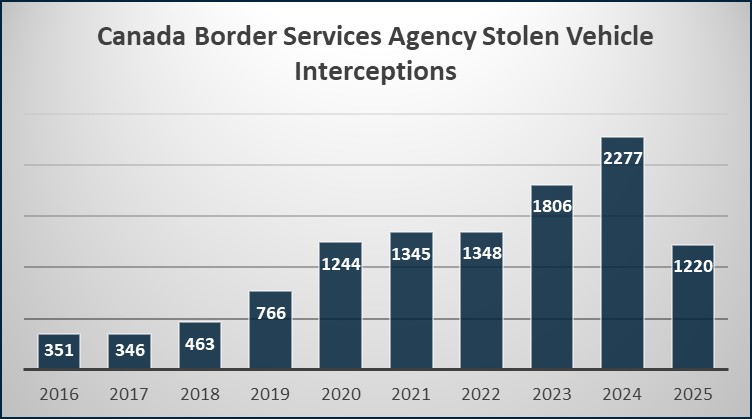
Figure 2 - Text version
| 2016 | 2017 | 2018 | 2019 | 2020 | 2021 | 2022 | 2023 | 2024 | 2025 |
|---|---|---|---|---|---|---|---|---|---|
| 351 | 346 | 463 | 766 | 1,244 | 1,345 | 1,348 | 1,806 | 2,277 | 1,220 |
What does CBSA do to screen rail
CBSA risk assesses everything and every body coming into the country. We take this responsibility very seriously.
In rail mode, like in other modes, carriers submit commercial information on their shipments crossing the border. Targeting officers refer high risk targets for examination by an officer. Frontline officers can conduct manual inspections or use available scanning technology to scan high risk containers.
Background
Commercial rail serves as the cornerstone of Canada's transportation infrastructure, facilitating one-third of U.S. exports to Canada and generating over $31.5 billion in cross-border trade value, including substantial flows from Mexico via the United States.
In 2024–2025, 1.87 million rail cars entered Canada, processed through the CBSA's 28 designated Railway Depots and 97 inland warehouses.
Cargo process flow:
- Prior to the freight train arriving in Canada, the carrier submits Advance Commercial Information to the CBSA. The CBSA's National Targeting Centre has the ability to conduct a preliminary risk assessment of the goods
- At the land border, which is Rail's first point of arrival, the carrier reports its arrival, fulfilling its reporting requirements under Section 12 of the Customs Act. This triggers the commercial release of goods as long as commercial accounting declarations have been submitted and goods are not referred for examination or other government department review
- Train cars and cargo requiring examination for health, safety and security risks that cannot be examined at First Point of Arrival will move onwards to what's called the First Point of Operational Intervention—this is where the selected cars are separated from the main train and their cargo is moved into a warehouse to be offloaded and examined by BSOs
- Rail cargo that has not been commercially released at the first point of arrival will move onwards to the port of final destination. Once the cargo arrives at the destination location, the warehouse operator transmits a warehouse arrival notification to the CBSA, triggering the commercial release or referral of the goods. Border Services Officers conduct commercial release processing and/or goods examination, including coordination with other government departments to ensure import requirements are met. Once complete, the goods are released to the importer
VP McCrorie regarding rail from the September 25 transcript
Caputo: what percentage of export containers are scanned at the border?
McCrorie: I couldn't give a breakdown of import vs. export, but I'd suggest around 1% to 2% of containers are examined. Need to distinguish between physically examined or scanned with x-rays, it's an important distinction; we use advance commercial information, whether inbound or outbound, and use a new targeting tool developed specifically in response to auto thefts which allows us to identify which containers should be subject to physical exam.
"The CBSA undertook additional work following the Summit thanks to special funding received, including the deployment of scanning technology in the Greater Toronto Area, or GTA, to improve our capacity to examine export-bound freight containers at intermodal facilities. …in the Toronto area rail yards, we deployed two scanners to look randomly for vehicles. We did 6,500 scans so far this year and have not found any stolen vehicles as a result of these."
"Not all cars that are stolen in Canada are bound for the export market… but we're seeing a decline in the number of vehicles we've intercepted at the border."
DeBellefeuille: In the National Action Plan to Combat Vehicle Theft, it says that new border services officers are to be hired to be deployed at ports, rail terminals, and intermodal facilities. The plan is one year old and will mark its first anniversary in . Mr. McCrorie, can you tell us exactly how many new officers have been deployed under the National Action Plan?
McCrorie: Very quickly, probably around 30 FTs have been hired, but the ones that really the 25 FTs that are operational. We had 10 new intelligence and targeting officers hired, and then 15 additional commercial exam officers hired to deploy to Montreal at the port, in the Toronto area rail yards, Port of Halifax and in the Port of Vancouver as well. They're in place…. We probably have on average 40 people working at the marine and rail examination centre at the Port of Montreal. With the additional resources another 6 were added.
How many asylum seekers have come to Canada through ports of entry in
- Asylum claims in air: 9,351
- Asylum claims in land: 18,775
- Asylum claims between the ports of entry (based on people brought to CBSA by PoJ): 1,458
- This represents a 42% decrease in overall claims since last year
- The most claims were at the Lacolle port of entry – so far this year we have had approximately 13,695 claimants (an increase of 116% over last year)
All data is as of
Chart showing claims over last 5 calendar years (CBSA only)
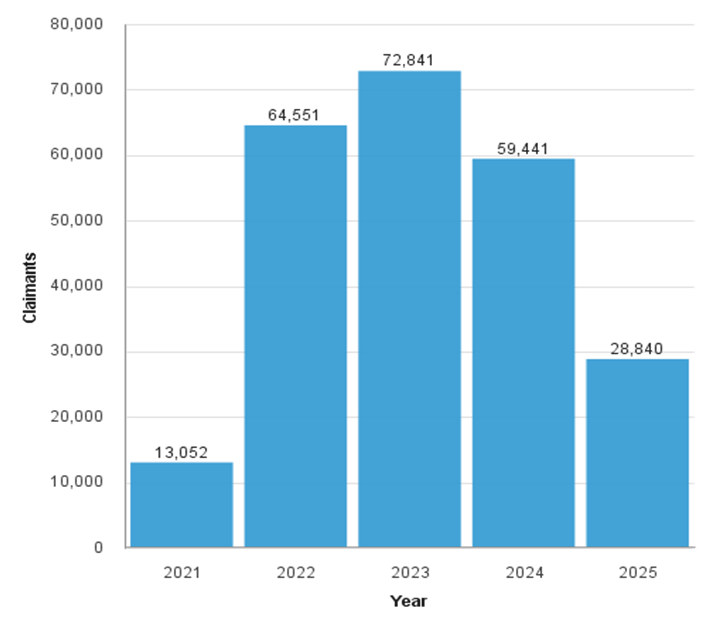
Figure 3 - Text version
| 2021 | 2022 | 2023 | 2024 | 2025 |
|---|---|---|---|---|
| 13,052 | 64,551 | 72,841 | 59,441 | 28,840 |
What is CBSA doing about fentanyl
Over a year ago, I appointed a senior operational executive charged with coordinating our activities relating to opioids – from targeting to information sharing to collaboration with allies and Canadian police forces.
We continue this work in force, including through focused efforts, such as Operation Blizzard, where we dedicated resources over 4 weeks period and looked at 691,000 packages in air, postal, marine and land modes.
The results were: 67.5% of all seizures made were of illegal narcotics coming to Canada from the United States, while 17.5% were of narcotics going to the United States. These included:
- 116 fentanyl seizures (1.73 kg), intercepted in British Columbia, Québec and Alberta. Of these seizures, 1.44 kg were on route to the United States and 0.26 kg were destined to other countries
- 17 meth seizures (5.38 kg and 89 pills)
- 24 cocaine seizures (13 kg)
- 26 heroin seizures (0.19 kg)
- 17 opium seizures (38.84 kg and 11 bottles)
- 48 MDMA seizures (2.32 kg and 82 pills)
- 249 cannabis and cannabis related product seizures
The United States was the country of destination or origin for over 85% of all seizures made during the Operation.
| Export | Import | Grand total | |
|---|---|---|---|
| February | 131 | 16.5 | 147.5 |
| March | 1628.9 | 11.6 | 1640.5 |
| April | 378.35 | 0.1 | 378.45 |
| May | 141.1 | 0.25 | 141.35 |
| June | 17.8 | 27.29 | 45.09 |
| July | 176.8 | 61.8 | 238.6 |
| August | 5.2 | - | 5.2 |
| September | - | 1 | 1 |
| Grand total | 2479.15 | 118.54 | 2597.69 |
What happened with the IT outages last week
Unfortunately, there were two outages. The first one came about as a result of routine maintenance that went badly, and corrupted some of our databases, which then made some of our commercial systems unstable. As such, we had to move to contingency plans that meant paper processes. In airports, the PIK machines went offline so we staffed our primary inspection line booths and processed travellers that way.
The second outage was a result of a critical patch that was applied to correct a security issue.
My colleague from Shared Services Canada and I will have a report as to the specific causes of these outages that I will provide to the Minister by the end of the month. I will be able to provide a copy to the committee shortly after the Minister has had a chance to review it.
We have also asked our respective Chief Audit Executives to collaborate on a joint audit that would be conducted as a priority to determine what operational steps we can put in place to add to any recommendations from the first report.
On security and lookouts:
The CBSA's intelligence and central targeting systems continued to function throughout these incidents. However the outages and backlog of commercial shipment transactions meant that pre-arrival lookouts were not possible, and targeting assessments were delayed. This was compensated by our extra officers who are highly-trained to spot irregularities. For travellers, there were delays in communicating lookout information, but communication between our National Targeting Centre and front line officers continued throughout.
What is in the new bill that relates to CBSA
The changes to the bill include removals of the following sections. All other previous provisions remain:
- Canada Post amendments (entirety of Bill C-2's Part 4)
- Prohibition on large cash transactions (entirety of Bill C-2's Part 11)
- Lawful access basic and subscriber information provisions (entirety of Bill C-2's Part 14)
- Supporting Authorized Access to Information Act (entirety of Bill C-2's Part 15)
- Safe harbour provisions (entirety of Bill C-2's Part 16)
The following CBSA provisions are included in the new bill and mirror what was included in C-2:
Requirements for owners and operators provide space and infrastructure for the CBSA to do export examinations
The proposed amendments to the Customs Act will bring facilities obligations in line with the creation of the Agency and its current mandate while aligning with the powers with respect to exported goods provided through amendments to the Customs Act in .
These amendments will align the facilities obligations with export authorities authorizes that already exist in the Customs Act.
The proposed amendments will mirror obligations that already exist for imported goods, such as infrastructure or facilities to conduct export exams, and require transporters and warehouse operators to allow access to premises under their control for the examination of goods destined for export.
- Amendments will obligate owners and operators at certain ports of entry/exit to provide, equip and maintain facilities free of charge for any purpose related to the administration and enforcement of the CBSA's mandate, which includes the examination and detention of goods destined for export
- Amendments will give the CBSA access to spaces further away from the port of entry/exit. The most effective place to perform export searches is at transportation hubs where containers are gathered, such as rail yards and warehouses before they reach a port. Performing export examinations at transportation hubs would reduce bottlenecks at busy ports of entry/exit and would respond to industry requests to perform CBSA services at warehouses located inland. This provision will mirror current obligations for goods destined for import
It is important to be clear that we currently conduct export exams in all modes and owners and operators have been good partners.
The proposed amendments would not significantly broaden the scope of what is already being provided to the CBSA by port owner/operators, transporters and sufferance warehouse operators with respect to imported goods.
Rather, they are intended to align import and export requirements to ensure greater consistency and would provide additional clarity regarding expectations for those locations in order for the CBSA to carry out export-related functions, including infrastructure considerations should those groups seek to expand or create new locations.
Other elements of the bill will help improve the CBSA's work relating to asylum seekers
Two new ineligibilities would be created making claims meeting those conditions ineligible to be referred to the Immigration and Refugee Board and help Canada better manage access to the refugee system.
- The first new ineligibility would apply if a claimant entered Canada one year before making a refugee claim. This ineligibility will apply only if the first entry into Canada was made on or after (when entry-exit records began)
- The second applies if a claimant entered Canada irregularly from the United States and made a claim after the 14-day time limit passed under the application of the Safe Third Country Agreement (STCA). Currently the STCA only applies if the claim is made within 14 days of entry
- In both cases, asylum seekers would still be eligible to apply for a pre-removal risk assessments to respect the principle of non-refoulement (international principle whereby countries cannot remove someone to a place where their life or freedoms would be in jeopardy)
- It is expected that most of these claims will be made at IRCC offices; however, some claims may be made through CBSA at ports of entry
The proposed new authorization for the appointment of representatives to assist minors or those who cannot understand proceeding at both the CBSA and IRCC will promote fairness throughout the whole asylum process. Currently, only the Immigration and Refugee Board has this authority at its hearings. Appointed representatives will be beneficial in CBSA removal proceedings to ensure the foreign national has support to fully participate in the process.
The bill proposes that removal orders will come into force the same day as when a refugee claim is withdrawn allowing the CBSA to enforce removal orders immediately for persons who withdrew their claim and wish to leave Canada. Currently officers need to wait 15 days.
The bill also seeks to introduce a new requirement that admissibility hearings and refugee claim hearings can only be held at the Immigration and Refugee Board if the person is present in Canada. CBSA interventions in hearings would therefore, be for individuals in the country and not abroad, which is consistent with the perspective that the asylum system provides protection for persons in Canada.
Finally, the bill would also create provisions to specify that various information and documents required to support a refugee claim are provided before the Immigration and Refugee Board hearing. This will support the CBSA's ability to conduct security screening and investigate potential inadmissibilities. Currently, a claim is referred as soon as the initial eligibility decision is made. The proposed Minister's Due Diligence provisions will establish a period of time before the referral to the Immigration and Refugee Board can take place to ensure the collection and review of materials.
- As claims will be pending Minister's Due Diligence, additional provisions will address when claimants fail to meet requirements in order to start abandonment of a claim before referral and to also allow CBSA or IRCC officials to accept withdrawals of refugee claims before referral
- Additional improvements include provisions to consolidate all the required documents into one single application online for consistency regardless of whether the claim is made at inland IRCC offices or CBSA ports of entry
Why are you making small businesses get a CARM account
The CBSA Assessment and Revenue Management (CARM) is a new system for importers, designed to facilitate the collection of duties and taxes for commercial goods imported into Canada, which successfully came on line last year. With its launch, CARM became the official system of record for the collection of duties and taxes for commercial goods imported into Canada.
Those who seek to import goods into Canada need to register in CARM. When they do, they are able to use an online self-service tool to see their account, register for various CBSA programs, receive notifications, provide the CBSA with supporting documents, view account statements, make payments, and perform other activities.
Importers are also provided the opportunity to either pay their duties and taxes at the time of release when their goods enter the country or enroll in the release prior to payment (RPP) program and post financial security, which allows them to defer payment of duties and taxes.
When CARM was launched, the CBSA also implemented regulatory amendments to require all importers (regardless of size) to post financial security rather than the broker posting security on their behalf, which was the previous practice. Once importers are enrolled in CARM, they can delegate day-to-day business to their customs broker. Small businesses still have the option to pay duties and taxes upon entry into Canada, but if they want the privilege to defer payment of duties and taxes, they are required to enroll in the release prior to payment program and post financial security.
The rationale for this is simple. With the broker-based security model, the CBSA had difficulty collecting on delinquent accounts and as such, had to write off debts for duties owing and in many cases, had limited to no recourse to collect on broker bonds. The regulatory changes to the Release Prior to Payment model that were introduced with CARM are designed to clarify and strengthen the accountability for the payment of duties and taxes owing. The intent is to reduce bad debt write-off by holding the importer and not the third party agent or customs broker responsible for any outstanding debt.
Currently, over 191,000 importers have enrolled in the CARM client portal and the volume of RPP enrollment represents 98.52% of the total release volume.
Infrequent importers, who import only a few times per year, represent a slower enrollment rate as these importers may be seasonal or may never import again and will have no need to register in CARM or release prior to payment. A portion of these infrequent importers are also non resident importers, based in other countries, and may be less aware of CARM and the release prior to payment program, which is why we are amplifying our outreach to spread awareness. Nonetheless, the CBSA continues to see a trend of small businesses enrollment increasing daily.
We understand that for some small businesses that import a few times a year, it may be more challenging to transition to CARM and post financial security. As such, we have worked with them to provide flexibility:
- Provided a 210-day transition period that gave importers the time to post their financial security
- Offered specific transition measures for a one year period, which have just been extended until or longer, to allow for the use of a broker's financial security for first time and one time importers and those who are in the process of registering in CARM and for release prior to payment
- Offered contingency measures that allowed brokers to use their financial security for time-sensitive and perishable products, as well as goods that contribute to an individual's health and well being
- Increased engagement efforts with a focus on small importers
- Offered help-desk services by phone and by webform to help clients enroll in CARM and a dedicated line for brokers who are helping their client register in CARM
Frequent user feedback and steps to improve
CARM challenges for importers
Frequent feedback received from the trade community on CARM falls into the following categories. A number of steps have been taken to improve where possible.
Challenge 1: CARM client portal business account creation (i.e. onboarding)
Description:
CARM requires businesses to register for their CARM account in order to proceed with activities such as delegation of authority or enrolment in Release Prior to Payment. Steps to account creation require access to information that is often challenging particularly for small businesses due to a number of factors:
- Legal entity name and/or address not up to date with CRA
- Financial transactional information required to authenticate account not available, or not understood – resulting in helpdesk request for assistance
September 8 updates
- We are working with Corporate Communications to re-promote the three key videos related to onboarding (create user credential and profile, request access to employer or create business account, delegate authority to third party)
- 48 webinars have been held since May 20. Webinars are available for registration via the CBSA website and promoted in communications. 8 webinars scheduled in September related to Onboarding and RPP (4 English, 4 French). 4 webinars were held in August: 481 registered, 275 attended (~45% attendance rate)
- Requests for onboarding assistance are handled live on the telephone (dedicated onboarding line) and via webform with a 5-business day turnaround time due to first-in first-out processing
- Although feedback on the webform revisions is not necessarily captured, the quantity of tickets where the issue is resolved prior to the helpdesk involvement is captured. At least 1190 tickets have been closed without helpdesk intervention, indicating that helpdesk revisions to direct users to self-help options have had a positive impact
October 1 updates
- 6 webinars held in September, 41% attendance rate (171 registered, 72 attended) – total webinars since May 20 is 54
- October webinar dates being confirmed – planning carrier-specific, a webinar specific to the annual financial security review and what actions need to be taken
- Onboarding assistance remains highest topic of support; average number of calls received per day in September was 512 calls
- Onboarding requests via webform continue to be processed in less than 5 business days (as of October 1, 2:30pm: 93 requests in the queue, oldest is from September 25)
- CTB and Corporate Communications working towards bringing Guide to importing commercial goods into Canada: Step 1. Preparing to import up to date. Once updated, it will be included in updates via web, social media, other communications
- User Guides continue to be updated to provide clarity on steps and bulletins published to share information – 28 user guides updated with the September 27/28 release, including the changes applicable to the credit card limit
- (ongoing) Continued improvements to CBSA website for CARM-related information
- CTB/Corporate Communications working with ISED to include CARM in their communication products and channels. Targeting the next available spot in their GCInsights newsletter (December 2) and exploring their other communication tools
Challenge 2: Helpdesk volumes and wait times
Description:
Helpdesk volumes remain high, particularly for onboarding and Release Prior to Payment assistance. Trade community callers are experiencing extended wait times on phone and webform responses.
September 8 updates
- Telephone and Webform stats provided at the end of this document. Since May 20, both telephone and webform volumes have been declining
- Average wait time for the month of August was 36 minutes
- Number of onboarded businesses per week continues to decline. Currently at over 189,500 registered businesses, with average of 1500 businesses onboarded per week in August (May and June were 2000/week, July was 1700/week)
- Upcoming changes to operate telephone line by time zone of caller is pending requirements confirmation with SSC/Bell on September 18. This change is expected to balance the calls across the country and continue to aid in improving wait times
October 1 updates
- Telephone and webform assistance requests continue to decline; month-over-month stats are provided at end of document
- Average wait time for September: 26 minutes (down from 36 minutes in August, 43 minutes in July, 66 minutes in June)
- Telephone response rate for September was 62% (up from 53% in August, 49% in July and 39% in June)
- Number of onboarded businesses per week continues to decline. As of September 26, over 194,468 registered businesses, with average of 1551 businesses onboarded per week in September (slightly up from 1538 per week in August, down from 1809 per week in July and 1965 per week in June)
- Implemented : on the BIS line, moved CARM down in the list of options and "Commercial importing" option to the forefront to aid in reducing calls coming to CARM for topics that BIS should be addressing
- Implemented : Improvements to BIS and CARM sections of CBSA webpage to clarify which area to contact for what topics
- Upcoming, date TBD dependent on Bell (telephony vendor): Pending telephone line changes to operate in a 8-4 local time capacity, with goal of better management of call volumes and distribution (this is how BIS line operates, making change to CARM options)
Challenge 3: External clients become unable to access previously created account
Description:
Helpdesk assistance is often required when:
- Users who onboarded following Release 1 (i.e. early adopters) fall into the category of 24+ months of inactivity, where GCKey service has a system rule that deactivates the key. Helpdesk needs to perform a profile switch
- Users forget username/password and either do not attempt recovery or erroneously revoke their existing key
- Business Account Manager (BAM) changes, for example previous BAM leaves company without reassigning role to a new BAM
September 8 updates
- Change request impact and cost for BAM switches was received, estimate is $200,000. CBSA requested the vendor return and review as the estimate should have decreased from previous estimate prior to R3
- The number of BAM switches requested per month is decreasing (May – 276, June – 146, July – 144, August – 105)
October 1 updates
- The number of BAM switches requested per month continues to decrease: 82 in September, down from 105 in August
- Discussions are ongoing with Deloitte regarding impact and cost for BAM switches
Challenge 4: Language used in CARM
Description:
Feedback from small businesses is that the language used in the CARM Portal is not clear or intuitive.
September 8 updates
- Deloitte will be making minor language improvements, at no cost, to some of the language on the registration screens to improve usability
October updates
- Changes implemented as of September 28
Challenge 5: Users with multiple businesses
Description:
The portal has been designed to operate by the principle of one user/login credential per business, which requires users who operate more than one business to have separate login credentials for each business.
September 8 update
- Not currently pursuing
October update
- Not currently pursuing
Monthly statistics
| June | July | August | September | |
|---|---|---|---|---|
| Calls received | 13,390 | 14,650 | 9,323 | 9,746 |
| Calls answered | 5,216 | 7,181 | 4,969 | 6,052 |
| Average wait time (minutes) | 66 | 43 | 36 | 26 |
| Answer rate | 39% | 49% | 53% | 62% |
| Cases opened | 10,645 | 9,786 | 6,554 | 5,751 |
| Cases closed | 8,845 | 10,896 | 8,927 | 7,686 |
| Case increase/decrease | 1,800 | minus1,110 | minus2,373 | minus1,935 |
What is CBSA doing about firearms
The CBSA's firearms strategy is focused on the identification, interdiction, and regulatory enforcement of firearms. This includes denying entry of illegal firearms or firearm parts into Canada. The CBSA also criminally prosecutes firearms smugglers and where they are not Canadian, denies them entry to or removes them from Canada.
Over a year ago, I appointed a senior operational official responsible for firearms. Her mandate is to make sure our many activities in CBSA were linked up, that we were engaging with police forces and that police forces were aware of CBSA's considerable authorities in this space and actively engages with US counterparts to improve timely information sharing. She also works with other federal agencies (RCMP and PS) to advance efforts to strengthen policy and legislation impacting enforcement at and beyond the border.
The CBSA has established three Integrated Firearms Enforcement Teams (The Ontario Firearms smuggling Enforcement Team (OFSET), The Prairie Integrated Firearms Enforcement Team (IFET) and the Québec Weapons Smuggling Integrated Enforcement Team (WSIET). The teams are composed of criminal investigators, intelligence officers, and firearms intelligence analysts. These cross-functional teams investigate, arrest and prosecute firearms smugglers.
Recognizing the threat of privately manufactured firearms (aka PMF's or ghost guns), the CBSA's has also bolstered efforts to target and interdict firearm parts arriving at the border by:
- Coordinating national intelligence through the National Targeting Center, the Firearms Intelligence Desk and, Regional Intelligence field offices
- Increasing the number of search warrants executed by our criminal investigators across the country to stop the proliferation of PMFs in Canadian communities
- Educating front line officers on concealment trends and risk indicators f both firearms and the parts that are used to manufacture firearms
- Utilizing and continuing to invest in detection technologies capacity (such as handheld devices, small scale and large-scale X-ray machines, and detector dogs)
In addition to CBSA independent efforts, we work alongside domestic and international law enforcement partners, such as the Royal Canadian Mounted Police (RCMP), other Canadian police agencies, and the U.S government (U.S. Customs and Border Protection, U.S. Homeland Security Investigations, and the U.S. Bureau of Alcohol, Tobacco, Firearms and Explosives) in joint efforts to prevent and prohibit those who engage in criminal activity from entering Canada.
- Example of these efforts includes: tracing all eligible firearms seized through an information sharing Memorandum of Understanding with the U.S. Bureau of Alcohol, Tobacco, Firearms and Explosives (ATF). This allows the CBSA and our US counterparts to investigate those engaging in firearms smuggling
- Sharing near-real time information on border seizures with the RCMP and US to support the identification of trends and persons engaged in firearm smuggling activities
- In , the CBSA seized over 930 firearms and 17,200 prohibited weapons. 90 percent of all firearms seized at our border coming into Canada came from the U.S.
- Between and , 3,295 firearms seized at our border came from the U.S.
| Export | Import | Grand total | |
|---|---|---|---|
| January | 1 | 54 | 55 |
| February | - | 44 | 44 |
| March | 2 | 49 | 51 |
| April | 1 | 58 | 59 |
| May | 2 | 85 | 87 |
| June | - | 89 | 89 |
| July | 1 | 99 | 100 |
| August | 1 | 103 | 104 |
| September | - | 99 | 99 |
| Grand total | 8 | 680 | 688 |
CBSA stats and facts
Budget – A and B base (source of info: 2025–2026 Main Estimates)
2025–2026 CBSA budget:
- A-Base (Ongoing) funding: $1,983 million
- B-Base (Temporary) funding: $729 million
- Statutory (Employee Benefit Plan) $281 million
- Total Budget: $2,993 million
FTEs – uniformed, operational and support
approximately 17,000 employees
over 8,500 front line
1,200 ports of entry and in 36 countries.
Ports of entry – air, land, marine
- 117 land-border crossings – 61 on a 24/7 basis
- 13 international airports – 10 on a 24/7 basis
- 27 rail sites
3 Major Ports (Halifax, Montréal and Vancouver) numerous marinas and reporting stations
IT Contracts – number and amount and decrease over past years (source of info: Q1 report to TBS)
36 IT consultants as of , compared to 250 in .
The reduction in consultants reflects the CBSA's steady decline in overall contract use. The amount of active contracts has reduced by 55% between and .
Executives
- 44% of VPs/RDGs have served on the frontline (8 out of 18)
- 66% of VPs and RDGs are women (12 out of 18)
Seizures by commodity
Please note for tables below: All fentanyl related statistics between calendar year 2020–2025 are sourced from the Travellers Business Line Data Analytics and Performance Reporting Unit deep-dive methodology. All other statistics are sourced from the Integrated Customs Enforcement System (ICES).
Seized from the U.S. (cocaine, fentanyl, methamphetamine)
| Commodity (kg) | 2020 | 2021 | 2022 | 2023 | 2024 | 2025 (up to Sep 30) |
Total |
|---|---|---|---|---|---|---|---|
| Cocaine | 553 | 573 | 689 | 896 | 2,178 | 1,501 | 6,390 |
| Fentanyl | 0.00 | 0.03 | 1.07 | 0.50 | 0.54 | 0.12 | 2.26 |
| Methamphetamine | 257 | 237 | 317 | 2,011 | 784 | 61 | 3,667 |
| Total | 810 | 810 | 1,007 | 2,907 | 2,963 | 1,562 | 10,059 |
| Commodity (quantity) | 2020 | 2021 | 2022 | 2023 | 2024 | 2025 (up to Sep 30) |
Total |
|---|---|---|---|---|---|---|---|
| Firearms | 459 | 573 | 581 | 843 | 839 | 604 | 3,899 |
| Prohibited weapons | 2,032 | 5,075 | 2,646 | 3,152 | 3,398 | 2,029 | 18,332 |
Seized from all other countries combined (cocaine, fentanyl, methamphetamine)
| Commodity (kg) | 2020 | 2021 | 2022 | 2023 | 2024 | 2025 (up to Sep 30) |
Total |
|---|---|---|---|---|---|---|---|
| Cocaine | 635 | 742 | 2,446 | 891 | 2,411 | 1,413 | 8,538 |
| Fentanyl | 6.90 | 2.87 | 2.81 | 0.16 | 4.39 | 2.48 | 19.61 |
| Methamphetamine | 530 | 649 | 1,423 | 8,117 | 1,388 | 1,009 | 13,116 |
| Total | 1,172 | 1,394 | 3,872 | 9,008 | 3,803 | 2,424 | 21,673 |
|
Note: Rest of the world includes Canada |
|||||||
| Commodity (quantity) | 2020 | 2021 | 2022 | 2023 | 2024 | 2025 (up to Sep 30) |
Total |
|---|---|---|---|---|---|---|---|
| Firearms | 36 | 498 | 519 | 75 | 93 | 84 | 1,305 |
| Prohibited weapons | 50,198 | 58,496 | 18,260 | 23,982 | 13,863 | 9,710 | 174,509 |
|
Date extracted: |
|||||||
Seized from the U.S. (cannabis, tobacco, heroin, ketamine)
| Commodity | 2020 | 2021 | 2022 | 2023 | 2024 | 2025 (up to Sep 30) |
Grand total |
|---|---|---|---|---|---|---|---|
| Cannabis | 4,339,876 | 11,908,899 | 1,434,494 | 4,822,950 | 1,484,573 | 730,025 | 24,720,817 |
| Grams | 3,034,646 | 3,412,298 | 813,276 | 3,744,865 | 1,052,891 | 675,534 | 12,733,510 |
| Dosage | 1,291,265 | 3,394,022 | 606,969 | 1,009,114 | 406,022 | 50,409 | 6,757,801 |
| ml | 13,965 | 5,102,579 | 14,250 | 68,971 | 25,660 | 4,082 | 5,229,507 |
| Tobacco | 581,102 | 406,581 | 728,933 | 725,073 | 1,889,237 | 3,714,200 | 8,045,126 |
| Kg | 544,272 | 394,963 | 404,932 | 678,210 | 507,180 | 213,997 | 2,743,554 |
| NMB | 36,359 | 10,015 | 217,587 | 40,915 | 1,380,002 | 3,456,114 | 5,140,992 |
| Cartons | 471 | 1,604 | 106,413 | 5,948 | 2,055 | 44,088 | 160,579 |
| Heroin | 71 | 543 | 182 | 63,389 | 80 | 529 | 64,794 |
| Grams | 71 | 543 | 169 | 63,389 | 80 | 529 | 64,781 |
| Dosage | 0 | 0 | 13 | 0 | 0 | 0 | 13 |
| Ketamine | 5 | 106 | 93 | 209 | 150 | 73 | 636 |
| Grams | 1 | 96 | 93 | 209 | 145 | 70 | 614 |
| Dosage | 5 | 10 | 0 | 0 | 5 | 3 | 23 |
Seized from all other countries combined (cannabis, tobacco, heroin, ketamine)
| Commodity | 2020 | 2021 | 2022 | 2023 | 2024 | 2025 (up to Sep 30) |
Grand total |
|---|---|---|---|---|---|---|---|
| Cannabis | 5,075,186 | 8,973,603 | 12,906,023 | 19,915,381 | 16,780,129 | 39,715,744 | 103,366,066 |
| Grams | 3,683,962 | 8,874,691 | 12,857,440 | 19,856,002 | 16,730,175 | 39,685,325 | 101,687,595 |
| Dosage | 1,305,864 | 72,952 | 41,773 | 40,366 | 40,989 | 19,739 | 1,521,683 |
| ml | 85,360 | 25,960 | 6,810 | 19,013 | 8,964 | 10,680 | 156,787 |
| Tobacco | 354,439 | 695,229 | 50,943 | 241,044 | 235,618 | 2,279,364 | 3,856,637 |
| Kg | 185,788 | 555,213 | 22,645 | 121,007 | 68,363 | 563,224 | 1,516,240 |
| NMB | 150,030 | 300 | 23,528 | 96,676 | 79,007 | 26,196 | 375,737 |
| Cartons | 18,621 | 139,716 | 4,770 | 23,361 | 88248 | 1,689,944 | 1,964,660 |
| Heroin | 91,751 | 131,017 | 397,659 | 26,634 | 37,919 | 73,441 | 758,421 |
| Grams | 91,751 | 131,017 | 397,659 | 24,234 | 37,919 | 73,441 | 756,021 |
| Dosage | 0 | 0 | 0 | 2,400 | 0 | 0 | 2,400 |
| Ketamine | 7,872 | 84,834 | 302,724 | 954,747 | 253,173 | 963,794 | 2,567,144 |
| Grams | 7,872 | 84,834 | 302,724 | 954,747 | 253,118 | 963,544 | 2,566,839 |
| Dosage | 0 | 0 | 0 | 0 | 55 | 250 | 305 |
|
Date extracted: |
|||||||
Removals by region
The CBSA collects removal data for all of Canada and organizes the data according to 7 regions.
| Region | 2019 | 2020 | 2021 | 2022 | 2023 | 2024 | 2025 Q1 | 2025 Q2 | 2025 Q3Tablenote 1 | 2025 TotalTablenote 1 |
|---|---|---|---|---|---|---|---|---|---|---|
| Atlantic | 139 | 57 | 69 | 60 | 104 | 158 | 49 | 58 | 4 | 111 |
| Quebec | 2,633 | 5,920 | 1,592 | 2,487 | 6,021 | 6,947 | 2,350 | 2,175 | 991 | 5,516 |
| Northern Ontario | 386 | 284 | 234 | 294 | 410 | 489 | 123 | 162 | 32 | 317 |
| Greater Toronto Area | 4,343 | 4,499 | 3,655 | 2,714 | 4,304 | 5,402 | 1,859 | 1,737 | 426 | 4,022 |
| Southern Ontario | 898 | 204 | 304 | 698 | 1,346 | 1,075 | 294 | 274 | 98 | 666 |
| Prairie | 967 | 966 | 830 | 588 | 770 | 1,112 | 372 | 337 | 97 | 806 |
| Pacific | 1,903 | 921 | 829 | 1,478 | 2,252 | 2,174 | 600 | 525 | 133 | 1,258 |
| Grand total | 11,269 | 12,851 | 7,513 | 8,319 | 15,207 | 17,357 | 5,647 | 5,268 | 1,782 | 12,697 |
| Removal order type | 2019 | 2020 | 2021 | 2022 | 2023 | 2024 | 2025 Q1 | 2025 Q2 | 2025 Q3Tablenote 1 | 2025 TotalTablenote 1 |
|---|---|---|---|---|---|---|---|---|---|---|
| Departure order | 2,287 | 1,356 | 939 | 971 | 2,180 | 4,342 | 1,294 | 1,175 | 271 | 2,740 |
| Exclusion order | 3,927 | 1,560 | 1,832 | 3,015 | 7,387 | 6,079 | 1,568 | 1,624 | 774 | 3,966 |
| Deportation order | 5,053 | 9,858 | 4,695 | 4,333 | 5,640 | 6,936 | 2,785 | 2,469 | 737 | 5,991 |
| Order type not captured in system | 2 | 77 | 47 | 0 | 0 | 0 | 0 | 0 | 0 | 0 |
| Grand total | 11,269 | 12,851 | 7,513 | 8,319 | 15,207 | 17,357 | 5,647 | 5,268 | 1,782 | 12,697 |
What happened to the 600 foreign nationals
- That is not a stock. Individuals come into our removals inventory and CBSA removes people all the time. Last year, we removed 18,000 individuals – the highest in 10 years and we are on track to exceed a commitment to remove 20,000 people this year
- But let me explain the 599 you are referring to. They are people who have been charged with and/or served sentences for criminality, ranging from theft to murder. Of course the 19 people who have served sentences for the most serious offenses are CBSA's priorities
- We actively work with police forces from across the country to track these individuals down
- Last year, we closed 542 immigration warrants involving criminals – 254 so far this year. We also removed 905 individuals inadmissible for criminality, organized criminality and security
- Last month, we removed 77 people with criminality from Canada
- I don't want to minimize this but it important context – almost 50% of the people in the number you cite were involved in non-violent, more minor offenses
- We are looking for everybody and every day we are finding people and removing them
Breakdown of criminality:
| OffencesTablenote 1 | Count |
|---|---|
| Murder, Attempted Murder, Manslaughter | 19 |
| Weapons Offences | 70 |
| Narcotics Offences | 71 |
| Assault-related Offences | 96 |
| Sex Offences | 51 |
| DUIs | 88 |
| Other types of offencesTablenote 2 | 204 |
| Total | 599 |
Current Status (This is a snapshot in time, there is continual movement of cases in and out of this inventory.)
| Count | |
|---|---|
| Initial Count | 599 |
| Warrants closedTablenote 1 | 41 |
| Removed by the CBSA | 12 |
| Departures confirmed by the CBSA | 2 |
| In criminal detention (serving a sentence)Tablenote 2 | 61 |
| The remainder subject to an active immigration arrest warrant and that are not presently in custody | 497Tablenote 3 |
Page details
- Date modified: