
Canada Border Services Agency's 2025 to 2026 Departmental results report
Copyright information
© His Majesty the King in Right of Canada, represented by the Minister of Public Safety, , ISSN: 2560-9998
At a glance
This Departmental Results Report details the CBSA's actual accomplishments against the plans, priorities and expected results outlined in its 2025 to 2026 Departmental Plan.
These results align with the priorities outlined in the mandate letter from the Prime Minister, as well as with the CBSA's vision, mission, raison d'être and operating context.
Key priorities
The CBSA identified the following key priorities for the 2025 to 2026 fiscal year:
- Effective border operations: Continue efforts to ensure border security and provide efficient border services for admissible persons and goods, while working with partners to deliver Canada's Border Plan. This includes a focus on high-priority import and export violations related to firearms, fentanyl and stolen vehicles, as well as human smuggling and inadmissible persons. This also includes joint efforts with federal and provincial law enforcement partners to address the increasing and violent incidents of extortion in communities across the country.
- Strengthening frontline capacity: Continue the recruitment, training and deployment of 1,000 new CBSA officers over the next three years, in support of the Government's commitment to reinforce our borders.
- Management excellence: Improve internal systems, controls and processes to ensure more effective management of the CBSA's resources and people, with a particular focus on reducing costs and increasing productivity.
- Immigration and asylum sustainability: Enhance the integrity and sustainability of the asylum system by increasing the removal of inadmissible individuals and adapting the CBSA's operations to manage detainees of all risk levels.
- International trade diversification, security and economic prosperity: Ensure the effective application of duties and taxes, including surtaxes, while administering Canada's international trade compliance, trade remedies and related recourse systems efficiently, as well as supporting Canada's efforts to diversify trade through new free trade agreements and other economic and security partnerships.
- Anti-racism, equity, diversity and inclusion: Continue efforts to improve diversity and inclusion, and to address barriers faced by employees and clients.
- Reconciliation with Indigenous Peoples: Continue engaging with Indigenous Peoples in support of the Government of Canada's commitment to reconciliation, while also addressing barriers facing Indigenous employees.
- Traveller Modernization: Continue the planning and delivery of Traveller Modernization, a multi-year initiative to modernize traveller processing through a suite of new tools and technologies to make travel smoother while continuing to keep the border safe.
Highlights
The CBSA operates in a complex and dynamic environment. It provides Canada's first line of defence at more than 1,200 service points across the country and protects the security of Canada's people, economy and infrastructure. Over 17,000 dedicated employees, including more than 8,500 uniformed officers, work tirelessly to stop dangerous goods and inadmissible persons from entering the country, while facilitating the flow of legitimate trade and travel.
Over the past fiscal year, the CBSA:
- Maintained a dual focus on cross-border security and facilitation in line with its mandate:
- Combatted the illegal cross-border movement of firearms, drugs and stolen vehicles, as well as intercepting human smuggling and inadmissible persons.
- Expedited border crossing for low-risk travellers and goods through processing and system enhancements, free trade agreements, and trusted traveller and trader programs.
- Began the recruitment, training and deployment of 1,000 new CBSA officers, which will continue over the next three years, strengthening its ability to detect, disrupt and deter illegal activity.
- Sustained investigative and enforcement efforts with law enforcement partners against those involved in serious criminality, such as organized crime and extortion.
- Prepared for the implementation of additional authorities granted to the CBSA by Bill C-12, the Strengthening Canada's Immigration System and Borders Act, which received Royal Assent in .
- Strengthened cyber security, data analytics and artificial intelligence capabilities, while working with Shared Services Canada on a joint action plan to improve the reliability and availability of IT systems to better manage and mitigate unexpected service disruptions at the border, particularly those that impact stakeholders.
- Fostered a strong organizational culture by diversifying the CBSA's workforce, supporting a healthy workplace free of harassment and discrimination, and advancing reconciliation with Indigenous Peoples.
In the 2025 to 2026 fiscal year, the CBSA's total spending and human resources were:
- Total actual spending (including internal services): $2,906,911,433
- Total full-time equivalent staff (including internal services): 16,595
For detailed information on the CBSA's total spending and human resources, consult the “Spending and human resources section” of this report.
Summary of results
The following provides a summary of the results achieved by the CBSA in the 2025 to 2026 fiscal year under its main areas of activity, which are called “core responsibilities.”
-
Core responsibility 1: Border management
The CBSA uses intelligence and risk assessments to keep legitimate travellers, traders and goods moving across the border, while identifying and addressing non-compliance to mitigate threats to Canada's national security, public safety and economic stability.
Key results in 2025 to 2026:
- Combatted the cross-border movement of illicit drugs and precursor chemicals, including synthetic opioids such as fentanyl, illegal shipments of firearms, prohibited weapons and stolen vehicles through collaboration with law enforcement partners and enhancements to detection capabilities.
- Advanced Traveller Modernization and other projects to improve the border experience for legitimate travellers, while enhancing capacity to process increasing volumes of cross-border goods, especially e-commerce imports.
- Collected approximately $44.8 billion in owed duty and tax revenue, addressed unfair trade practices, and defended domestic producers to protect Canadian jobs.
- Conducted rigorous screening of visa applicants and asylum claimants through the CBSA's Immigration National Security Screening Program to identify inadmissible persons seeking entry into Canada.
- Achieved full operational readiness for the opening of Canada's new port of entry at the Gordie Howe International Bridge, along with ongoing improvements to infrastructure at multiple ports of entry through the Land Border Crossing Project.
Actual spending: $1,923,438,199
Actual human resources: 11,445 full-time equivalents
For more information on the CBSA's activities related to border management, consult the “Results: What we achieved” section of this report.
-
Core responsibility 2: Border enforcement
To protect Canada's security, the CBSA takes immigration enforcement action when necessary and supports the prosecution of people who break the law. The Agency also supports the immigration and refugee system when determining a person's admissibility to Canada.
Key results in 2025 to 2026:
- Conducted immigration investigations to identify persons inadmissible to Canada and focused resources on high-risk immigration cases.
- Contributed to national efforts to combat extortion across the country, including joint efforts with federal and provincial law enforcement partners, by opening hundreds of investigations resulting in the removal of foreign nationals linked to organized extortion networks and violent organized crime.
- Enforced the inadmissibility of senior officials of the Iranian regime.
- Detained high-risk individuals subject to immigration enforcement using the CBSA's Immigration Holding Centres and Designated Immigrant Station in order to protect public safety and maintain the integrity of the immigration system.
- Supported the efficient processing of refugee claims in collaboration with Immigration, Refugees and Citizenship Canada.
- Removed inadmissible foreign nationals from Canada, while prioritizing removals for criminality and failed refugee claimants who arrived through irregular migration.
- Investigated and supported the prosecution of persons who committed criminal offences against Canada's border-related legislation, with the aim of securing convictions and deterring further criminal activity.
Actual spending: $442,676,427
Actual human resources: 2,293 full-time equivalents
For more information on the CBSA's activities related to border enforcement, consult the “Results: What we achieved” section of this report.
From the Minister
I am pleased to present to Parliament the Canada Border Services Agency (CBSA) Departmental Results Report for the 2025 to 2026 fiscal year.
Every day, the CBSA is at work across the country and around the world to protect Canadians and our economy. The CBSA works closely with the Royal Canadian Mounted Police and other Canadian police forces, along with provincial, territorial and Indigenous governments, United States counterparts, and international partners to enhance public safety in Canada.
Border security is a top federal priority and the CBSA has been delivering on the commitments set out in Canada's $1.3 billion Border Plan, first announced in . In the 2025 to 2026 fiscal year, this included the graduation and frontline deployment of the first wave of 1,000 additional CBSA officers, with the Agency on track to have all additional employees in place by 2028 to 2029.
The CBSA also bolstered its detection capabilities, deploying additional x-ray scanners for commercial containers and introducing new detector dog service teams trained to identify fentanyl. These new tools, together with the passage of Bill C-12, the Strengthening Canada's Immigration System and Borders Act, have further strengthened the Agency's operations, and its strong enforcement results over the past fiscal year demonstrate that this investment is paying off.
The CBSA seized over 87,000 kilograms of illegal drugs entering and leaving Canada in 2025 to 2026 (roughly 30,000 kg more than in 2024 to 2025), protecting communities from harm and combatting the organized crime networks responsible for drug trafficking. In addition, almost 850 illegal firearms and over 18,000 prohibited weapons were kept out of the hands of criminals thanks to seizures at our borders and investigative efforts by the CBSA. The Agency also prevented nearly 1,600 stolen vehicles from leaving Canadian marine ports as part of the National Action Plan on Combatting Auto Theft.
The CBSA is a strong partner in national efforts to combat human trafficking, trade-based money laundering, and other organized crime, such as the concerning rise of violent extortion incidents across the country. In 2025 to 2026, the CBSA played a key role in several joint extortion task forces with law enforcement partners by investigating immigration violations, resulting in the removal from Canada of 35 individuals linked to extortion schemes before they could cause more harm to their victims. In total, the CBSA removed over 22,000 inadmissible people from Canada in 2025 to 2026 (a 30% increase from the previous fiscal year), prioritizing dangerous criminals and other serious inadmissibility cases as well as failed refugee claimants who entered Canada illegally.
To support Canada's economy, the CBSA managed large volumes of cross-border commercial shipments arriving by land, sea and air, and continued to ensure that billions of dollars in duties and taxes were collected on imported goods. The much-anticipated opening in of its new port of entry at the Gordie Howe International Bridge connecting Windsor, Ontario, and Detroit, Michigan, is an important example of the Agency's focus on using modern facilities and technologies to better protect and serve Canada.
Efforts also took place away from the border to support international trade diversification and economic prosperity through collaboration on trade agreements, economic and security partnerships, and the CBSA's investigations into unfair trade practices, such as dumping and subsidization. This has been key to protecting Canadian producers in an increasingly volatile international trade environment. At the same time, to improve the reliability of IT systems and reduce unexpected service disruptions at the border, the Agency continued implementing its joint action plan with Shared Services Canada.
The results of the important work done by the CBSA are having a positive impact on Canada's safety, security and prosperity. I wish to thank border services officers and all CBSA employees for their ongoing commitment and hard work on behalf of Canadians.

Results – what we achieved
Core responsibilities and internal services
Core responsibility 1: Border management
Description
The CBSA assesses risk to identify threats, manages the free flow of admissible travellers and commercial goods into, through and out of Canada, and manages non-compliance.
Quality of life impacts
This core responsibility contributes to the “Good Governance” domain of the Quality of Life Framework for Canada, particularly the “Safety and Security” and “Justice and Human Rights” subdomains, by safeguarding Canada’s borders and supporting the fair and equal application of Canada’s border-related laws and requirements.
Progress on results
This section details the CBSA's performance against its targets for each departmental result under its core responsibility of border management.
Table 1: The CBSA's intelligence, threat and risk assessment activities contribute to the identification, mitigation and neutralization of risks and threats to the safety, security and prosperity of Canadians and Canada
Table 1 below shows the target, the date to achieve the target, and the actual result for each indicator under the departmental result of “The CBSA's intelligence, threat and risk assessment activities contribute to the identification, mitigation and neutralization of risks and threats to the safety, security and prosperity of Canadians and Canada” in the last three fiscal years.
Departmental result indicator |
Target |
Date to achieve target |
Actual result |
|---|---|---|---|
Percentage of air travellers targeted for examination that led to an intended result |
At least 16% |
|
|
Percentage of marine and air cargo targeted for examination that led to an intended result |
At least 0.5% |
|
|
Percentage of recommendations for admissibility provided/completed within relevant service standards |
At least 80% |
|
|
Table 2: Admissible travellers are processed in an efficient manner
Table 2 below shows the target, the date to achieve the target, and the actual result for each indicator under the departmental result of “Admissible travellers are processed in an efficient manner” in the last three fiscal years.
Departmental result indicators |
Target |
Date to achieve target |
Actual results |
|---|---|---|---|
Percentage of time the CBSA is meeting the Highway Border Wait Time Service Standard |
At least 95% |
|
|
Percentage of travellers using Primary Inspection Devices (PID) at PID-enabled airports |
At least 95% |
|
|
Actual availability of Primary Inspection Devices as a percentage of planned availability |
At least 99% |
|
|
Table 3: Travellers and their goods are compliant with applicable legislation
Table 3 below shows the target, the date to achieve the target, and the actual result for each indicator under the departmental result of “Travellers and their goods are compliant with applicable legislation” in the last three fiscal years.
Departmental result indicators |
Target |
Date to achieve target
|
Actual results |
|---|---|---|---|
Percentage of traveller immigration examinations that produced a result (enforcement or facilitation action) |
At least 40% |
|
|
Traveller goods selective examination resultant rate is 'X' times higher than the traveller goods random examination resultant rate |
At least 10 |
|
Table 4: Admissible commercial goods and conveyances are processed in an efficient manner
Table 4 below shows the target, the date to achieve the target, and the actual result for each indicator under the departmental result of “Admissible commercial goods and conveyances are processed in an efficient manner” in the last three fiscal years.
Departmental result indicators |
Target |
Date to achieve target
|
Actual results |
|---|---|---|---|
Percentage of time the CBSA met the commercial Highway Border Wait Time Service Standard |
At least 90% |
|
|
Percentage of eligible release decisions provided within established timeframes |
At least 95% |
|
|
Actual availability of Single Windows as a percentage of planned availability |
At least 99% |
|
Table 5: Traders are compliant with applicable legislation and requirements
Table 5 below shows the target, the date to achieve the target, and the actual result for each indicator under the departmental result of “Traders are compliant with applicable legislation and requirements” in the last three fiscal years.
Departmental result indicators |
Target |
Date to achieve target |
Actual results |
|---|---|---|---|
Percentage of high-risk commercial goods targeted by the National Targeting Centre that are examined at the border |
At least 95% |
|
|
Percentage of random commercial examinations that produced a result |
At most 1% |
|
|
Percentage of commercial examinations that produce a result related to non-compliance against a trader |
At most 1.5% |
|
|
Percentage of penalties applied against traders representing continued non-compliance |
At most 5% |
|
|
Table 6: Importers comply with revenue requirements
Table 6 below shows the target, the date to achieve the target, and the actual result for each indicator under the departmental result of “Importers comply with revenue requirements” in the last three fiscal years.
Departmental result indicators |
Target |
Date to achieve target |
Actual results |
|---|---|---|---|
Percentage of importers not compliant with revenue requirements |
At most 5% |
|
|
Return on investment (ROI) for compliance activities related to revenue requirements |
At least 15:1 |
|
|
Table 7: Canadian producers are protected from unfairly dumped and subsidized imports
Table 7 below shows the target, the date to achieve the target, and the actual result for each indicator under the departmental result of “Canadian producers are protected from unfairly dumped and subsidized imports” in the last three fiscal years.
Departmental result indicators |
Target |
Date to achieve target |
Actual results |
|---|---|---|---|
Percentage of imports potentially subject to anti-dumping or countervailing duties verified to ensure compliance |
At least 80% |
|
|
Table 8: Trusted Traveller and Trader programs increase processing efficiency of low-risk, pre approved travellers and traders
Table 8 below shows the target, the date to achieve the target, and the actual result for each indicator under the departmental result of “Trusted Traveller and Trader programs increase processing efficiency of low-risk, pre approved travellers and traders” in the last three fiscal years.
Departmental result indicators |
Target |
Date to achieve target |
Actual results |
|---|---|---|---|
Percentage of time the CBSA is meeting the NEXUS Highway Border Wait Time Service Standard |
At least 95% |
|
|
Percentage of kiosk processing time saving per trusted traveller passage at NEXUS air ports of entry |
At least 40% |
|
|
Percentage of active members who are compliant with program requirements and border legislation |
At least 99.9% |
|
|
Ratio of conventional traders and their goods that are examined at the border compared to Trusted Traders and their goods |
At least 3.5:1 |
|
|
Percentage of trade by value of goods imported into Canada by participants in the CBSA's Trusted Trader programs |
At least 25% |
|
|
Table 9: Travellers and the business community have access to timely redress mechanisms
Table 9 below shows the target, the date to achieve the target, and the actual result for each indicator under the departmental result of “Travellers and the business community have access to timely redress mechanisms” in the last three fiscal years.
Departmental result indicators |
Target |
Date to achieve target |
Actual results |
|---|---|---|---|
Percentage of trade appeals received that are decided within established service standards |
At least 70% |
|
|
Percentage of enforcement appeals received that are decided within established service standards |
At least 70% |
|
The ‘Results' section of the CBSA's Infographic on GC InfoBase provides additional information on results and performance related to its program inventory.
Details on results
This section describes the results for the CBSA's core responsibility of border management in the 2025 to 2026 fiscal year compared with the planned results set out in its corresponding Departmental Plan.
The CBSA's intelligence, threat and risk assessment activities contribute to the identification, mitigation and neutralization of risks and threats to the safety, security and prosperity of Canadians and Canada
The CBSA continued to combat the cross-border movement of illicit drugs and precursor chemicals, with a particular focus on synthetic opioids such as fentanyl. The Agency used an array of measures to intercept illegal substances at ports of entry, including targeting and intelligence development, enhanced controls at ports of entry, and enforcement tools and technology for the safe examination of goods suspected to contain highly toxic substances. The Agency collaborated with law enforcement partners and international counterparts by sharing intelligence and information to identify and interdict illicit shipments.
The Agency also completed the training and deployment of four new detector dog service teams specialized in fentanyl detection, joining a total of more than 80 detector dog service teams currently operating across the country.
During the 2025 to 2026 fiscal year, the CBSA seized a total of 87,449 kg of illegal drugs, exceeding the 49,880 kg seized in the previous fiscal year. This includes:
- 1.12 kg of fentanyl, comprising 0.32 kg from import seizures and 0.80 kg from export seizures, helping to protect both Canadian streets and international markets.
- 9,552 kg of other highly dangerous drugs (Schedule I substances) such as cocaine, heroin, methamphetamine, and opioids.
- 53,859 kg of cannabis, representing a 230% increase compared to the previous fiscal year, denying millions of dollars in illicit revenue to organized crime.
A key initiative in the Agency's efforts to disrupt the import and export of illicit drugs was Operation Meridian, a targeted 60-day operation that took place in Southern Ontario in the fall of 2025. Initiated under Canada's Border Plan, the goal of this operation was to disrupt the import and export of illicit narcotics through commercial channels at ports of entry across Southern Ontario. During the operation, border services officers increased examinations of inbound and outbound commercial shipments, using detection tools and increased referrals from the Agency's National Targeting Centre.
The success of Operation Meridian resulted in over 724 kg of narcotics (as well as nine firearms and 19 weapons) being kept out of Canadian communities. Roughly 90% of seizures in this operation were attempts to smuggle into Canada, while only 10% involved seizures on export. Consult the Operation Meridian news release for further information.
To combat the illegal importation of firearms on an ongoing basis, the CBSA collaborated with law enforcement partners through its National Firearms Intelligence Desk, National Targeting Centre, and specialized regional teams. These teams played a key role in sharing information with all regions and key partners in order to support firearm interdictions at ports of entry. The Agency also combatted gun and gang violence through enhancements to detection capabilities, including the expanded use of x-ray technology, together with the continued operation of detector dog service teams, specialized training, and increased availability of examination equipment.
During the 2025 to 2026 fiscal year, the CBSA confiscated 849 firearms (compared to 890 in the previous fiscal year) and 18,351 prohibited weapons (compared to 14,819 in the previous fiscal year).
The CBSA continued to support the National Action Plan on Combatting Auto Theft, encompassing targeted efforts to prevent vehicle theft, recover stolen vehicles, stop their export, and combat the organized criminal networks behind this crime. The Agency collaborated with law enforcement partners, rail carriers and port authorities to expand export examination capabilities, while using intelligence to identify containers of interest and technology for the detection of stolen vehicles. Through intelligence sharing with law enforcement partners, the Agency also contributed to efforts to identify transnational organized crime groups and their members involved in stolen vehicle exports.
During the 2025 calendar year, the CBSA prevented the export of 1,590 stolen vehicles, responding to every police referral and acting on internal intelligence. Compared to the 2,277 vehicles intercepted in 2024, this result is consistent with a broader national decline in auto theft. The CBSA also responded to 3,884 requests for information related to stolen vehicles in 2025.
The CBSA continued working closely with the Canadian Food Inspection Agency to prevent the importation of high-risk food, plant and animal products in order to protect Canada's ecosystems, livestock and agricultural economy from threats such as invasive species, crop pests, foreign animal diseases, and contaminated foods. Particular focus was placed on combatting the ongoing threat of African swine fever through specialized detector dog service teams trained to detect and intercept prohibited food, plant and animal products, along with a public awareness campaign aimed at travellers and stakeholders in Canada and abroad.
During the 2025 to 2026 fiscal year, the CBSA's detector dog service teams uncovered 15,593 prohibited food, plant and animal products.
To identify inadmissible persons seeking entry into Canada, the CBSA continued to conduct comprehensive screening of visa applicants and asylum claimants through its Immigration National Security Screening Program. This program is responsible for screening temporary and permanent resident applicants, including refugees from abroad selected for resettlement by Immigration, Refugees and Citizenship Canada, as well as conducting mandatory security screening of all adult in-Canada asylum claimants and those who present at a Canadian port of entry. The Agency also advanced the Security Screening Automation project, which aims to facilitate information sharing with its security screening partners and enhance security screening processes through an array of improvements, including a new case management system.
During the 2025 to 2026 fiscal year, the CBSA conducted security screenings for 106,285 individuals, representing a 28.5% decrease compared to the previous fiscal year.
To combat human smuggling, human trafficking and immigration fraud, and to protect vulnerable persons and the integrity of Canada's immigration programs, the CBSA continued to use its intelligence capabilities to generate leads for the investigation of serious offences in contravention of the Immigration and Refugee Protection Act. In collaboration with federal and international partners, the Agency's intelligence-led operational initiatives seek to identify and interdict national security threat actors, including those suspected of engaging in terrorism or espionage, who may be inadmissible to Canada pursuant to section 34 of the Immigration and Refugee Protection Act.
To combat human trafficking, the CBSA's National Targeting Centre uses multiple data sources to identify suspected traffickers and facilitators, particularly those that exploit vulnerable groups to enter the sex trade. In the 2025 to 2026 fiscal year, these efforts led to 120 enforcement actions, 90 travel authorizations flagged for revalidation or cancellation, and 333 targets/lookouts/alerts issued on previously unknown entities.
To protect Canada's reputation in international trade, the CBSA continued efforts to detect, disrupt and deter trade-based money laundering, terrorist financing and sanction evasion threats, which typically occur through the movement of illicit financial flows to and from Canada disguised as legitimate trade. The CBSA's role in Canada's Anti-Money Laundering and Anti-Terrorist Financing Regime has grown in response to the evolving landscape of global financial crime. In , Part 2.1 of the Proceeds of Crime (Money Laundering) and Terrorist Financing Act and associated regulations came into force, requiring entities to disclose whether goods being imported or exported are proceeds of crime or related to money laundering, terrorist financing or sanctions evasion, as well as to confirm that declarations of goods are true, accurate and complete. This provided the CBSA with new authorities to investigate and enforce compliance with the aforementioned Act, while Budget 2024 provided funding for the Agency to implement the new regulatory regime along with a Trade Transparency Unit, which uses data analytics to identify behaviours indicative of money laundering, terrorist financing or sanctions evasion.
In the 2025 to 2026 fiscal year, the CBSA's National Targeting Centre conducted Operation Treasure Trove targeting counterfeit currency in the postal mode, resulting in 181 seizures, over 81,000 bills seized, and over $5.3 million in bill values.
The activities of the CBSA's National Targeting Centre supported many of the results achieved in this section. The NTC routinely uses advanced operational data analytics, informed by tactical targeting intelligence, to detect high-risk people and goods at the earliest point in the travel and trade continuum. The following examples expand on the National Targeting Centre's multi-faceted role in supporting the Agency's mission to ensure national security and the health and safety of Canadians:
- Targeting for commercial imports: As criminal networks routinely disguise contraband within legitimate supply chains, the National Targeting Centre uses pre-arrival manifest data to screen cargo shipments entering Canada via all modes of transport and identify anomalies to be referred for examination. In fiscal year 2025 to 2026, this led to contraband interdictions valued at approximately $249 million.
- Targeting for marine exports: The National Targeting Centre has expanded its targeting capability for marine exports, notably to operationalize efforts to provide 24/7 coverage in this area with the support of tactical intelligence and data analytics. In fiscal year 2025 to 2026, this led to 25 domestic seizures valued at approximately $120 million, comprising mostly cannabis but also hashish and methamphetamine. In cases where shipments were not reached in time to prevent export, the National Targeting Centre worked with the CBSA's international network of Liaison Officers to intercept those shipments upon arrival in other countries where possible. This involved multiple international controlled deliveries and resulted in 8 international seizures valued at approximately $103 million, along with multiple criminal charges laid.
- Targeting for air travellers:
- Post-departure: The National Targeting Centre uses Advance Passenger Information provided by airlines after a commercial flight takes off for Canada in order to assess potential threats while travellers are in the air, allowing any threats to be intercepted upon arrival. In fiscal year 2025 to 2026, post-departure targeting for air travellers resulted in 1,815 immigration enforcement actions and 772 kg of seized narcotics valued at over $34 million.
- Pre-departure: In some cases, the National Targeting Centre screens travellers at their international point of origin or transit, and CBSA Liaison Officers stationed abroad work with air industry partners in preventing improperly documented, ineligible or inadmissible travellers from boarding Canada-bound flights in the first place. When a high-risk traveller triggers an alert, the National Targeting Centre sends a referral to a Liaison Officer. Upon further review and obtaining more information, the Liaison Officer may recommend to the airline that it refuse boarding to the traveller because they are not properly documented, no longer eligible, or potentially inadmissible to Canada (pursuant to the commercial transporter obligations set out in the Immigration and Refugee Protection Act). The no-board recommendation is given before the plane leaves the gate, thereby avoiding the operational costs associated with in-Canada immigration enforcement actions if and when warranted. In fiscal year 2025 to 2026, CBSA Liaison Officers fielded 4,546 pre-departure referrals from the NTC, with 2,731 of those resulting in a no-board recommendation to the airline, representing a 60% resultant rate. These no-board recommendations were primarily for travellers being improperly documented or ineligible, with some allegations of serious inadmissibility such as organized crime or national security concerns.
- In addition, the CBSA's International Network assisted with 15,225 cases outside of those noted above during the same period, resulting in 4,008 additional travellers being denied boarding onto a flight to Canada by the airline, primarily for being improperly documented or ineligible as well as some for inadmissibility concerns. CBSA Liaison Officers also facilitated the travel of foreign nationals, permanent residents and Canadian citizens. This partnership with the airline industry was aided by over 8,800 airline industry and foreign immigration/law enforcement members being trained in one of the 443 training sessions conducted by the CBSA's International Network during fiscal year 2025 to 2026, enhancing airline capacity to identify and intercept improperly documented travellers before they reach Canada.
- Generating intelligence lookouts for high-risk travellers: A lookout is a digital flag placed on an individual or vehicle to alert CBSA officers that the subject may pose a high risk. When a CBSA officer scans a passport or licence plate that matches an active lookout, the system prompts them to immediately refer the traveller for a secondary inspection. The National Targeting Centre generates lookouts using specific risk indicators, intelligence files and past data, which could include previous border-crossing issues, immigration violations, inter-agency requests, and/or suspicions of criminality or terrorism. In fiscal year 2025 to 2026, traveller lookouts led to 366 immigration enforcement actions; 949 kg of seized narcotics valued at roughly $17 million; 169 detentions of hate propaganda; 2,120 travel authorizations flagged for revalidation or cancellation; and disclosures to law enforcement partners of 253 cases involving national security threats and 7 cases involving child exploitation or sexual abuse.
- Conducting high-volume traveller vetting: To support processing of large passenger conveyances such as cruise ships and trans-border rail, as well as major event processing for political summits, international sports events, or surges of people fleeing geopolitical crises or war zones, the National Targeting Centre conducts extensive vetting of individuals to identify risks and enable regional intervention. In fiscal year 2025 to 2026, the National Targeting Centre conducted vetting activities on approximately 2.8 million travellers and crew, leading to 1,515 risks identified for regional intervention prior to arrival in Canada.
Admissible travellers are processed in an efficient manner
The CBSA maintained effective border operations for travellers, with a total of 81.5 million travellers processed in the 2025 to 2026 fiscal year across the highway, air, rail and marine modes, representing an 11.4% increase compared to the previous fiscal year.
Under its Traveller Modernization initiative, in , the Agency began developing a new system for frontline officers at highway and ferry ports of entry, with implementation starting in the summer of 2026 and continuing into 2027. This new system will replace several decades-old IT systems and will include data analytics capabilities to assist officers in decision-making.
Once Traveller Modernization is fully implemented in the years ahead, the travel experience for Canadians and visitors to Canada will be improved, while officers will be better able to focus on travellers who may pose a higher security risk. Ultimately, by facilitating the border experience for low-risk travellers using digital tools and biometric technologies, the Agency will be better able to focus on higher-risk activities in keeping with its safety and security mandate.
Travellers and their goods are compliant with applicable legislation
The CBSA continued its collection and use of exit data on outbound travellers, allowing the Agency to verify a more complete travel history to support decision-making and focus attention on individuals of higher or unknown risk.
The CBSA kept working toward testing land preclearance in a co-located facility in the United States. This two-year test is planned to launch in the 2026 to 2027 fiscal year at the Covey Hill/Cannon Corners border crossing between Quebec and New York State, and the findings of the pilot will inform how we implement preclearance in ports of entry that would benefit from such an arrangement.
Admissible commercial goods and conveyances are processed in an efficient manner
The CBSA maintained effective border operations in the commercial stream, with 32 million commercial releases processed in the 2025 to 2026 fiscal year across the highway, air, rail and marine modes (representing a 2.3% increase compared to the previous fiscal year), as well as 158.6 million courier low-value shipments processed. This amounts to a total value of goods of $907 billion (compared to $879 billion in the previous fiscal year). The CBSA also assessed a total of $43.09 billion in duties and taxes in the 2025 to 2026 fiscal year (compared to $42.7 billion in the previous fiscal year), plus an additional $4.28 billion in surtaxes.
Through its Single Window initiative, the CBSA continued to streamline the release of commercial goods into Canada. This initiative allows trade chain partners to electronically submit information required by the CBSA and participating government departments and agencies through a single window to obtain a digital release decision. Along with the CBSA, there are nine participating government departments and agencies representing 38 government programs.
The CBSA continued to use its eManifest applications, which support commercial processing by streamlining risk assessment, examination results and data reporting capabilities, while taking steps to enhance eManifest functionality. The enhanced functionality has enabled targeting officers and border services officers to process commercial shipments using a modern, integrated suite of systems that provide more efficient processing in all modes.
It is important to note that some significant disruptions in commercial and passenger system functionality occurred during the 2025 to 2026 fiscal year, causing prolonged system outages and processing delays from late September to early , and again in . In response, the CBSA has developed a 10-point plan in collaboration with Shared Services Canada to improve its system functionality, while also strengthening its System Outage Contingency Plan through engagement with stakeholders, including trade chain partners and other government departments.
As part of efforts to keep pace with rising e-commerce import volumes, the CBSA continued to develop the E-Commerce Business System, which aims to enhance risk targeting in the courier low-value shipment stream by using automation and analytics to intercept contraband. The Agency is working with authorized courier low-value shipment program participants to support implementation readiness, with the first production release and initial onboarding of participants planned for the third quarter of the 2026 to 2027 fiscal year, to be followed by broader onboarding after a subsequent release planned for . In addition, the Agency is working with the Canada Post Corporation to strengthen operations at international mail centres in order to manage postal volumes on a daily basis and during peak periods. This work is key to limiting the misuse of the postal stream as a means of importing contraband.
Traders are compliant with applicable legislation and requirements
To improve commercial examination capacity in the marine mode, the CBSA continued efforts to equip its marine container examination facilities with enhanced imaging technology to inspect marine containers and large conveyances targeted for examination.
The CBSA continued efforts to ensure that sufferance and bonded warehouse operators comply with applicable requirements governing their facilities in order to support safety, security and compliance with revenue requirements. These facilities are important for maintaining and growing Canada's supply chain and achieving the Government's trade diversification objectives. The Agency is developing a warehouse strategy geared toward strengthening related licensing and inspection processes, as well as compliance management policies, practices and operations.
To support industry in complying with applicable requirements, the CBSA began the development of an evergreen workplan to ensure that trade-related D-memoranda, which provide guidance to the public on applicable rules and requirements, are regularly reviewed and updated. Industry feedback will be sought on a regular basis to inform priorities, updates and sequencing in this area. Additional support for industry in complying with applicable legislation is provided through the Agency's CARM Helpdesk and Border Information Service contact centres.
Importers comply with revenue requirements
As of , CBSA Assessment and Revenue Management (CARM) became the official system of record for importers and other trade chain partners to assess and pay duties and taxes. CARM simplifies the overall importing process by providing a modern interface for importing into Canada, giving importers self-service access to their information and improving consistency of compliance with trade rules. By the end of the 2025 to 2026 fiscal year, over 230,000 businesses were registered in CARM, helping to improve the Agency's operational visibility, compliance monitoring and revenue protection.
During the 2025 to 2026 fiscal year, the CARM system:
- helped the CBSA administer approximately $44.8 billion in duty and tax revenue;
- processed over 41 million Commercial Accounting Declarations;
- enabled Release Prior to Payment enrolment, which contributed to an electronic release rate of 99.46% for commercial imports, expediting the clearance of goods at the border;
- provided a high rate of dependability for registered users of the CARM Client Portal (available 99.86% of the time).
In the 2025 to 2026 fiscal year, the CBSA further transformed how it manages trade and revenue collection through enhanced trade compliance activities aimed at identifying and addressing issues as quickly as possible. These efforts helped ensure that importers meet their obligations, government revenues are protected, legitimate trade moves efficiently across the border, and Canadian businesses are safeguarded from unfair international competition. In addition, the Agency implemented, administered and collected Government of Canada surtaxes imposed in response to unfair foreign trade practices, including the imposition of tariffs on Canadian goods, while also administering related remission orders to provide relief to Canadian companies. Together, these measures strengthened Canada's economy while maintaining public confidence in the fairness and integrity of the trade system.
The CBSA's trade compliance activities have provided a strong return on investment (increasing from 9:1 in fiscal year 2024 to 2025 up to 23.3:1 in fiscal year 2025 to 2026) by identifying undeclared duties and taxes, improving importer compliance, and protecting government revenues through targeted, risk-based interventions.
The CBSA also launched enhancements to its Border Watch online portal in , improving the means for individuals and businesses to provide information on suspected trade non-compliance, specifically related to alleged non-compliance involving steel goods.
Canadian producers are protected from unfairly dumped and subsidized imports
To guard against unfair trade practices, defend domestic producers, and protect Canadian jobs, the CBSA continued to conduct anti-dumping and countervailing investigations through its administration of the Special Import Measures Act (SIMA), with a total of 33 investigations in the 2025 to 2026 fiscal year for 10 different products. This includes 23 investigations into steel products, helping to support Canada's multibillion-dollar steel industry, which directly employs over 23,000 Canadians.
The purpose of these investigations is to determine whether products are being sold at unfair prices in Canada or receiving financial support from foreign governments, and they are conducted in conjunction with the Canadian International Trade Tribunal's investigations into injury to Canadian industry caused by dumping and subsidizing.
The CBSA successfully launched its SIMA e-filing web application in , which provides a digital self-service platform that enables external clients and legal counsel to access and download SIMA exhibits and materials, and to electronically submit documents related to active SIMA proceedings. This new application enhances the client experience, supports more timely program delivery, and strengthens the overall administration of Canada's trade remedy system. The continued use of this platform demonstrates progress toward modernization and service-oriented trade programs.
In addition, the CBSA continued to update trade remedy measures to ensure their relevance and effectiveness amid evolving global market conditions, while also investigating potential circumvention of Canada's trade remedy measures to maintain a level playing field for Canadian industries.
During the 2025 to 2026 fiscal year, the CBSA enforced 187 trade remedy measures for industrial and consumer products from over 40 countries. These measures resulted from investigations where it was found that dumping and subsidization occurred and was causing or threatening to cause harm to Canadian producers, allowing the CBSA to impose SIMA duties when necessary. SIMA measures applied to approximately $3.3 billion in imports and supported Canadian industries generating $17.2 billion in production and sales while employing over 43,700 people.
Trusted Traveller and Trader programs increase processing efficiency of low-risk, pre-approved travellers and traders
The bilateral NEXUS program between Canada and the United States supports communities and economic interests on both sides of the border by expediting the crossing of pre-screened travellers and allowing border services officers to focus more attention on areas of higher risk. The CBSA continues to monitor and adjust application processing capacity as needed to improve processing for current and prospective NEXUS members. In the 2025 to 2026 fiscal year, joint NEXUS enrolment events were organized in Miami and Seattle to respond to upcoming international events, resulting in approximately 1,500 additional enrolments.
The CBSA's Trusted Trader programs simplify the border process for pre-approved, low-risk traders in order to facilitate the movement of cross-border trade. The Partners in Protection program allows the CBSA to work together with businesses to enhance border and trade chain security, while the Customs Self-Assessment program simplifies import requirements so that low-risk shipments can be processed quickly and efficiently at the border, saving businesses time and money.
Travellers and the business community have access to timely redress mechanisms
The Recourse Program provides individuals and businesses with an accessible mechanism to seek an impartial review of CBSA decisions taken under border legislation, including the Customs Act, the Proceeds of Crime (Money Laundering) and Terrorist Financing Act, the Agriculture and Agri-Food Monetary Penalties Act, and the Special Import Measures Act, as well as Trusted Traveller program decisions.
To support the CBSA's operations, the Recourse Program is implementing a coordinated operational response aimed at maintaining performance against service standards, strengthening capacity, and modernizing program delivery, with a view to ensuring access to recourse, supporting operational delivery, and sustaining public confidence in fair, transparent and timely redress processes.
The Recourse Program is also responsible for the management of the CBSA's public complaints mechanism. On , Bill C-20, An Act establishing the Public Complaints and Review Commission and amending certain Acts and statutory instruments, received Royal Assent. The Public Complaints and Review Commission will be the independent review body for both the CBSA and the Royal Canadian Mounted Police. The Commission will have the authority to investigate and review public complaints related to programs, policies and levels of service, as well as the conduct of CBSA employees. It will also have the authority to initiate reviews of CBSA activities unrelated to national security and intelligence, and to review the Agency's responses to serious incidents. The CBSA's Public Complaints and External Reviews Division within the Recourse, Standards and Program Integrity Branch is charged with supporting the new functions and responsibilities of the Commission.
Additional initiatives
The CBSA advanced its policy agenda across the commercial, trade and traveller streams, including through the development of proposals to support the Agency’s mandate, with the following key results achieved in the 2025 to 2026 fiscal year:
- Pursued investments to enhance detection and examination capabilities across all modes and to increase the CBSA's capacity to examine and interdict synthetic illicit drugs, precursor chemicals, and illegal firearms.
- Pursued legislative amendments to the Customs Act to obligate industry partners to provide access to adequate accommodation and spaces when required for the examination of exported goods by CBSA officers, while ensuring greater consistency between import and export requirements more generally. This was part of Bill C-12, which received Royal Assent on .
- Pursued legislative amendments to the Customs Act and commenced policy work to enable regulatory drafting and amendments for next fiscal year to incorporate the Agreement between Canada and the European Union on the transfer and processing of Passenger Name Record data into Canada's statutory framework.
- Pursued regulatory amendments to support Canada's trade diversification strategy, including the implementation of free trade agreements.
- Pursued regulatory changes that now allow for a simplified process for international travellers transiting through Canada to another international destination by removing the requirement for them to interact with the CBSA before departing on their flight. This initiative reduces regulatory red tape by removing unnecessary administrative requirements for travellers, while increasing operational efficiency for the CBSA and air industry partners.
- Developed a proposed regulatory package that would address concerns raised by the Standing Joint Committee for the Scrutiny of Regulations and the Office of the Auditor General regarding the use of the term “good character,” which is an eligibility criterion for participation in the CBSA's Trusted Traveller programs that is not defined in regulation. The package also includes proposed updates to the Reporting of Imported Goods Regulations, the Returning Persons Exemption Regulations and the Accounting for Imported Goods and Payment of Duties Regulations.
The CBSA also advanced initiatives related to the following:
- Frontline workforce: In response to the Government of Canada's commitment to reinforce our borders, the CBSA began the recruitment, training and deployment of 1,000 new CBSA officers, which will continue over the next three years. This will bolster the Agency's capacity for enforcement across the traveller, commercial and trade streams, while strengthening its ability to detect, disrupt and deter illegal activity. By the end of the 2025 to 2026 fiscal year, 54 new officers were hired. The Agency also continued to align frontline and operational recruitment and retention efforts in support of its priorities, while fostering a high-performing, adaptable and diverse workforce representative of the population it serves, and addressing workforce availability gaps across equity-seeking groups and official language requirements.
- Gordie Howe International Bridge: In the 2025 to 2026 fiscal year, the CBSA achieved full operational readiness for the opening of the Canadian port of entry at the Gordie Howe International Bridge. This includes completing the installation of furniture, fixtures, specialized equipment and detection technology, and onboarding the full complement of staff required to operate the new port of entry. Additional accomplishments include the following:
- Successfully delivered end-to-end procurement and installation for the new port of entry, full-site surveillance coverage, furnishings to support operational and administrative functions, and critical operational technologies.
- Moved from interim operations to the permanent facility at the site, including relocation of all frontline personnel, equipment and assets, ensuring operational readiness and workforce integration.
- Oversaw the construction and commissioning of a Large Scale Imaging facility at the site, while also launching project planning for a shooting range to be constructed at the site.
- Land Border Crossing Project: The CBSA continued the Land Border Crossing Project, which aims to rebuild multiple land ports of entry over several years, with the following accomplishments in the 2025 to 2026 fiscal year:
- Advanced construction at the Saint-Bernard-de-Lacolle port of entry, which is Quebec's busiest land border crossing, with tender awards reaching 90% and completion of significant work on the demolition, foundation and superstructure. In addition, the first phase of the Primary Inspection Line replacement strategy was implemented, including successful measures for management of border wait times.
- Posted or initiated construction tenders for three smaller ports of entry, namely Paterson (British Columbia), Pleasant Camp (British Columbia) and Wild Horse (Alberta), aiming to begin construction next fiscal year.
- Advanced planning and design work for Pacific Highway (British Columbia), Regway (Manitoba), Sprague (Manitoba), St-Armand (Quebec), and St-Léonard (New Brunswick).
- Completed and closed out the replacement project for Ste-Aurélie (Quebec).
- Indigenous reconciliation: Guided by its Indigenous Framework and Strategy, the CBSA strives to be a leading organization that engages, cooperates and partners with Indigenous Peoples in providing integrated border services that support national security and public safety priorities, while facilitating the free flow of admissible people and goods. Ongoing efforts include:
- Supporting implementation of the United Nations Declaration on the Rights of Indigenous Peoples Act, including Action Plan Measure Shared Priority 52 to address complex border crossing and migration challenges faced by Indigenous Peoples divided by Canada's international borders.
- Strengthening relationships with Indigenous partners by taking a Nation-to-Nation approach, including through the Jay Treaty Border Alliance – Collaboration Initiative.
- Implementing the recommendations of the Many Voices, One Mind report, with monitoring and reporting on progress to address gaps and barriers facing Indigenous employees. The commitments are categorized into one of the five pillars of Many Voices, One Mind: recruitment and retention; cultural competency; learning and development; talent management; and creating safe spaces.
Key risks
Under the CBSA's core responsibility of border management, the rise in e-commerce imports has led to fundamental changes in how goods enter Canada, presenting operational challenges. In addition to the rising volumes of legitimate goods procured online, e-commerce shipments can be misused as a means of illegally importing drugs, firearms and other contraband that pose a risk to the health, safety and security of Canadians.
A key operational challenge for the CBSA is that it lacks the ability to enforce the submission of advance electronic data for goods imported into Canada through the courier low-value shipment program. The CBSA's reliance on third-party courier systems and their associated manual processing has limited its capacity to effectively conduct pre-arrival risk assessments on these goods in order to identify and mitigate health, safety and security threats while ensuring the efficient release of goods coming into Canada. As set out in the Agency's Forward Regulatory Plan, the CBSA is proposing regulatory changes to mandate the submission of advance electronic data for goods imported into Canada via the CLVS program. The proposed approach will support the implementation of a new risk management framework, increase supply chain visibility, facilitate legitimate trade, and enhance the Agency's ability to interdict high-risk goods before they can enter the Canadian market.
Additional challenges are posed by the fact that CBSA commercial systems, beyond CARM, are mostly dated and require substantial effort to ensure stability. Although a new system is being implemented for processing of courier low-value shipment imports (the E-Commerce Business System), which will partially address these challenges, there are also rising volumes of e-commerce imports that are not eligible for the CLVS program and are therefore processed through legacy systems. There is a risk that further system outages or processing delays may occur, which would negatively impact trade chain partners.
Resources required to achieve results
Table 10: Snapshot of resources required for border management in 2025 to 2026
Table 10 below provides a summary of the planned and actual spending and full-time equivalents required to achieve results.
Resource |
Planned |
Actual |
|---|---|---|
Spending |
$1,998,495,608 |
$1,923,438,199 |
Full-time equivalents |
12,277 |
11,445 |
The ‘Finances' section of the CBSA's Infographic on GC InfoBase and the ‘People' section of the CBSA's Infographic on GC InfoBase provide complete financial and human resources information related to its program inventory.
Related government priorities
This section highlights government priorities that are being supported by the CBSA's core responsibility of border management.
Gender-based Analysis Plus
For details on how the CBSA is implementing GBA Plus across the organization, please refer to the GBA Plus supplementary information table.
United Nations 2030 Agenda for Sustainable Development and the Sustainable Development Goals
As part of continued efforts under its Departmental Sustainable Development Strategy, the CBSA is applying a sustainability lens across its operations to support the long-term wellbeing of the environment as well as the communities that it serves. For example, the Agency is taking steps to further build its climate resilience, reduce greenhouse gas emissions from its facilities and fleet, and protect Canada's biodiversity through border measures to prevent invasive alien species from entering Canada.
More information on the CBSA's contributions to Canada's Federal Implementation Plan on the 2030 Agenda and the Federal Sustainable Development Strategy can be found in its 2023 to 2027 Departmental Sustainable Development Strategy and its related 2025 to 2026 Progress Report.
Artificial Intelligence
In an era defined by rapid technological advancement, artificial intelligence (AI) offers a number of opportunities for the CBSA to deliver more efficient services, both in the operational environment and in organizational processes. Through the responsible use of AI tools, there is potential for the Agency to enhance its workforce efficiency by streamlining routine tasks, enabling faster access to relevant non-sensitive information, providing contextual support across various documents, facilitating human analysis of complex data, and enabling faster turnaround time on repetitive tasks.
Recognizing that AI also introduces risks, the CBSA is developing practices that promote responsible innovation and AI literacy across the organization, while identifying and managing risks and ensuring that privacy safeguards are in place. The Agency has also implemented a mandatory training course for all employees exploring ethical principles for the responsible development and use of AI.
Examples of the CBSA's AI initiatives include:
- Detection Technology: The CBSA is using AI to augment its detection technology capabilities, supporting the training and skills of CBSA officers in identifying and flagging potentially high-risk shipments with greater accuracy and efficiency. For example, the CBSA is piloting the use of machine learning algorithms to mitigate radiation detection alarms on marine containers containing naturally occurring radioactive materials. This AI-enabled approach for commercial targeting and threat detection informs decisions to clear alarms and reduces the need for further assessment by CBSA officers. Historical enforcement data is used to train the algorithms, allowing for continual AI learning and improvement to threat detection capabilities. The CBSA is also experimenting with commercial algorithms trained to identify contraband in x-ray images. Through work with Border Five and World Customs Organization partners, the CBSA has helped to establish standard data formats enabling broad-scale use of AI across different x-ray machines, which can be hampered by proprietary data structures. The CBSA now uses the Unified File Format as a requirement in its procurement processes for detection technology.
- E-Commerce Business System: The CBSA is using AI techniques and historical data to identify which low-value shipments are more likely to contain contraband. This is augmented by current intelligence-informed approaches to provide border services officers with prioritized lists of packages so that they can focus greater scrutiny on the packages most likely to contain contraband in order to ultimately decide what to inspect. This combined approach allows the Agency to be more flexible and adjust quickly to emerging trends.
- Export Compliance Dashboard: The CBSA has developed an AI tool for its Export Compliance Dashboard, which compares export declaration information against historical records to identify shipments that may have a higher probability of non-compliance. This helps officers check whether outgoing shipments are compliant with customs requirements or in need of further examination. More information about the Export Compliance Dashboard is available on the Agency's website.
Program inventory
The CBSA's core responsibility of border management is supported by the following programs:
- Targeting
- Intelligence Collection and Analysis
- Security Screening
- Traveller Facilitation and Compliance
- Commercial Facilitation and Compliance
- Trade Facilitation and Compliance
- Anti-dumping and Countervailing
- Trusted Traveller
- Trusted Trader
- Recourse
- Force Generation
- Buildings and Equipment
- Field Technology Support (renamed “Science and Engineering” as of 2026 to 2027)
Additional information related to the program inventory is available on the CBSA's “Results” page on GC InfoBase.
Core responsibility 2: Border enforcement
Description
The CBSA contributes to Canada's security by supporting the immigration and refugee system when determining a person's admissibility to Canada, taking the appropriate immigration enforcement actions when necessary, and supporting the prosecution of persons who violate our laws.
Quality of life impacts
This core responsibility contributes to the “Good Governance” domain of the Quality of Life Framework for Canada, particularly the “Safety and Security” and “Justice and Human Rights” subdomains, by safeguarding Canada's borders and supporting the fair and equal application of Canada's border-related laws and requirements.
Progress on results
This section details the CBSA's performance against its targets for each departmental result under its core responsibility of border enforcement.
Table 11: Immigration investigations identify persons inadmissible to Canada
Table 11 below shows the target, the date to achieve the target, and the actual result for each indicator under the departmental result of “Immigration investigations identify persons inadmissible to Canada” in the last three fiscal years.
Departmental result indicators |
Target |
Date to achieve target |
Actual results |
|---|---|---|---|
Percentage of immigration investigations concluded that result in a person being identified as inadmissible to Canada |
At least 55% |
|
Table 12: Persons are placed on alternatives to detention whenever possible, or placed in the most appropriate detention facility according to their risk profile
Table 12 below shows the target, the date to achieve the target, and the actual result for each indicator under the departmental result of “Persons are placed on alternatives to detention whenever possible, or placed in the most appropriate detention facility according to their risk profile” in the last three fiscal years.
Departmental result indicators |
Target |
Date to achieve target |
Actual results |
|---|---|---|---|
Percentage of individuals detained in appropriate facilities based on their assessed risk profile |
At least 85% |
|
|
Persons released from detention on alternatives to detention as a percentage of all persons detained |
At least 25% |
|
Table 13: The Minister's positions are appropriately represented in immigration and refugee decision-making processes
Table 13 below shows the target, the date to achieve the target, and the actual result for each indicator under the departmental result of “The Minister's positions are appropriately represented in immigration and refugee decision-making processes” in the last three fiscal years.
Departmental result indicators |
Target |
Date to achieve target |
Actual results |
|---|---|---|---|
Percentage of admissibility hearings, detention reviews and appeals where the Minister's position is upheld by the Immigration Division and the Immigration Appeal Division |
At least 70% |
|
|
Percentage of refugee hearings where the Minister's position is upheld by the Refugee Protection Division and the Refugee Appeal Division |
At least 70% |
|
Table 14: Inadmissible foreign nationals are prioritized and removed expeditiously from Canada
Table 14 below shows the target, the date to achieve the target, and the actual result for each indicator under the departmental result of “Inadmissible foreign nationals are prioritized and removed expeditiously from Canada” in the last three fiscal years.
Departmental result indicators |
Target |
Date to achieve target |
Actual results |
|---|---|---|---|
Percentage of high-priority foreign nationals removed (in other words, on grounds of serious inadmissibility such as criminality, war crimes, security) |
At least 80% |
|
|
Percentage of removals with no known impediments |
At least 80% |
|
Table 15: People and businesses that are referred to Crown counsel for prosecution are convicted
Table 15 below shows the target, the date to achieve the target, and the actual result for each indicator under the departmental result of “People and businesses that are referred to Crown counsel for prosecution are convicted” in the last three fiscal years.
Departmental result indicators |
Target |
Date to achieve target |
Actual results |
|---|---|---|---|
Referrals for prosecution accepted by the Public Prosecution Service of Canada (PPSC) as a percentage of all referrals made to PPSC |
At least 85% |
|
|
Percentage of prosecutions concluded that result in a conviction |
At least 80% |
|
|
The ‘Results’ section of the CBSA’s Infographic on GC InfoBase provides additional information on results and performance related to its program inventory.
Details on results
The following section describes the results for the CBSA's core responsibility of border enforcement in the 2025 to 2026 fiscal year compared with the planned results set out in its corresponding Departmental Plan.
Immigration investigations identify persons inadmissible to Canada
The CBSA focused its inland investigative resources on high-risk immigration cases, with the highest priorities being national security, criminality, organized crime, and human and international rights violations. The Agency's immigration enforcement operations were supported by its warrant management strategy, with a focus on serious inadmissibility warrant cases.
In the 2025 to 2026 fiscal year, the CBSA concluded a total of 47,894 immigration investigations, with 79% of persons identified as inadmissible to Canada.
A key area of focus for the CBSA's immigration investigation and enforcement teams has been combatting the increasing prevalence and violence of extortion incidents across the country. These cases come to the Agency's attention through various sources, including collaboration with extortion task forces, tips from partner agencies and the public, and the Agency's own investigative work. The Agency is working closely with federal and provincial law enforcement partners through joint task forces, such as the British Columbia Extortion Task Force in BC's Lower Mainland and the Alberta Law Enforcement Response Team in Edmonton and Calgary, as well as joint efforts with local police in Ontario and across the country. When police identify individuals who may be in violation of the Immigration and Refugee Protection Act and who are suspected of engaging in extortion, they notify the CBSA's inland enforcement officers who conduct investigations that may lead to immigration enforcement action, including removal from Canada.
In , the CBSA began formally monitoring immigration enforcement cases potentially linked to extortion in the Pacific and Prairie Regions, expanding this work to the Greater Toronto Area Region in . As of , the CBSA has opened 372 extortion-related immigration investigations, leading to 70 removal orders being issued for various inadmissibility grounds and 35 removals being enforced.
The CBSA continued to enforce the designation of the Iranian regime, whereby senior officials who have served in this regime are rendered inadmissible to Canada. The role of the Agency is to investigate individuals in Canada who have served in the Iranian regime and refer them to the Immigration and Refugee Board (IRB) for admissibility hearings.
Under the designation of the Iranian regime, a total of 181 investigations have been opened by the CBSA as of , of which:
- 89 investigations have been closed. These include cases where the suspected senior official was not located in Canada, and cases where the CBSA determined that the individual did not meet the definition of a senior official and was therefore admissible.
- 37 persons have been reported inadmissible by the CBSA for being a senior official in the regime; however, the IRB makes the final decision on all cases once they are referred for an admissibility hearing and the case proceeds.
- 55 investigations remain ongoing.
Additional investigations will be opened as new information becomes available.
Persons are placed on alternatives to detention whenever possible, or placed in the most appropriate detention facility according to their risk profile
The CBSA upheld its responsibility to detain individuals who are subject to immigration enforcement, ensuring reasonable grounds in line with applicable legislation, in order to mitigate risks to the public and maintain the integrity of the immigration system. The Agency opened its Designated Immigrant Station in Sainte-Anne-des-Plaines, Quebec in , and took further steps in the 2025 to 2026 fiscal year to upgrade its Immigration Holding Centres to enable the secure detention of high-risk individuals. These steps include improving infrastructure and increasing the tools, training and human resources dedicated to the safe and compassionate management of high-risk individuals.
Using the detention space available in its Immigration Holding Centres and Designated Immigrant Station, the CBSA is able to safely detain individuals of all risk levels and provide a high standard of care. Detention decisions are based on thorough consideration of the specific factors of the case, national detention standards, available alternatives to detention, potential impacts of release, and other relevant considerations, including support to removal operations. Other considerations could also include whether there are reasonable grounds to believe that a foreign national or permanent resident is a danger to the public or unlikely to appear for immigration proceedings.
Founded on consistent, risk-based decisions, alternatives to detention are used for individuals whose risk can be appropriately mitigated while being released into the community. In cases where detention is required, the CBSA's ongoing engagement with the Canadian Red Cross provides documented detention monitoring services. With the loss of access to provincial correctional facilities, the CBSA has developed new risk tools to ensure that detainees are managed within its Immigration Holding Centres or its Designated Immigrant Station, all the while respecting applicable domestic and international detention standards and obligations.
In the 2025 to 2026 fiscal year, 35% of all persons detained were released on alternatives to detention, exceeding the CBSA's target of 25%, and their risks were appropriately assessed and mitigated by the alternatives to detention program.
The Minister's positions are appropriately represented in immigration and refugee decision-making processes
The CBSA supported the effective management of its hearings-related activities through updated training materials and guidelines with regard to hearings before the Immigration and Refugee Board of Canada. The Agency also supported efficient triage of refugee claims in collaboration with Immigration, Refugees and Citizenship Canada.
In the 2025 to 2026 fiscal year, the CBSA triaged a total of 76,786 refugee claims, representing a 5.8% increase compared to the previous fiscal year.
Inadmissible foreign nationals are prioritized and removed expeditiously from Canada
The CBSA continued to effect removals based on a robust risk management regime. Serious inadmissibility cases (i.e., those involving national security, criminality, organized crime, and/or human rights violations) are considered the highest priority for the safety and security of Canada and its citizens. Failed refugee claimants are the next priority due to their impact on the integrity of Canada's asylum determination system, followed by all other inadmissible persons. Cases are triaged based on priority and assigned without delay to support timely removals.
The CBSA effected a total of 22,859 removals in the 2025 to 2026 fiscal year, representing a 30% increase compared to the previous fiscal year. The CBSA continued to prioritize removals for serious inadmissibility cases, of which 1,100 were removed.
The CBSA kept working with other government departments to address challenges in obtaining required travel documents from countries that may be uncooperative with removal operations, as this remains the most common impediment to removal. The Agency also continued to encourage voluntary removals and operate its Removals Help Line allowing foreign nationals to call in with program-related questions or case-specific enquiries.
People and businesses that are referred to Crown counsel for prosecution are convicted
The CBSA continued to investigate and support the prosecution of people and businesses that violate Canada's border-related legislation, with an emphasis on complex cases of fraud and other serious offences involving individuals and organizations that pose a threat to Canada's immigration system, economy and the safety of our communities. Operational priorities are primarily focused on cases of fraud by organizers and facilitators of serious immigration offences, including human smuggling, employment fraud, and offences involving immigration consultants, as well as serious customs offences, including trade fraud, trade-based money laundering, and firearms and weapons smuggling.
In the 2025 to 2026 fiscal year, criminal investigations conducted by the CBSA helped to secure convictions in 139 cases involving border offences, including:
- 56 cases involving firearms and weapons smuggling;
- 22 cases involving human smuggling;
- 3 cases involving fraudulent immigration consultants;
- 5 cases involving trade fraud.
In addition, many other cases remain in the investigative process or with charges laid and prosecutions still before the courts. Note that a case usually entails multiple charges and may involve more than one type of offence.
Additional initiatives
The CBSA advanced its immigration enforcement policy agenda in the context of its continued efforts to ensure border security and provide efficient border services for admissible persons, while working to interdict inadmissible persons and support the prosecution of human smugglers and traffickers. The Agency also advanced policy reforms to enhance the integrity and sustainability of the asylum system by ensuring the removal of inadmissible individuals and adapting its operations to manage detainees of all risk levels. In particular, the Agency supported the development and passage of Bill C-12, the Strengthening Canada's Immigration System and Borders Act, which received Royal Assent in , while laying the groundwork to ensure that the immigration and asylum reforms being advanced in this bill can be fully implemented, including all necessary regulations.
In support of the National Strategy to Combat Human Trafficking, the CBSA continued efforts to assess the impacts of gender-based violence, including human trafficking, throughout its immigration enforcement and inadmissibility policy frameworks. The Agency also advanced work outlined in its regulatory plan aimed to help avoid inadvertently re-traumatizing victims and survivors of gender-based violence. Fostering trust and building stronger relationships with victims and survivors may also increase their willingness to share their experiences with law enforcement and support the prosecution of perpetrators.
The CBSA continued efforts to support persons fleeing persecution and hold those responsible for human rights violations accountable through targeted immigration measures. These efforts include working with federal partners to enforce sanctions on countries such as Russia, while also enforcing the designation of regimes involved in terrorism, war crimes, crimes against humanity, genocide, and/or systematic or gross human rights violations, whereby senior officials of such regimes are deemed inadmissible to Canada.
Key risks
Under its core responsibility of border enforcement, the CBSA continued to monitor and respond to geopolitical developments with potential implications for border operations, including the conflict in Ukraine, the situation in Afghanistan following the collapse of the former Government of the Islamic Republic of Afghanistan, and ongoing conflicts in Israel, the West Bank, the Gaza Strip, and Iran. These events have required the Agency to support the implementation of special immigration measures and to facilitate the movement of affected individuals, including Canadian citizens, permanent residents, and their eligible dependants. While these activities were managed within existing resources during the reporting period, sustained or escalating geopolitical events may continue to require operational attention and flexibility. Concurrently, removal efforts involving inadmissible persons have encountered obstacles stemming from the limited cooperation of some foreign governments in issuing travel documents for their citizens.
Immigration detention is a necessary tool that backstops the CBSA's enforcement mandate and is a requirement for maintaining the integrity of the Canadian immigration system; however, there is a risk that the Agency will be unable to meet detention capacity needs in line with its legislation. The CBSA currently has 397 detention spaces across the country, and while it has gained capacity until to hold 25 high-risk males in the Designated Immigrant Station at Sainte-Anne-des-Plaines, Quebec, future requirements are estimated at approximately 575 beds by . Insufficient detention capacity would place the Agency's ability to discharge its lawful mandate at risk, curtailing its ability to enforce removals by at least 30% at current removal levels, and may pose clear public safety risks where an individual's identity is unknown or where they are suspected of serious inadmissibility, such as organized crime.
The CBSA continues to work with federal partners and implement strategies to strengthen its operations across the immigration continuum.
Resources required to achieve results
Table 16: Snapshot of resources required for border enforcement in 2025 to 2026
Table 16 below provides a summary of the planned and actual spending and full-time equivalents required to achieve results.
Resource |
Planned |
Actual |
|---|---|---|
Spending |
$513,244,952 |
$442,676,427 |
Full-time equivalents |
2,335 |
2,293 |
The ‘Finances' section of the CBSA's Infographic on GC InfoBase and the ‘People' section of the CBSA's Infographic on GC InfoBase provide complete financial and human resources information related to its program inventory.
Related government priorities
This section highlights government priorities that are being supported by the CBSA’s core responsibility of border enforcement.
Gender-based Analysis Plus
For details on how the CBSA is implementing GBA Plus across the organization, please refer to the GBA Plus supplementary information table.
Program inventory
The CBSA’s core responsibility of border enforcement is supported by the following programs:
- Immigration Investigations
- Detentions
- Hearings
- Removals
- Criminal Investigations
Additional information related to the program inventory is available on the CBSA's “Results” page on GC InfoBase.
Internal services
Description
Internal services are the activities and resources that support a department in meeting its corporate obligations and delivering its programs. The 10 categories of internal services are:
- acquisition management services
- communications services
- financial management services
- human resources management services
- information management services
- information technology services
- legal services
- material management services
- management and oversight services
- real property management services
Progress on results
This section presents details on how the CBSA performed to achieve results for its internal services.
Improving the CBSA's management practices
The CBSA maintained sound procurement practices through its Executive Procurement Review Committee, which provides senior oversight of all contracting activities with a focus on delivering value for money, while also taking steps to reduce its reliance on external consultants. This benefits the Agency by strengthening its stewardship of public resources, while also providing greater assurance to Parliament and Canadians.
The CBSA continued to foster an organizational culture that promotes excellence and delivers results for Canadians, aligned with the Government of Canada's corporate priorities and the Clerk of the Privy Council's message on strengthening organizational accountabilities and advancing a value-based culture across the public service. In support of this commitment, the Agency has reinforced awareness of values and ethics through ongoing dialogue at all levels, including annual conflict of interest affirmations and regular reminders integrated into the performance management cycle to ensure sustained compliance with values and ethics instruments. The Agency has also enhanced its suite of values and ethics resources, providing leaders with practical tools and guidance to support ongoing values and ethics discussions within their teams, foster ethical decision-making, and strengthen awareness of organizational expectations. Additional resources have been developed to help managers understand and fulfill their responsibilities related to conflict of interest, political activities, and the proactive management of values and ethics risks. Complementing these efforts, the Management Excellence priority, featuring email communication, executive newsletters, information sessions, and learning series discussions, as well as a series of concise videos on key topics grounded in values, ethics and core principles of effective management, has enhanced awareness and engagement of employees on this important priority. To further reinforce management excellence and consequential accountability, the Agency has incorporated management responsibilities directly into executive performance agreements through clearly defined commitments and performance measures.
The CBSA Code of Conduct sets out the expected behaviours for employees at all levels and serves as a guide for interacting with others, making sound decisions and contributing to a professional, values-based workplace. In support of its commitment to a safe and respectful environment free of harassment and discrimination (workplace behaviours), the Agency encourages employees to raise concerns and ensures that policies and processes are in place to support those who experience or witness inappropriate behaviour. These efforts are further supported through accessible information, guidance and tools on values and ethics, helping employees and managers understand their obligations and uphold the highest standards of integrity, respect, stewardship and accountability.
The Agency has also strengthened its approach to addressing misconduct and wrongdoing (policy and legislative breaches) by enhancing transparency in how founded cases are reported and managed, with its first annual report published on its website (covering the 2024 to 2025 fiscal year). By providing greater visibility into outcomes and processes, these efforts help demonstrate that concerns are taken seriously and acted upon. This responsiveness to both employees and the public reinforces a culture in which individuals feel confident in speaking up and trust that their concerns will be handled appropriately.
In , the Senior Advisor to the CBSA President was tasked with reviewing the structures, policies and systems meant to address harassment, discrimination, misconduct and wrongdoing in the workplace. The first phase of the review was to gather data from across the Agency and similar organizations, as well as from employees and union representatives, to help identify and diagnose the most pressing issues that need to be addressed. This work, along with other ongoing efforts, has already led to change, such as:
- A pilot project to introduce mediation earlier in the grievance process, giving employees and managers another option for resolving grievances.
- Specialized training for employees who conduct Professional Standards Investigations.
- A new people management program piloted in the summer of 2026 and planned for roll-out in the fall.
- Planning for a Gender-based Analysis Plus review of key internal policies to identify barriers and consider where changes are needed.
With more changes still to come, the CBSA is committed to strengthening its management practices in order to better meet the expectations of Canadians and uphold the integrity of the organization.
Supporting a modern and healthy workplace
The CBSA continued efforts to support a modern and healthy workplace where employees are valued and engaged, as well as a diverse and inclusive workforce that reflects Canada's population. Key highlights for the 2025 to 2026 fiscal year include:
- People Management Strategy: The CBSA remains committed to excellence in people management based on strong human resources planning; thoughtfully designed organizational structures; successful and targeted recruitment and retention efforts; meaningful employee training, development and feedback; the promotion of healthy and respectful workplaces; and the sound stewardship of human resources management. The Agency plays a pivotal role in enabling the success of its workforce by providing high-quality human resources management programs and services, while also serving as a strategic business partner and business accelerator.
- Wellness Strategy: The CBSA is implementing its 2024 to 2028 Wellness Strategy based on four strategic priorities: improving wellness on the front line; supporting managers to create healthy workplaces; adjusting to a continually evolving work reality; and implementing a wellness management system.
- National Officer Recruitment and Outreach Strategy: Through its multi-year National Officer Recruitment Outreach Strategy and accompanying Action Plan, the CBSA remains committed to ensuring that the public service is representative of the country it serves as Canada's population continues to evolve. In order to meet its organizational needs, the Agency must attract suitable applicants ready to work as officers in a federal border services organization. As values of integrity, respect and professionalism are key at the CBSA, recruits are carefully selected based on a range of physical, psychological and personal competencies. The National Officer Recruitment Outreach Strategy and Action Plan aim to bring about more effective and efficient screening processes, targeting known gaps in employment equity representation, operational language requirements, and staffing of small, remote or difficult-to-staff ports of entry. The four key prongs of the strategy are Indigenous Peoples, women, bilingual candidates, and persons with disabilities, while also being inclusive of the 2SLGBTQI+ community and factoring in the distinct lived realities of Black employees.
- Anti-Racism, Equity, Diversity and Inclusion Action Plan: The CBSA is implementing its 2024 to 2027 Anti Racism, Equity, Diversity and Inclusion Action Plan, which aims to build an inclusive and representative organization where everyone feels valued and respected. This Action Plan focuses on three priorities: closing representation gaps and supporting employee career development and retention; fostering inclusion and belonging; and improving communication and demonstrating leadership accountability.
- Accessibility Plan: The CBSA has launched the next iteration of its Accessibility Plan, covering 2026 to 2028, with a view to removing accessibility barriers for persons with disabilities and enabling everyone to participate equally across the organization. The Agency continues to engage persons with disabilities in the development and implementation of its policies, programs and digital solutions. For example, through its lending library and accessibility assessments of information and communication technologies, the Agency is supporting employees to fully participate in the workplace.
- Official Languages Action Plan: The CBSA has strengthened its Official Languages guidelines and directives to ensure that employees are aware of their respective official languages obligations. Measures have been put in place to better align training resources with official languages gaps, particularly among supervisory roles and on the front line. In fiscal year 2025 to 2026, 283 employees were trained through instructor-led training and another 675 through self-directed learning.
- Many Voices, One Mind Action Plan: The CBSA is implementing its 2025 to 2028 Many Voices, One Mind Action Plan with the aim of reducing barriers encountered by Indigenous Peoples currently working in or looking to join the CBSA. Through this Action Plan, the Agency is taking further steps to foster a workplace where Indigenous employees are welcomed, respected and encouraged to thrive.
Supporting an effective organization through information technology, cyber security and data analytics
The CBSA continually refines its applications, software and hardware to support an IT environment where national systems and related business processes are cost-effectively managed; innovation can be easily introduced to increase business value; and rationalization occurs as needed to address technical debt.
The CBSA is strengthening its cyber security posture through collaboration with internal and external partners to develop and deliver a first-rate security program and provide safe and secure solutions to protect Canadian borders. The Agency is also strengthening cyber security defence mechanisms by increasing capacity and procuring new tools to bolster cyber capabilities, while reinforcing security consciousness across the organization and fostering a culture shift toward a security-by-design mindset.
Improvements to cyber and information technology security are underway, such as strengthening the CBSA's identity, credential and access management capabilities; modernizing risk assessment practices with a business-focused approach; and stabilizing end-point protection. The Agency is also taking steps to augment its threat detection and response, as well as its vulnerability management capabilities, by creating a Vulnerability Management Program with partial automation and defined processes, using enterprise solutions provided by Shared Services Canada to align with the Government of Canada's Enterprise Cyber Security Strategy.
The CBSA is strengthening the reliability and availability of its digital systems through work with Shared Services Canada on a joint action plan to better manage and mitigate unexpected service disruptions at the border. The plan includes improvements to IT change management and incident management practices, as well as communications and engagement practices, in both organizations and with external partners such as airports, airlines and trade chain members. A joint audit is being conducted to make recommendations for further improvements and the Agency's business continuity plans will be strengthened for added resiliency to digital system outages.
The CBSA is enhancing the maturity of its data, analytics and artificial intelligence capabilities through the implementation of its Data Strategy 2.0, whereby the Agency is consolidating all priority data into a single, cloud-based integrated platform to serve as the authoritative source for enterprise reporting. This unified data environment supports a hub-and-spoke model that allows for consistency and governance, while granting autonomy to business lines and enabling them to independently explore and analyze data through self-service analytics. A Centre of Excellence for analytics further supports this model by providing expert guidance and fostering best practices to maximize the value of data-driven insights. Together, these initiatives are designed to strengthen evidence-based decision-making across the organization. The Agency strives to provide reliable information to support informed decisions and to build confidence that any information shared externally is accurate and consistent.
Supporting CBSA activities through effective communications
Canadians and CBSA stakeholders, including travellers, businesses, parliamentarians, and the media, rely on the Agency for clear and complete information. To meet this need, the Agency provides proactive, transparent and accessible information in both official languages.
To support Canada's national security and public safety priorities, and to facilitate trade and economic development, the CBSA reaches audiences in Canada and abroad using a variety of communications tactics, including proactive outreach to media, timely responses to parliamentary questions, media enquiries and public information requests, and social media posts and engagement on many platforms.
The CBSA is implementing strategies to enhance communications in key areas:
- Misinformation and Disinformation Strategy: In an effort to counter harmful, false and misleading information, the CBSA has developed and is implementing a strategy to help prevent, detect and respond to misinformation and disinformation related to the border and the Agency's mandate. This work is part of the Government of Canada's efforts to safeguard the trust of Canadians in government institutions.
- Internal Communications Strategy: The CBSA uses compelling and proactive communications to share information, build community, and engage with its diverse workforce located across the country and around the world.
Balancing privacy and effective information sharing
To ensure that the public receives information that they are entitled to access in a timely manner, the CBSA targets an on-time compliance rate of 80% for all requests made pursuant to the Access to Information Act and the Privacy Act. The Agency achieved a result of 95.8% for the 2025 to 2026 fiscal year, surpassing its target.
In light of accelerating global trends in the collection, access and use of data, along with increased public expectations around transparency, the CBSA has developed a new Privacy Strategy that includes efforts to improve transparency; enhance privacy breach management and reporting processes; strengthen Privacy Impact Assessment practices through more efficient and timely reviews; and advance the quality and consistency of privacy notices. The Agency is also driving collaboration among key areas of the organization, including Cyber Security, Information Management, the Chief Data Office, and other enabling functions, to ensure that privacy considerations are embedded across programs, services and initiatives. Ultimately, these steps aim to build public trust, maintain operational security, and ensure that data is handled responsibly while the Agency continues to innovate.
Resources required to achieve results
Table 17: Snapshot of resources required for internal services in 2025 to 2026
Table 17 below provides a summary of the planned and actual spending and full-time equivalents required to achieve results.
Resource |
Planned |
Actual |
|---|---|---|
Spending |
$481,231,389 |
$540,796,807 |
Full-time equivalents |
2,677 |
2,857 |
The ‘Finances' section of the CBSA's Infographic on GC InfoBase and the ‘People' section of the CBSA's Infographic on GC InfoBase provide complete financial and human resources information related to its program inventory.
Risk and compliance process
The Risk and Compliance Process is a self-assessment designed to help deputy heads verify that they have controls and practices in place to meet their accountabilities under legislation and Treasury Board policy, and to effectively manage risks within their departments.
In the 2025 to 2026 fiscal year, the CBSA completed the Risk and Compliance Process self-assessment, covering ten Areas of Focus (Data, Financial and Expenditure Management, Performance Management, Procurement, Real Property, Security, Service, Technology, Values and Ethics, and Workplace Health). The results of the Risk and Compliance Process self-assessment showed strong compliance and performance overall, with some minor compliance issues identified in the area of Performance Management.
While the Agency demonstrated maturity in many aspects of Performance Management, including well-developed processes with clear standards and procedures, some aspects were identified for improvement. To increase compliance in Performance Management, the Agency is taking steps to strengthen oversight, accountability and follow-through, including:
- Actively monitoring progress throughout the year, which includes tracking completion rates, reporting to senior management, and following up to ensure that performance agreements are completed within Treasury Board of Canada Secretariat timelines.
- Reinforcing accountability for executives by requiring the completion of both their own performance agreement and those of their direct reports in a timely manner to better inform decisions on performance pay. Performance agreements also include clear performance measures aligned with Agency priorities. A robust calibration process is in place to ensure fairness and consistency in assessments.
- Supporting compliance for non-executive employees by providing practical tools and guidance, tracking completion rates closely, and communicating clear expectations and timelines across the organization.
In addition, the Agency has developed an Action Plan to implement and monitor Performance Improvement Plans, establishing a standardized and documented process with clear expectations, roles and support mechanisms for employees and managers. The Action Plan will serve as a tracking and oversight mechanism to monitor the implementation and progression of Performance Improvement Plans, identify trends and gaps, and strengthen accountability and follow-through in the years ahead.
Contracts awarded to Indigenous businesses
Government of Canada departments are required to award at least 5% of the total value of contracts to Indigenous businesses every year.
Table 18: Total value of contracts awarded to Indigenous businesses
As shown in Table 18 below, the CBSA awarded 6.57% of the total value of all contracts to Indigenous businesses for the fiscal year.
| Contracting performance indicators | 2025 to 2026 Results |
|---|---|
| Total value of contractsTablenote 1 awarded to Indigenous businessesTablenote 2 (A) | $16,143,889.81 |
| Total value of contracts awarded to Indigenous and non‑Indigenous businesses (B) | $471,700,506.56 |
| Value of exceptions approved by deputy head (C) | $226,054,424.38 |
| Proportion of contracts awarded to Indigenous businesses [A / (B − C) × 100] | 6.57% |
In its most recent Departmental Plan, the CBSA estimated that it would award 5% of the total value of its contracts to Indigenous businesses by the end of the 2025 to 2026 fiscal year. The Agency has exceeded this target by 1.57% after the removal of the value of exceptions.
It should be noted that most of the Agency's exceptions involve procurement needs that run through Public Services and Procurement Canada or Shared Services Canada standing offers, such as those related to fleet management or multifunctional devices. For other procurement needs, such as those related to enhanced guards or medical services for Immigration Holding Centres, the Agency continues to include point-rated criteria related to Indigenous initiatives and/or Indigenous Participation Plans. One notable exception involves enforcement-related subscriptions and software licences, which are highly specialized applications for international enforcement activities with no current Indigenous capacity.
Spending and human resources
This section provides an overview of the CBSA's actual spending and human resources for the past three fiscal years as well as planned spending for the next three fiscal years.
-
In this section
Spending
This section presents an overview of the CBSA's actual and planned expenditures from fiscal year 2023 to 2024 through fiscal year 2028 to 2029.
Budgetary performance summary
Table 19: Actual three-year spending on core responsibilities and internal services (dollars)
Table 19 below shows the money that the CBSA spent in each of the past three fiscal years on its core responsibilities and internal services.
Core responsibilities and internal services |
2025 to 2026 Main Estimates |
2025 to 2026 total authorities available for use |
Actual spending over three years (authorities used) |
|---|---|---|---|
Border management |
1,998,495,608 |
2,137,160,083 |
|
Border enforcement |
513,244,952 |
509,852,821 |
|
Subtotal |
2,511,740,560 |
2,647,012,904 |
|
Internal services |
481,231,389 |
556,335,917 |
|
Total |
2,992,971,949 |
3,203,348,821 |
|
Analysis of the past three fiscal years of spending
The CBSA's total authorities available for use in fiscal year 2025 to 2026 were greater than the Main Estimates by $210 million due to incremental funding approved through the Supplementary Estimates C process, such as funding to reinforce Canada's borders and to establish the Public Complaints and Review Commission, collective bargaining agreements settled in the actual fiscal year, and unused authorities carried forward from the previous fiscal year.
Between fiscal year 2023 to 2024 and fiscal year 2025 to 2026, the CBSA's total budgetary spending increased by $213 million. This growth reflects a combination of targeted investments to strengthen border operations, respond to evolving migration and security pressures, modernize programs and infrastructure, and address compensation pressures.
Key drivers of spending growth over this period include investments to advance Canada's Border Plan, strengthen frontline capacity, and support major capital projects such as the Land Border Crossing Project and border infrastructure upgrades at the Lacolle port of entry. Additional expenses have been incurred from measures supporting the Immigration Levels Plan, the stabilization and integrity of Canada's asylum system, and enhanced enforcement activities related to trade compliance, financial crime and the Canada Trade Remedy System. Spending also increased to address operational requirements within Immigration Holding Centres, including contracting security services and infrastructure upgrades.
The ‘Finances' section of the CBSA's Infographic on GC InfoBase provides more financial information from previous years.
Planned spending for next three fiscal years
Table 20: Planned three-year spending on core responsibilities and internal services (dollars)
Table 20 below shows the CBSA's planned spending for each of the next three fiscal years on its core responsibilities and internal services.
Core responsibilities and internal services |
2026 to 2027 planned spending |
2027 to 2028 planned spending |
2028 to 2029 planned spending |
|---|---|---|---|
Border management |
2,130,705,079 |
2,135,729,054 |
2,095,366,077 |
Border enforcement |
504,458,367 |
495,862,695 |
459,566,980 |
Subtotal |
2,635,163,446 |
2,631,591,749 |
2,554,933,057 |
Internal services |
434,732,131 |
418,310,730 |
413,512,582 |
Total |
3,069,895,577 |
3,049,902,479 |
2,968,445,639 |
Analysis of the next three fiscal years of planned spending
In fiscal year 2026 to 2027, the CBSA will receive additional funding to reinforce Canada's borders and enhance its ability to safeguard Canada's people and economy. This includes investments to support the phased hiring of approximately 1,000 new CBSA officers over the coming years, which will increase capacity to detect and deter the movement of illegal goods, firearms and drugs, enforce import measures, and investigate unfair trade practices.
Despite these targeted investments, there is a decline in overall planned spending beginning in fiscal year 2026 to 2027. This reduction is primarily attributable to the sunsetting of time-limited initiatives, such as Removals Backlog, Measures to Combat Vehicle theft in Canada, and Safe Third Country Agreement Modernization.
The ‘Finances' section of the CBSA's Infographic on GC InfoBase provides more detailed financial information related to future years.
Budgetary actual gross spending
Table 21: Budgetary actual gross spending summary (dollars)
Table 21 below reconciles gross spending with net spending for the 2025 to 2026 fiscal year.
Core responsibilities and internal services |
2025 to 2026 actual gross spending |
2025 to 2026 actual revenues netted against expenditures |
2025 to 2026 actual net spending (authorities used) |
|---|---|---|---|
Border management |
1,955,642,574 |
(32,204,375) |
1,923,438,199 |
Border enforcement |
442,676,427 |
0 |
442,676,427 |
Subtotal |
2,398,319,001 |
(32,204,375) |
2,366,114,626 |
Internal services |
540,796,807 |
0 |
540,796,807 |
Total |
2,939,115,808 |
(32,204,375) |
2,906,911,433 |
Analysis of budgetary actual gross spending summary
The purpose of this table is to help present the full scope of the CBSA's operations that are materially funded through revenues or special purpose accounts.
The ‘Finances' section of the CBSA's Infographic on GC InfoBase provides information on the alignment of the Agency's spending with the Government of Canada's spending and activities.
Funding
This section provides an overview of the CBSA's voted and statutory funding for its core responsibilities and internal services.
Graph 1 below summarizes the CBSA's approved voted and statutory funding from fiscal year 2023 to 2024 through fiscal year 2028 to 2029.
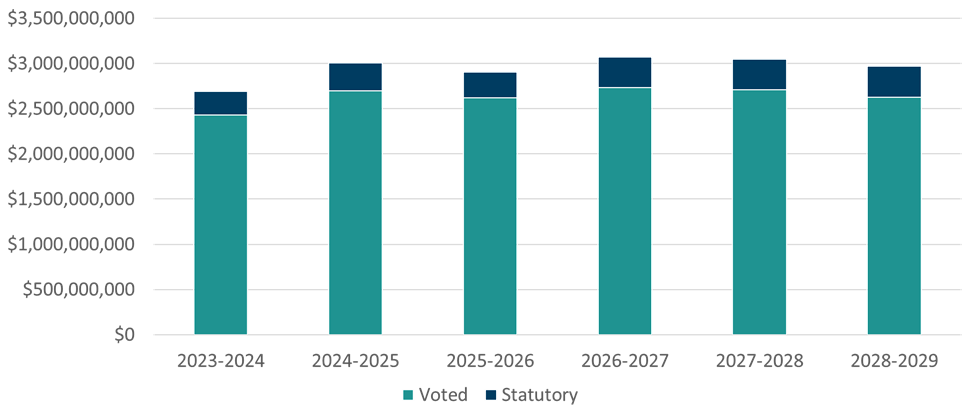
Text version of Graph 1:
Graph 1 includes the following information in a bar graph:
Fiscal year |
Statutory ($) |
Voted ($) |
Total ($) |
|---|---|---|---|
2023 to 2024 |
262,629,524 |
2,431,281,627 |
2,693,911,151 |
2024 to 2025 |
309,338,076 |
2,699,594,883 |
3,008,932,959 |
2025 to 2026 |
285,911,004 |
2,621,000,429 |
2,906,911,433 |
2026 to 2027 |
338,365,259 |
2,731,530,318 |
3,069,895,577 |
2027 to 2028 |
340,243,176 |
2,709,659,303 |
3,049,902,479 |
2028 to 2029 |
342,895,539 |
2,625,550,100 |
2,968,445,639 |
Analysis of statutory and voted funding over a six-year period
Please refer to the earlier explanations provided for Table 19 (analysis of the past three years of spending) and Table 20 (analysis of the next three years of spending).
Consult the Public Accounts of Canada for further information on the CBSA's departmental voted and statutory expenditures.
Financial statement highlights
The CBSA's financial statements (unaudited) for the year ended are available online.
For financial reporting purposes, the CBSA's activities are divided into two sets of financial statements:
- Agency Activities, comprising the operational revenues and expenses that are managed by the CBSA and utilized in operating the organization.
- Administered Activities, comprising tax and non-tax revenues, assets and liabilities administered on behalf of federal, provincial and territorial governments.
One reason for the distinction between Agency Activities and Administered Activities is to facilitate the assessment of the CBSA's administrative efficiency in delivering on its mandate.
The Departmental Financial Statements are prepared on an accrual accounting basis in accordance with the Treasury Board Directive on Accounting Standards: GC 4500 Departmental Financial Statements, and include non-cash transactions. Financial information provided in other sections of this report is cash-based (planned and actual spending) and is tied to annual parliamentary appropriations (authorities).
Agency Activities
Table 22: Agency Activities – Condensed Statement of Operations (unaudited) for the year ended (dollars)
Table 22 below summarizes the expenses and revenues for the 2025 to 2026 fiscal year, which net to the cost of operations before government funding and transfers.
Financial information |
2025 to 2026 actual results |
2025 to 2026 planned results |
Difference (actual results minus planned) |
|---|---|---|---|
Total expenses |
3,261,704,000 |
2,983,297,000 |
278,407,000 |
Total revenues |
32,204,000 |
29,030,000 |
3,174,000 |
Net cost of operations before government funding and transfers |
3,229,500,000 |
2,954,267,000 |
275,233,000 |
Analysis of expenses and revenues for 2025 to 2026
Total expenses were $278.4 million (9.3%) more than planned as a result of the additional funding provided to the CBSA so that it can continue to deliver on its mandate. Total revenues were $3.1 million (10.9%) more than planned, mainly due to the increase in other fees and charges.
The planned results information for fiscal year 2025 to 2026 is provided in the CBSA’s related Future-Oriented Statement of Operations and Notes.
Table 23: Agency Activities – Condensed Statement of Operations (unaudited) for 2024 to 2025 and 2025 to 2026 (dollars)
Table 23 below summarizes actual expenses and revenues and shows the net cost of operations before government funding and transfers.
Financial information |
2025 to 2026 actual results |
2024 to 2025 actual results |
Difference (2025 to 2026 minus 2024 to 2025) |
|---|---|---|---|
Total expenses |
3,261,704,000 |
3,273,380,000 |
(11,676,000) |
Total revenues |
32,204,000 |
37,700,000 |
(5,496,000) |
Net cost of operations before government funding and transfers |
3,229,500,000 |
3,235,680,000 |
(6,180,000) |
Analysis of differences in expenses and revenues between 2024 to 2025 and 2025 to 2026
Total expenses in fiscal year 2025 to 2026 are $11.7 million (0.4%) lower than actuals for the previous fiscal year. This decrease is mainly due to the decrease in salaries and employee future benefits of $162.7 million offset by an increase in the provision for environmental and contingent liabilities of $80.2 million, an increase in the amortization of tangible capital assets of $33.2 million, and an increase in professional and special services of $19.2 million. To further explain these figures:
- The $162.7 million decrease in salaries and employee future benefits is the result of collective agreements signed in fiscal year 2024 to 2025 and consequent retro pay.
- The $33.2 million increase in amortization of tangible capital assets is mainly a result of increased amortization in informatics software developed in-house.
- The $19.2 million increase in professional and special services is the result of a $22.3 million increase in building protection services.
Total revenues in fiscal year 2025 to 2026 decreased by $5.5 million (14.6%) mainly as a result of a $6.1 million decrease in NEXUS program revenues.
Table 24: Agency Activities – Condensed Statement of Financial Position (unaudited) as at (dollars)
Table 24 below provides a brief snapshot of the amounts that the CBSA owes or must spend (liabilities) and its available resources (assets), which helps to indicate its ability to carry out programs and services.
Financial information |
Actual fiscal year 2025 to 2026 |
Previous fiscal year 2024 to 2025 |
Difference (2025 to 2026 minus 2024 to 2025) |
|---|---|---|---|
Total net liabilities |
538,737,000 |
513,519,000 |
25,218,000 |
Total net financial assets |
244,841,000 |
322,414,000 |
(77,573,000) |
Departmental net debt |
293,896,000 |
191,105,000 |
102,791,000 |
Total non-financial assets |
1,198,507,000 |
1,169,045,000 |
29,462,000 |
Departmental net financial position |
904,611,000 |
977,940,000 |
(73,329,000) |
Analysis of departmental liabilities and assets since last fiscal year
The increase of $25.2 million (4.9%) in total net liabilities is mainly due to an $89.4 million increase in the provision for claims and litigation offset by a $60.6 million decrease in accounts payable and accrued liabilities.
The decrease of $77.6 million (24.1%) in total net financial assets is attributable to a decrease of $83.8 million due from the Consolidated Revenue Fund, which is mainly due to timing differences between the charging of authorities and the disbursement or receipt of funds.
The increase of $29.5 million (2.5%) in total non-financial assets can be mainly explained by a $17.0 million increase in net book value of machinery and equipment and a $5.2 million increase in net book value of informatics hardware.
The decrease of $73.3 million (7.5%) in net financial position reflects the changes in assets and liabilities.
Administered Activities
Table 25: Administered Activities – Condensed Statement of Administered Revenues (unaudited) for the year ended (dollars)
Table 25 below provides a brief snapshot of the CBSA's administered revenues for the actual fiscal year compared to the previous fiscal year.
Financial information |
Actual fiscal year 2025 to 2026 |
Previous fiscal year 2024 to 2025 |
Difference (2025 to 2026 minus 2024 to 2025) |
|---|---|---|---|
Tax revenues |
44,765,904,000 |
41,696,912,000 |
3,068,992,000 |
Non-tax revenues |
88,071,000 |
117,831,000 |
(29,760,000) |
Bad debt expense |
273,076,000 |
(398,000) |
273,474,000 |
Net results |
44,580,899,000 |
41,815,141,000 |
2,765,758,000 |
Analysis of administered revenues since last fiscal year
Note that, unlike the Condensed Statement of Operations (Agency Activities), the Condensed Statement of Administered Revenues (Administered Activities) does not include planned results as it is not subject to the Treasury Board Directive on Accounting Standards: GC 4500 Departmental Financial Statements.
Total revenues reported within the Administered Activities financial statements were $44.6 billion for fiscal year 2025 to 2026, an increase of $2.8 billion (6.6%) over the total revenues of $41.8 billion for the previous fiscal year. This increase is mainly due to the assessment of surtaxes on certain goods of United States origin since .
Table 26: Administered Activities – Condensed Statement of Administered Assets and Liabilities (unaudited) as at (dollars)
Table 26 below provides a brief snapshot of the CBSA's administered assets and liabilities for the actual fiscal year compared to the previous fiscal year.
Financial information |
Actual fiscal year 2025 to 2026 |
Previous fiscal year 2024 to 2025 |
Difference (2025 to 2026 minus 2024 to 2025) |
|---|---|---|---|
Total administered assets |
5,443,242,000 |
6,060,540,000 |
(617,298,000) |
Total administered liabilities |
794,512,000 |
627,264,000 |
167,248,000 |
Net amount due to the Consolidated Revenue Fund |
4,648,730,000 |
5,433,276,000 |
(784,546,000) |
Total administered liabilities and net amount due to the Consolidated Revenue Fund |
5,443,242,000 |
6,060,540,000 |
(617,298,000) |
Analysis of administered assets and liabilities since last fiscal year
Total administered assets in fiscal year 2025 to 2026 have shown a decrease of 10.2% compared to the previous fiscal year, which is attributed to the timing of the collection of accounts receivable from external parties and related deposits to the Consolidated Revenue Fund.
Total administered liabilities in fiscal year 2025 to 2026 have shown an increase of 26.6% compared to the previous fiscal year, which is mainly attributed to the increase of cash and securities received from importers to guarantee payment of excise taxes and customs duties on imported goods.
Human resources
This section presents an overview of the CBSA's actual and planned human resources from fiscal year 2023 to 2024 through fiscal year 2028 to 2029.
Table 27: Actual human resources for core responsibilities and internal services for the last three fiscal years
Table 27 below shows a summary in full-time equivalents of human resources for the CBSA's core responsibilities and internal services for the previous three fiscal years.
Core responsibilities and internal services |
2023 to 2024 actual full-time equivalents |
2024 to 2025 actual full-time equivalents |
2025 to 2026 actual full-time equivalents |
|---|---|---|---|
Border management |
11,075 |
11,404 |
11,445 |
Border enforcement |
2,150 |
2,170 |
2,293 |
Subtotal |
13,225 |
13,574 |
13,738 |
Internal services |
3,245 |
3,316 |
2,857 |
Total |
16,470 |
16,890 |
16,595 |
Analysis of human resources for the last three fiscal years
Between fiscal year 2023 to 2024 and fiscal year 2025 to 2026, the CBSA's workforce increased by 125 full-time equivalents. This growth reflects the expansion of operational capacity required to address increased travel and trade volumes, evolving migration pressures, and the implementation of Canada's Border Plan.
This growth in human resources supported initiatives to modernize and sustain border operations, strengthen frontline capacity, and improve processing times for temporary resident applications. Additional resources were dedicated to the asylum and irregular migration system, and to major infrastructure initiatives such as the Gordie Howe International Bridge and the Land Border Crossing Project. This growth in human resources also supported enforcement and regulatory functions, including trade remedy activities, financial crime detection, and upgrades to Immigration Holding Centres.
Planned human resources for next three years
Table 28: Human resources planning summary for core responsibilities and internal services for the next three fiscal years
Table 28 below shows the planned full-time equivalents for the CBSA's core responsibilities and internal services for the next three fiscal years. Human resources for the current fiscal year are forecasted based on year to date.
Core responsibilities and internal services |
2026 to 2027 planned full-time equivalents |
2027 to 2028 planned full-time equivalents |
2027 to 2028 planned full-time equivalents |
|---|---|---|---|
Border management |
13,235 |
13,448 |
13,708 |
Border enforcement |
2,476 |
2,410 |
2,351 |
Subtotal |
15,711 |
15,858 |
16,059 |
Internal services |
2,288 |
2,287 |
2,290 |
Total |
17,999 |
18,145 |
18,349 |
Analysis of human resources for the next three fiscal years
The growth in the CBSA's planned human resource levels is mainly attributable to new investments announced in Budget 2025 to reinforce Canada's borders. This increase is partially offset by reductions under the Comprehensive Expenditure Review, corresponding to a planned decrease of approximately 200 full-time equivalents. Overall, planned human resource levels balance fiscal restraint measures with targeted investments to maintain operational readiness and support key government priorities at Canada's borders.
Supplementary information tables
The following supplementary information tables are available on CBSA's website:
Federal tax expenditures
The tax system can be used to achieve public policy objectives through the application of special measures such as low tax rates, exemptions, deductions, deferrals and credits. The Department of Finance Canada publishes cost estimates and projections for these measures each year in the Report on Federal Tax Expenditures. This report also provides detailed background information on tax expenditures, including descriptions, objectives, historical information and references to related federal spending programs, as well as evaluations and GBA Plus of tax expenditures.
Corporate information
Departmental profile
Appropriate minister(s):
The Honourable Gary Anandasangaree, P.C., K.C., M.P.
Institutional head:
Erin O'Gorman
Ministerial portfolio:
Public Safety
Enabling instrument(s):
Canada Border Services Agency Act
Department of Public Safety and Emergency Preparedness Act
Year of incorporation / commencement:
Departmental contact information
The CBSA's contact information is available on its website.
Definitions
List of terms
- appropriation (crédit)
- Any authority of Parliament to pay money out of the Consolidated Revenue Fund.
- budgetary expenditures (dépenses budgétaires)
- Operating and capital expenditures; transfer payments to other levels of government, departments or individuals; and payments to Crown corporations.
- core responsibility (responsabilité essentielle)
- An enduring function or role of a department. The departmental results listed for a core responsibility reflect the outcomes that the department seeks to influence or achieve.
- Departmental Plan (plan ministériel)
- A report that outlines the anticipated activities and expected performance of an appropriated department over a three-year period. Departmental Plans are usually tabled in Parliament in the spring.
- departmental priority (priorité)
- A plan, project or activity that a department focuses and reports on during a specific planning period. Priorities represent the most important things to be done or those to be addressed first to help achieve the desired departmental results.
- departmental result (résultat ministériel)
- A high-level outcome related to the core responsibilities of a department.
- departmental result indicator (indicateur de résultat ministériel)
- A quantitative or qualitative measure that assesses progress toward a departmental result.
- Departmental Results Framework (cadre ministériel des résultats)
- A framework that connects the department's core responsibilities to its departmental results and departmental result indicators.
- Departmental Results Report (rapport sur les résultats ministériels)
- A report outlining a department's accomplishments against the plans, priorities and expected results set out in the corresponding Departmental Plan.
- Full-time equivalent (équivalent temps plein)
- Measures the person years in a departmental budget. An employee's scheduled hours per week divided by the employer's hours for a full-time workweek calculates a full-time equivalent. For example, an employee who works 20 hours in a 40-hour standard workweek represents a 0.5 full-time equivalent.
- Gender-based Analysis Plus (GBA Plus) (analyse comparative entre les sexes plus [ACS Plus])
- An analytical tool that helps to understand the ways diverse individuals experience policies, programs and other initiatives. Applying GBA Plus to policies, programs and other initiatives helps to identify the different needs of the people affected, the ways to be more responsive and inclusive, and the methods to anticipate and mitigate potential barriers to accessing or benefitting from the initiative. GBA Plus goes beyond biological (sex) and socio-cultural (gender) differences to consider other factors, such as age, disability, education, ethnicity, economic status, geography (including rurality), language, race, religion, and sexual orientation.
- government priorities (priorités pangouvernementales)
- For the purpose of the 2025 to 2026 Departmental Results Report, government priorities are the high-level themes outlining the government's agenda as announced in the 2025 Speech from the Throne.
- horizontal initiative (initiative horizontale)
- A program, project or other initiative where two or more federal departments receive funding to work collaboratively on a shared outcome usually linked to a government priority, and where the ministers involved agree to designate it as horizontal. Specific reporting requirements apply, including that the lead department must report on combined expenditures and results.
- Indigenous business (entreprise autochtones)
- For the purposes of a Departmental Result Report, this includes any entity that meets the Indigenous Services Canada's criteria of being owned and operated by Elders, band and tribal councils, registered in the Indigenous Business Directory or registered on a modern treaty beneficiary business list.
- non‑budgetary expenditures (dépenses non budgétaires)
- Net outlays and receipts related to loans, investments and advances, which change the composition of the financial assets of the Government of Canada.
- performance (rendement)
- What a department did with its resources to achieve its results, how well those results compare to what the department intended to achieve, and how well lessons learned have been identified.
- performance indicator (indicateur de rendement)
- A qualitative or quantitative measure that assesses progress toward a departmental-level or program-level result, or the expected outputs or outcomes of a program, policy or initiative.
- plan (plan)
- The articulation of strategic choices, which provides information on how a department intends to achieve its priorities and associated results. Generally, a plan will explain the logic behind the strategies chosen and tend to focus on actions that lead to the expected result.
- planned spending (dépenses prévues)
- For Departmental Plans and Departmental Results Reports, planned spending refers to the amounts presented in Main Estimates. Departments must determine their planned spending and be able to defend the financial numbers presented in their Departmental Plans and Departmental Results Reports.
- program (programme)
- An Individual, group, or combination of services and activities managed together within a department and focused on a specific set of outputs, outcomes or service levels.
- program inventory (répertoire des programmes)
- A listing that identifies all the department's programs and the resources that contribute to delivering on the department's core responsibilities and achieving its results.
- result (résultat)
- An outcome or output related to the activities of a department, policy, program or initiative.
- statutory expenditures (dépenses législatives)
- Spending approved through legislation passed in Parliament, other than appropriation acts. The legislation sets out the purpose and the terms and conditions of the expenditures.
- target (cible)
- A quantitative or qualitative, measurable goal that a department, program or initiative plans to achieve within a specified time period.
- voted expenditures (dépenses votées)
- Spending approved annually through an appropriation act passed in Parliament. The vote also outlines the conditions that govern the spending.
Page details
- Date modified: