
Annual Report to Parliament on the Access to Information Act: 2024 to 2025
Chapter one: Access to Information Act report
Introduction
The Canada Border Services Agency (CBSA) is pleased to present to Parliament, in accordance with section 94 of the Access to Information Act (the ATIA) and section 20 of the Services Fees Act, its annual report on the management of these Acts. The report describes the activities that support compliance with the ATIA for the period of , and ending .
The purpose of the ATIA is to enhance the accountability and transparency of federal institutions in order to promote an open and democratic society and to enable public debate on the conduct of those institutions. To further that purpose:
- part 1 extends the present laws of Canada to provide a right of access to information in records under the control of a government institution in accordance with the principles that government information should be available to the public, that necessary exceptions to the right of access should be limited and specific, and that decisions about the disclosure of government information should be reviewed independently of government
- part 2 sets out the requirements for the proactive publication of informationFootnote 1
As stated in subsections 94(1) and (2) of the ATIA, "Every year the head of every government institution shall prepare a report on the administration of this Act within the institution during the period beginning on of the preceding year and ending on of the current year… Every report prepared under subsection (1) shall be laid before each House of Parliament on any of the first 15 days on which that House is sitting after of the year in which the report is prepared."Footnote 1
Organization
1. About the Canada Border Services Agency
The CBSA has been an integral part of the Public Safety Canada portfolio since . It is responsible for protecting Canadians and maintaining a peaceful and safe society by providing integrated border services that support national security and public safety priorities and facilitate the free flow of persons and goods, including animals and plants, that meet all requirements under the program legislation.Footnote 2
The CBSA carries out its responsibilities with a workforce of approximately 16,500 employees, including over 8,600 frontline CBSA officers who provide services at approximately 1,200 points across Canada and at 36 international locations.
2. Information sharing, Access to Information and Chief Privacy Office
In accordance with section 95 of the ATIA, the head of a government institution may, by order, delegate any of their powers, duties or functions under this Act to one or more officers or employees of that institution. This includes specific powers and functions to employees within the CBSA's Information Sharing, Access to Information, and Chief Privacy Office.
A copy of the Delegation Order is provided in Annex A.
Positioned within two levels of the President and with direct report to the Vice-President of the Communications, Parliamentary and Public Affairs Branch, the Director General of the Information Sharing, Access to Information, and Chief Privacy Office, acts as the departmental Chief Privacy Officer with full delegated authority to administer and coordinate the ATIA and the Privacy Act.
The Information Sharing, Access to Information, and Chief Privacy Office's primary role is to ensure that the CBSA is compliant with the requirements of the Privacy Act, ATIA, Customs Act, Security of Canada Information Disclosure Act (SCIDA), and the Avoiding Complicity in Mistreatment by the Foreign Entities Act (ACMFEA). This includes, but is not limited to, providing functional guidance and internal services pertaining to access rights, personal information handling practices, privacy impact assessments, disclosure, and privacy breaches.
The Information Sharing, Access to Information, and Chief Privacy Office builds upon relevant government policies, regulations, and guidelines to bring agency-wide awareness on privacy principles and is the CBSA's main point of contact for the Office of the Privacy Commissioner and the Office of the Information Commissioner.
Managed by the Director General with the support of two directors, the workforce is divided into two main groups comprised of seven units: one Intake team, three Case Management units, and three Policy units:
- The Intake team receives all incoming requests and consultations, ensures quality control of all outgoing correspondence, and supports the Case Management units in their day-to-day business.
- The Case Management units assign branches and regions with retrieval requests, process requests for information under the ATIA, and provide daily operational guidance and support to CBSA employees.
- The Access to Information and Privacy (ATIP) Policy and Support Unit develops policies, tools, and procedures to support ATIP requirements within the CBSA and provides training to employees. The unit is also responsible for handling complaints related to ATIP requests.
- The Privacy Compliance and Governance Unit is responsible for conducting privacy impact assessments and compliance reviews, managing privacy breach reporting and response, providing expert advice on privacy requirements, and supporting internal governance and accountability mechanisms to ensure alignment with applicable privacy legislation.
- The Information Sharing and Collaborative Arrangements Policy (ISCAP) Unit provides policy and front line support related to information sharing activities and initiatives. The unit also provides functional guidance on the development and implementation of Written Collaborative Arrangements with Domestic and International partners. ISCAP is also responsible for the development and maintenance of associated policies and guidelines.
During fiscal year to , the Information Sharing, Access to Information, and Chief Privacy Office employed 118 full time equivalents and 24 part time, casual, and student employees.
To support the overall departmental compliance with the ATIA and Privacy Act, the Information Sharing, Access to Information, and Chief Privacy Office seeks advice on legal, public affairs, policy, and operational security matters from other organizations and specialists as required, and consults internally with other CBSA branches and program areas.
Having access to corporate databases and information management systems is key to maintaining compliance with the statutory time requirements of the ATIA. The Information Sharing, Access to Information, and Chief Privacy Office's ability to efficiently obtain records directly from the Global Case Management System, Field Operations Support System, Cognos, Integrated Customs Enforcement System, and the National Case Management System has allowed the CBSA to process a combined total of 60,000 requests.
Furthermore, supported by a network of ATIP liaison officers embedded within 19 offices of primary interest across the regions and branches of the CBSA, the Information Sharing, Access to Information, and Chief Privacy Office is optimally positioned to receive, coordinate, and process requests for information under the ATIA.
Lastly, to share best practices and develop streamlined processes for the retrieval of jointly held records within the 30-day legislated timeframe, the office works closely with the other agencies of the Public Safety portfolio, which include the Canadian Security Intelligence Service, the Correctional Service of Canada, the Parole Board of Canada, and the Royal Canadian Mounted Police.
Activities and accomplishments
1. Performance
Despite challenges, including the unexpected outage of the case management system in , which continued into fiscal year 2024 to 2025, the CBSA was committed to maintaining service delivery. Significant effort was dedicated to recovering affected files and stabilizing operations to ensure continued support to requesters.
As part of the ongoing efforts to modernize and improve service efficiency, the CBSA implemented ATIPXpress, a case management solution made available through a government-wide procurement process. While the system offered some improvements, its configuration did not fully align with the operational needs of the CBSA and did not offer the anticipated efficiency gains original sought. As a result, the transition to AMANDA, which is the new version of CBSA's current ATIP case management system, is presently underway, with implementation and deployment targeted for completion by the end of fiscal year 2025 to 2026.
In pursuing the modernization of its ATIP program, the CBSA continued to develop the use of Robotic Process Automation (RPA) tools as part of its strategy to improve operational efficiency. The CBSA have five (5) active RPA tools which resulted in measurable efficiency gains equivalent to 25 Full-Time Equivalent positions, allowing the CBSA to reallocate resources to more complex tasks and enhance service delivery.
Lastly, pursuant to section 96 of the ATIA, the CBSA has not provided, nor received, services related to any power, duty or function conferred or imposed on the CBSA under the ATIA to or from another government institution that is under the responsibility of the Minister of Public Safety and Emergency Preparedness.
2. Education and training
In fiscal year to , the Information Sharing, Access to Information, and Chief Privacy Office continued to provide support and guidance to CBSA employees, adapt to numerous changes, and explore alternative measures to delivery. Specifically, the Office delivered 11 Access to Information and Privacy sessions to over 450 employees. These training sessions are designed to ensure that the participants fully understand their responsibilities under the ATIA and the Privacy Act, with a focus on requests made pursuant to the Acts and the duty to assist principles.
The Canada School of Public Service's Access to Information and Privacy Fundamentals (COR502) course also remained on the CBSA list of mandatory training. The course must be successfully completed, within six months of joining the CBSA, by all persons employed by the CBSA on a full-time, part-time, or seasonal basis and who occupy an indeterminate, term, casual, or student position.
Moreover, 5 in-person and virtual information sharing training sessions on the disclosure of personal information pursuant to section 107 of the Customs Act, section 8 of the Privacy Act, and other relevant legislation were delivered to over 100 CBSA employees located in headquarters and regional offices. As a prerequisite, the CBSA also developed an information sharing introductory online course.
To raise employees' awareness of their obligations under the ATIA and promote ATIP tools and resources, the CBSA continued to leverage the daily newsletter to communicate important information with employees.
The CBSA, as represented by the Chief Privacy Office, holds a membership to the ATIP Community Development Office (APCDO) and is an active participant in the Treasury Board of Canada Secretariat-led ATIP coordinators, ATIP practitioners, ADM Access to information and openness committee (ATIO), and ATIP Community meetings. These meetings provide opportunities for employees of the Office to liaise with colleagues from other institutions to discuss various issues and challenges that have been identified by the ATIP community.
3. New and revised Access to Information Act policies and procedures
During the reporting period, the CBSA did not implement any new or revised institution-specific policies, guidelines, or written procedures related to the ATIA. However, the CBSA continued to apply and uphold existing policies and procedures to ensure compliance with the ATIA and related Treasury Board of Canada Secretariat.
As required by the Directive on the Administration of the ATIA and as part of the open government initiative, the CBSA continued to post monthly summaries of completed access to information requests on the Government of Canada's mandated websiteFootnote 3. These requests do not include personal information or any other information that would be exempted or excluded under the ATIA or that could reveal a requester's identity.
In addition, the CBSA has continued to fulfil its legal requirements under the ATIA to proactively publish a broad range of information for the purposes of Part 2 of the ATIA.Footnote 4 These proactive publications include titles of briefing notes received by ministers and deputy heads; briefing packages for new or incoming ministers and deputy heads; briefing packages for Parliamentary Committee appearances by ministers and deputy heads; reports tabled in Parliament, and Question Period Notes.
The CBSA is responsible for proactively disclosing briefing note titles and ATIA Summary Reports, which are made available within the legislated timelines, and continued to informally review CBSA records for internal programs with the intention to proactively disclose as though they had been requested under the ATIA.
As previously stated, the CBSA falls under the Public Safety Portfolio. Accordingly, Public Safety is responsible for proactively publishing QPNs on behalf of the CBSA on the open government website.Footnote 5
The CBSA is also subject to sections 82 to 88 of the ATIA; however such responsibilities fall under the purview of other CBSA directorates. To ensure compliance with existing policy as well as new legal requirements, the CBSA continued to publish travel and hospitality expenses incurred by selected government officials; contracts over $10,000; information concerning the reclassification of occupied positions within the CBSA, and annual reports.
The CBSA has and continues to meet the requirement to proactively publish government information, per Part 2 of the ATIA, in an effort to promote transparency, openness, and accountability.
The CBSA closely monitors the time it takes to process access to information requests. Monthly reports, which show trends and performance, are submitted to the Director General and Chief Privacy Officer as well as the Director and Assistant Directors, within the Case Management division. Quarterly compliance reports, which provide performance statistics for the offices of primary interest, are also shared with Vice Presidents and Regional Director Generals to keep them informed of their Branch or Region's compliance status.
The CBSA remains committed to upholding its duty to assist and ensuring the public's right of access is respected. Guided by its core values of service, integrity, and protection, the CBSA will continue to implement strategic and innovative approaches that reinforce transparency, accountability, and trust in government operations.
4. Reading room
The CBSA, in accordance with the ATIA, maintains a reading room for applicants who wish to review material in person. Access to the reading room can be requested by contacting the CBSA's Information Sharing, Access to Information, and Chief Privacy Office by telephone at 343-291-7021 or email at atip-aiprp@cbsa-asfc.gc.ca. The reading room is located at:
Place Vanier Complex, 14th Floor, Tower A
333 North River Road
Ottawa, Ontario K1A 0L8
5. Audits of, and investigations into the access to information practices of the Canada Border Services Agency
Two major systemic investigations were initiated by the Office of the Information Commissioner (OIC) of Canada during fiscal year 2024 to 2025.
The ATIA provides under subsection 30(3) that the Information Commissioner may initiate a complaint if there are reasonable grounds to investigate a matter relating to requesting or obtaining access to records. Accordingly, the OIC launched an ongoing systemic investigation into matters related to requesting and obtaining access to records regarding ArriveCAN for the period of , and . As of the end of the fiscal year 2024 to 2025, the OIC has not completed their investigation.
Due to a high number of complaints alleging that the CBSA failed to respond within the time limits set out in the ATIA to access requests for records related to immigration application information, in , the Information Commissioner initiated a second systemic investigation to better understand and address the root cause of the issue.
In , the Information Commissioner informed the Minister of Public Safety and Emergency Preparedness of her finding's. Based on an examination of the CBSA's inventory of complaints as well as information received, the Information Commissioner found:
- "As IRCC's implementation of its action plan is out of CBSA's control, CBSA should expect that immigration clients will continue to seek access to immigration application information by making access requests for the foreseeable future.
- The number of requests and complaints is high and must be addressed.
- CBSA has invested in a multi-pronged approach to ensuring its ATIP team has adequate resources and efficient processes to meet the high demand for its services yet only time will tell if these measures are sufficient to meet the demand for immigration application information."Footnote 6
The Information Commissioner made the following recommendations: (1) Develop Robotic Process Automation (RPA) tools to improve efficiency, (2) Improve the consistent application of minimal exemptions by collaborating with IRCC and CSIS, (3) Collaborate with IRCC and other partners to ensure best practices are adopted in a timely manner, (4) Secure adequate funding and human resources for the CBSA ATIP office to meet its legal obligations under the Act, and ultimately eliminate its backlog of access requests.
The CBSA agreed with the recommendations made by the Information Commissioner and notes that the proposed measures were already implemented. The CBSA remains committed to these ongoing efforts and has continued to advance the following initiatives:
- 1. Develop Robotic Process Automation (RPA) tools to improve efficiency
- In line with the Information Commissioner's recommendation, as previously mentioned, the CBSA has continued the development of Robotic Process Automation tools as part of its strategy to improve operational efficiency. In alignment with this approach, the CBSA developed three additional Robotic Process Automation tools, allowing the CBSA to reallocate resources to more complex tasks and enhance service delivery.
- 2. Improve the consistent application of minimal exemptions by collaborating with IRCC and CSIS
- In line with the Information Commissioner's recommendation, the CBSA has maintained a sustained effort to apply exemptions in a minimal and consistent manner. The Canada Border Services Agency has continued to collaborate regularly with Immigration, Refugees and Citizenship Canada (IRCC) and the Canadian Security Intelligence Service (CSIS) to promote a shared understanding and alignment in exemption practices. These efforts have contributed to a reduction in exemption-related complaints and improved the transparency and consistency of responses.
- 3. Collaborate with IRCC and other partners to ensure best practices are adopted in a timely manner
- The CBSA has long recognized the value of interdepartmental collaboration in advancing best practices. As part of this ongoing commitment, the CBSA continues to engage in regular meetings with the IRCC and other partners to exchange knowledge and align on effective practices for processing access to information requests. These collaborations have strengthened consistency across departments and supported innovation in service delivery.
The Information Commissioner also recommended that the Minister secure adequate funding and human resources for the CBSA ATIP office to meet its legal obligations under the Act, and ultimately eliminate its backlog of access requests.
Consistent with internal assessments and ongoing modernization efforts, the CBSA allocated an additional $2.1 million to the ATIP Case Management Division. This investment has enhanced the CBSA's capacity to meet legislative obligations and process requests in a timely manner.
Chapter two: Statistical report
Statistical report on the Access to Information Act
Refer to Annex B for the CBSA's statistical report on the Access to Information Act.
Interpretation of the statistical report
1. Requests processed under the Access to Information Act
In fiscal year to , the CBSA received 1,765 new ATIA requests, representing an 86.71% decrease from the previous reporting period. This notable decline is primarily due to the implementation of the Treasury Board of Canada Secretariat's online request platform, the ATIP Online Request Service (AORS).
The AORS portal is designed to guide requesters through a streamlined intake process by first asking what type of information they are seeking. If a requester indicates they are seeking records about themselves, the system redirects them to submit a request under the Privacy Act rather than the ATIA. As a result of this logic-based routing, a significant number of requests that would previously have been submitted under the ATIA were instead redirected and processed under the PA in this reporting year.
Although the number of ATIA requests received has decreased, the overall volume of requests submitted to the CBSA remains substantial, with many now being processed under the Privacy Act due to the nature of the information being sought and the structure of the AORS.
A total of 2,195 requests were completed during fiscal year 2024 to 2025. Evidently, the number of requests completed for fiscal year 2024 to 2025 shows a substantial decline compared to last year's report; however, when measured against the number of requests received during the same reporting period, the number of completed requests exceeds the number of requests received.
For the past five years, the CBSA has consistently ranked among the top federal institutions in terms of the volume of ATIA requests received and processed. While we recognize a recent decline in our on-time response rate, this is largely attributable to our deliberate efforts to address longstanding backlog files, as well as increasing complexity of the remaining requests received via the ATIA. As compliance rates are measured based on the requests closed during the reporting period, the closure of older files negatively affect our compliance rate. Nevertheless, this strategic effort to reduce the backlog demonstrates the CBSA's continued commitment to transparency and service improvement, while actively implementing measures to regain previous performance levels moving forward.
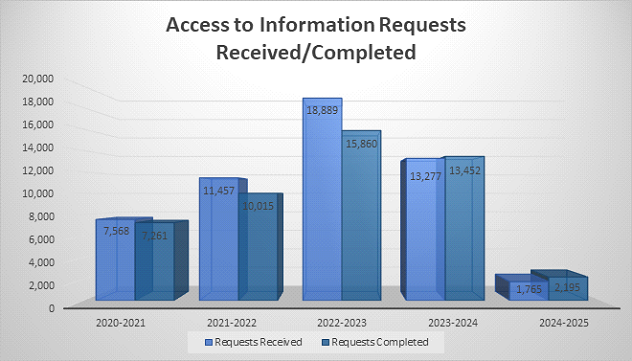
Text description
| Fiscal year | Requests received | Requests completed |
|---|---|---|
| 2020 to 2021 | 7,568 | 7,261 |
| 2021 to 2022 | 11,457 | 10,015 |
| 2022 to 2023 | 18,889 | 15,860 |
| 2023 to 2024 | 13,277 | 13,452 |
| 2024 to 2025 | 1,765 | 2,195 |
2. Completion time
The chart below presents the response times for the 2,195 requests that the CBSA completed during this fiscal year. Please consult Annex B for the full details.
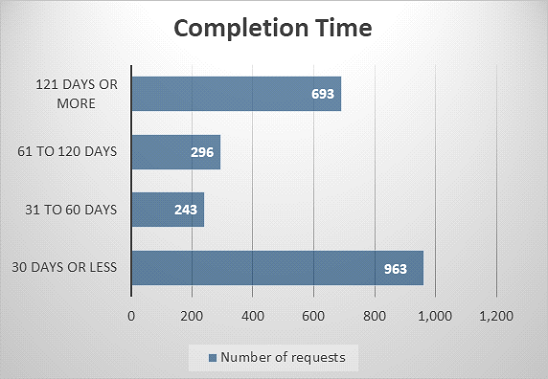
Text description
| Number of days | Number of requests |
|---|---|
| 121 or more | 693 |
| 61 to 120 | 296 |
| 31 to 60 | 243 |
| 30 or less | 963 |
The chart below provides an overview of the disposition of these completed requests. Please consult Annex B for the full details.
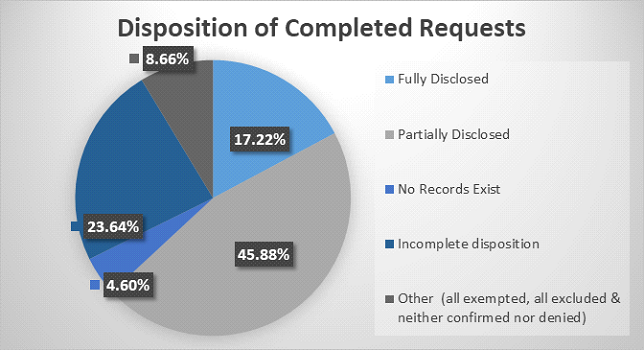
Text description
| Category | Percentage (%) |
|---|---|
| Fully disclosed | 17.22% |
| Partially disclosed | 45.88% |
| No records exist | 4.60% |
| Request abandoned | 23.64% |
| Other | 8.66% |
Out of the 2,195 completed requests, 378 records, representing 38.60% of requests, were fully disclosed and 1,007, representing 45.88% of requests, were partially disclosed.
As per the TBS Privacy Implementation Notice 2022-02: Identity Verification for Personal Information Requests, the CBSA is required to request and verify Identity (ID) documents of requesters to ensure adequate privacy protection of the personal information under its control prior to disclosure. As a result, the CBSA has implemented an "Incomplete disposition" to track and report on requests that are lacking the required documentation for ID verification. Specifically, 354 of the 519 incomplete requests received by the CBSA during the year were missing ID documentation, which represents 68.21% of all incomplete requests.
3. Extensions
During the fiscal year 2024 to 2025, a total of 585 extensions were applied. The chart below provides the reasons for extensions and disposition of requests during the 2024 to 2025 reporting period. Please consult Annex B for the full details.
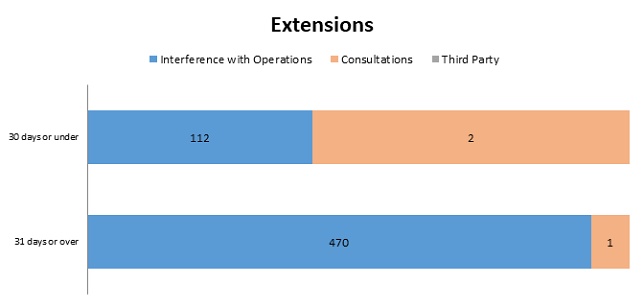
Text description
| Reason | 30 days or under | 31 days or over |
|---|---|---|
| Interference with operations | 112 | 470 |
| Consultations | 2 | 1 |
| Third party notice | 0 | 0 |
4. Consultations received from other institutions and organizations
The chart below provides an overview of the consultations received from other government institutions and organizations during the fiscal year 2024 to 2025. During this fiscal year, the CBSA completed 478 consultation requests from other institutions and organizations.
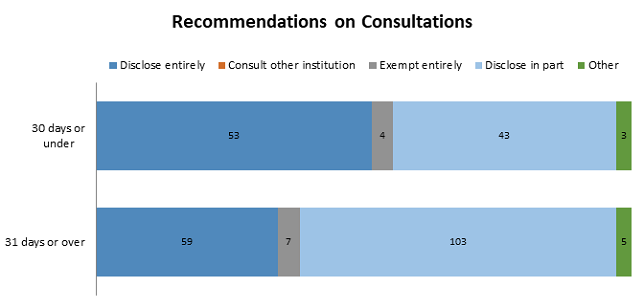
Text description
| Recommendation | 30 days or under | 31 days or over |
|---|---|---|
| Disclose entirely | 53 | 59 |
| Consult other institution | 0 | 0 |
| Exempt entirely | 4 | 7 |
| Disclose in part | 43 | 103 |
| Other | 3 | 5 |
5. Completion time of consultations on Cabinet confidences
Although Cabinet Confidences are excluded from the application of the ATIA (section 69), Treasury Board of Canada Secretariat policies require agencies and departments to consult their legal services to determine if requested information should be excluded. In case of any doubt, or if the records contain discussion papers, legal counsel must consult the Office of the Counsel to the Clerk of the Privy Council Office (PCO).
In fiscal year 2024 to 2025, the CBSA did not consult CBSA Legal services regarding Cabinet confidence exclusions, due to the fact that many requesters are excluding Cabinet confidences from their requests.
6. Complaints and investigations
Subsection 30(1) of the ATIA describes how the Office of the Information Commissioner receives and investigates complaints from individuals regarding the information held by a government institution. Examples of complaints the Office of the Information Commissioner may choose to investigate include refusal to disclose records, missing information, or failure to provide information in the official language requested by the individual.
In fiscal year 2024 to 2025, a noticeable decrease in the number of complaints was observed compared to the previous years. More precisely, in fiscal year 2024 to 2025, the CBSA received 161 complaints, which represent 9.12% of the 1,765 access to information requests received.
While the complaints originated from various parties, the CBSA received 586 complaints from immigration consultants in fiscal year 2023 to 2024. During fiscal year 2024 to 2025, the CBSA received approximately 30, which represents an estimated 95% decrease. This substantial decrease reflects our continued efforts to respond to requests efficiently and maintain service despite operational challenges.
By , the CBSA had addressed 418 complaints, representing 70% of the overall total of accumulated active complaints.
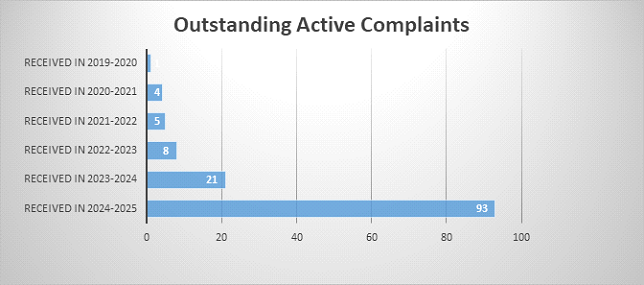
Text description
| Fiscal year | Number of complaints |
|---|---|
| 2019 to 2020 | 1 |
| 2020 to 2021 | 4 |
| 2021 to 2022 | 5 |
| 2022 to 2023 | 8 |
| 2023 to 2024 | 21 |
| 2024 to 2025 | 93 |
Refer to Annex C for details related to the number of complaints.
Following a reorganization to improve complaint management, the CBSA significantly reduce both outstanding complaints from previous reporting periods and complaints received in fiscal year 2024 to 2025. Regular collaboration with the OIC and our continued efforts contributed to clearer, more efficient representations and a notable decrease in the overall volume of active complaints.
7. Fees
The Service Fees Act requires a responsible authority to report annually to Parliament on the fees collected by the institution. With respect to fees collected under the ATIA, the information below is reported in accordance with the requirements of section 20 of the Service Fees Act.
- Enabling authority
- Access to Information Act.
- Fee payable
- $5.00 application fee is the only fee charged for an access to information request.
- Total revenue
- The total fee revenue for this reporting period is $4,090.
- Fees waived
- The total amount of fees waived for this reporting period is $600. In accordance with the Interim Directive on the Administration of the ATIA, issued on , and the changes to the ATIA that came into force on , the CBSA waives all fees prescribed by the Act and Regulations, other than the $5 application fee set out in section 7 of the Regulations.
- Cost of operating the program
- The total cost for operating the ATIA program during this reporting period is $2,869,927.
8. Conclusion
The achievements portrayed in this report reflect the CBSA's commitment to ensuring that every reasonable effort was made to meet its obligations under the ATIA. The CBSA strives to provide Canadians with the information to which they have a right to in a timely and helpful manner by balancing the right of access with the need to protect the integrity of the border services that support national security and public safety priorities.
Annex A: Delegation order
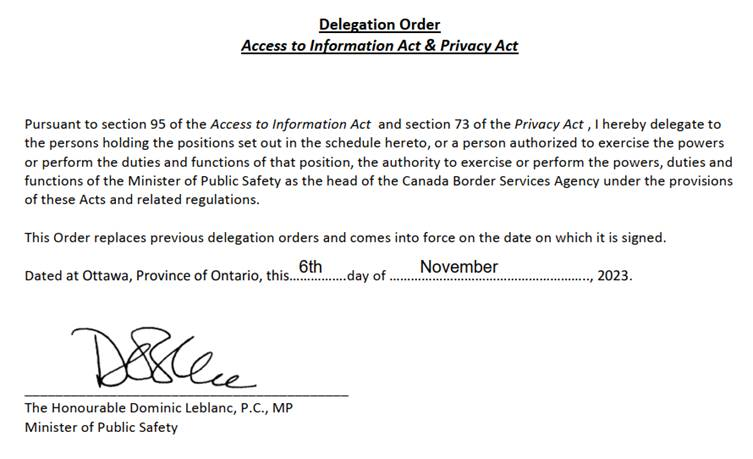
Text description
Delegation order
Access to Information Act and Privacy Act
Pursuant to section 95 of the Access to Information ActFootnote 1 and section 73 of the Privacy ActFootnote 2, I hereby designate the persons holding the positions set out in the schedule hereto, or a person authorized to exercise the powers or perform the duties and functions of that position, the authority to exercise or perform the powers, duties and functions of the Minister of Public Safety as the head of the Canada Border Services Agency under the provisions of these Acts and related regulations.
This Order replaces previous designation orders and comes into force on the date on which it is signed.
Dated at Ottawa, Province of Ontario, this .
The Honourable Dominic LeBlanc, P.C., M.P.
Minister of Public Safety
| Position | Access to Information Act and Regulations | Privacy Act and Regulations |
|---|---|---|
| President | Full authority | Full authority |
| Executive Vice-President | Full authority | Full authority |
|
Vice-President Strategic Policy Branch |
Full authority | Full authority |
|
Director General and Chief Privacy Officer Information Sharing, Access to Information and Privacy Office (ISATICPO) |
Full authority | Full authority |
|
Director ISATICPO |
Full authority |
Full authority (except 8(2)(m)) |
|
Assistant Director ISATICPO |
Full authority |
Full authority (except 8(2)(m)) |
|
Team Leader ISATICPO |
Full authority |
Full authority (except 8(2)(m)) |
|
Senior Analyst ISATICPO |
Full authority |
Full authority (except 8(2)(m)) |
|
Junior Analyst ISATICPO |
Section 19 authority | Section 26 authority |
Annex B: Statistical report
Statistical report on the Access to Information Act
- Name of institution
- Canada Border Services Agency
- Reporting period
- , to
Section 1: Requests under the Access to Information Act
| Category | Number of requests |
|---|---|
| Received during reporting period | 1,765 |
|
Outstanding from previous reporting period
|
683 |
| Total | 2,448 |
| Closed during reporting period | 2,195 |
|
Carried over to the next reporting period
|
253 |
| Source | Number of requests |
|---|---|
| Media | 53 |
| Academia | 23 |
| Business (private sector) | 529 |
| Organization | 70 |
| Public | 981 |
| Decline to identify | 109 |
| Total | 1,765 |
| Channel | Number of requests |
|---|---|
| Online | 1,358 |
| 524 | |
| 153 | |
| In person | 0 |
| Phone | 0 |
| Fax | 0 |
| Total | 1,765 |
Section 2: Informal requests
| Category | Number of requests |
|---|---|
| Received during reporting period | 773 |
|
Outstanding from previous reporting period
|
0 |
| Total | 773 |
| Closed during reporting period | 773 |
| Carried over to next reporting period | 0 |
| Channel | Number of requests |
|---|---|
| Online | 773 |
| 0 | |
| 0 | |
| In person | 0 |
| Phone | 0 |
| Fax | 0 |
| Total | 773 |
| 1 to 15 days |
16 to 30 days |
31 to 60 days |
61 to 120 days |
121 to 180 days |
181 to 365 days |
More than 365 days |
Total |
|---|---|---|---|---|---|---|---|
| 75 | 195 | 219 | 161 | 76 | 47 | 0 | 773 |
| Category (pages released) | Number of requests | Number of pages released |
|---|---|---|
| Less than 100 | 0 | 0 |
| 100 to 500 | 0 | 0 |
| 501 to 1000 | 0 | 0 |
| 1001 to 5000 | 0 | 0 |
| More than 5000 | 0 | 0 |
| Category (pages released) | Number of requests | Number of pages released |
|---|---|---|
| Less than 100 | 151 | 7,561 |
| 100 to 500 | 306 | 30,690 |
| 501 to 1000 | 140 | 77,390 |
| 1001 to 5000 | 124 | 124,350 |
| More than 5000 | 52 | 260,211 |
Section 3: Applications to the Information Commissioner on declining to act on requests
| Category | Number of requests |
|---|---|
| Outstanding from previous reporting period | 0 |
| Sent during reporting period | 0 |
| Total | 0 |
| Approved by the Information Commissioner during reporting period | 0 |
| Declined by the Information Commissioner during reporting period | 0 |
| Withdrawn during reporting period | 0 |
| Carried over to next reporting period | 0 |
Section 4: Requests closed during the reporting period
| Disposition | 1 to 15 days |
16 to 30 days |
31 to 60 days |
61 to 120 days |
121 to 180 days |
181 to 365 days |
More than 365 days |
Total |
|---|---|---|---|---|---|---|---|---|
| All disclosed | 46 | 165 | 49 | 48 | 37 | 27 | 6 | 378 |
| Disclosed in part | 18 | 298 | 146 | 164 | 91 | 162 | 128 | 1,007 |
| All exempted | 0 | 4 | 3 | 7 | 6 | 13 | 4 | 37 |
| All excluded | 0 | 0 | 0 | 1 | 0 | 0 | 0 | 1 |
| No records exist | 11 | 14 | 21 | 24 | 7 | 21 | 3 | 101 |
| Request transferred | 0 | 0 | 0 | 0 | 0 | 0 | 0 | 0 |
| Request abandoned | 355 | 30 | 19 | 47 | 17 | 32 | 19 | 519 |
| Neither confirmed nor denied | 20 | 2 | 5 | 5 | 2 | 41 | 77 | 152 |
| Decline to act with the approval of the Information Commissioner | 0 | 0 | 0 | 0 | 0 | 0 | 0 | 0 |
| Total | 450 | 513 | 243 | 296 | 160 | 296 | 237 | 2,195 |
4.2 Exemptions
| Section | Number of requests |
|---|---|
| 13(1)(a) | 502 |
| 13(1)(b) | 4 |
| 13(1)(c) | 5 |
| 13(1)(d) | 8 |
| 13(1)(e) | 0 |
| 14 | 0 |
| 14(a) | 1 |
| 14(b) | 0 |
| 15(1) | 0 |
| 15(1) - I.A.Tablenote 1 | 13 |
| 15(1) - Def.Tablenote 2 | 15 |
| 15(1) - S.A.Tablenote 3 | 469 |
| Section | Number of requests |
|---|---|
| 16(1)(a)(i) | 2 |
| 16(1)(a)(ii) | 1 |
| 16(1)(a)(iii) | 0 |
| 16(1)(b) | 44 |
| 16(1)(c) | 749 |
| 16(1)(d) | 0 |
| 16(2) | 8 |
| 16(2)(a) | 0 |
| 16(2)(b) | 1 |
| 16(2)(c) | 208 |
| 16(3) | 0 |
| 16.1(1)(a) | 0 |
| 16.1(1)(b) | 0 |
| 16.1(1)(c) | 0 |
| 16.1(1)(d) | 0 |
| Section | Number of requests |
|---|---|
| 16.2(1) | 0 |
| 16.3 | 0 |
| 16.4(1)(a) | 0 |
| 16.4(1)(b) | 0 |
| 16.5 | 0 |
| 16.6 | 0 |
| 17 | 28 |
| 18(a) | 0 |
| 18(b) | 2 |
| 18(c) | 0 |
| 18(d) | 0 |
| 18.1(1)(a) | 1 |
| 18.1(1)(b) | 0 |
| 18.1(1)(c) | 0 |
| 18.1(1)(d) | 0 |
| Section | Number of requests |
|---|---|
| 19(1) | 827 |
| 20(1)(a) | 2 |
| 20(1)(b) | 11 |
| 20(1)(b.1) | 0 |
| 20(1)(c) | 11 |
| 20(1)(d) | 0 |
| 20.1 | 0 |
| 20.2 | 0 |
| 20.4 | 0 |
| 21(1)(a) | 15 |
| 21(1)(b) | 12 |
| 21(1)(c) | 5 |
| 21(1)(d) | 2 |
| 22 | 1 |
| 22.1(1) | 0 |
| 23 | 16 |
| 23.1 | 0 |
| 24(1) | 21 |
| 26 | 7 |
4.3 Exclusions
| Section | Number of requests |
|---|---|
| 68(a) | 5 |
| 68(b) | 0 |
| 68(c) | 0 |
| 68.1 | 0 |
| 68.2(a) | 0 |
| 68.2(b) | 0 |
| Section | Number of requests |
|---|---|
| 69(1) | 0 |
| 69(1)(a) | 0 |
| 69(1)(b) | 0 |
| 69(1)(c) | 0 |
| 69(1)(d) | 0 |
| 69(1)(e) | 0 |
| 69(1)(f) | 0 |
| Section | Number of requests |
|---|---|
| 69(1)(g) re (a) | 0 |
| 69(1)(g) re (b) | 0 |
| 69(1)(g) re (c) | 0 |
| 69(1)(g) re (d) | 0 |
| 69(1)(g) re (e) | 0 |
| 69(1)(g) re (f) | 0 |
| 69.1(1) | 0 |
| Paper | E-record | Data set | Video | Audio | Other |
|---|---|---|---|---|---|
| 36 | 1,340 | 0 | 3 | 6 | 1 |
4.5 Complexity
| Number of pages processed | Number of pages disclosed | Number of requests |
|---|---|---|
| 329,651 | 231,651 | 2,094 |
4.5.2 Relevant pages processed per request disposition for paper and e-record formats by size of requests
| Disposition | Number of requests | Pages processed |
|---|---|---|
| All disclosed | 339 | 8,557 |
| Disclosed in part | 508 | 18,026 |
| All exempted | 23 | 1,251 |
| All excluded | 0 | 0 |
| Request abandoned | 500 | 3,227 |
| Neither confirmed nor denied | 152 | 0 |
| Decline to act with the approval of the Information Commissioner | 0 | 0 |
| Total | 1,522 | 31,061 |
| Disposition | Number of requests | Pages processed |
|---|---|---|
| All disclosed | 33 | 6,089 |
| Disclosed in part | 361 | 41,321 |
| All exempted | 13 | 2,035 |
| All excluded | 1 | 159 |
| Request abandoned | 15 | 2,011 |
| Neither confirmed nor denied | 0 | 0 |
| Decline to act with the approval of the Information Commissioner | 0 | 0 |
| Total | 423 | 51,615 |
| Disposition | Number of requests | Pages processed |
|---|---|---|
| All disclosed | 4 | 2,494 |
| Disclosed in part | 74 | 40,301 |
| All exempted | 0 | 0 |
| All excluded | 0 | 0 |
| Request abandoned | 3 | 2,063 |
| Neither confirmed nor denied | 0 | 0 |
| Decline to act with the approval of the Information Commissioner | 0 | 0 |
| Total | 81 | 44,858 |
| Disposition | Number of requests | Pages processed |
|---|---|---|
| All disclosed | 1 | 1,785 |
| Disclosed in part | 57 | 88,081 |
| All exempted | 1 | 1,670 |
| All excluded | 0 | 0 |
| Request abandoned | 1 | 2,160 |
| Neither confirmed nor denied | 0 | 0 |
| Decline to act with the approval of the Information Commissioner | 0 | 0 |
| Total | 60 | 93,696 |
| Disposition | Number of requests | Pages processed |
|---|---|---|
| All disclosed | 1 | 42,593 |
| Disclosed in part | 7 | 65,828 |
| All exempted | 0 | 0 |
| All excluded | 0 | 0 |
| Request abandoned | 0 | 0 |
| Neither confirmed nor denied | 0 | 0 |
| Decline to act with the approval of the Information Commissioner | 0 | 0 |
| Total | 8 | 108,421 |
| Number of minutes processed | Number of minutes disclosed | Number of requests |
|---|---|---|
| 1,681 | 576 | 6 |
4.5.4 Relevant minutes processed per requests disposition for audio formats by size of requests
| Disposition | Number of requests | Pages processed |
|---|---|---|
| All disclosed | 1 | 18 |
| Disclosed in part | 0 | 0 |
| All exempted | 0 | 0 |
| All excluded | 0 | 0 |
| Request abandoned | 2 | 0 |
| Neither confirmed nor denied | 0 | 0 |
| Decline to act with the approval of the Information Commissioner | 0 | 0 |
| Total | 3 | 18 |
| Disposition | Number of requests | Pages processed |
|---|---|---|
| All disclosed | 0 | 0 |
| Disclosed in part | 0 | 0 |
| All exempted | 0 | 0 |
| All excluded | 0 | 0 |
| Request abandoned | 0 | 0 |
| Neither confirmed nor denied | 0 | 0 |
| Decline to act with the approval of the Information Commissioner | 0 | 0 |
| Total | 0 | 0 |
| Disposition | Number of requests | Pages processed |
|---|---|---|
| All disclosed | 1 | 0 |
| Disclosed in part | 3 | 1,663 |
| All exempted | 0 | 0 |
| All excluded | 0 | 0 |
| Request abandoned | 0 | 0 |
| Neither confirmed nor denied | 0 | 0 |
| Decline to act with the approval of the Information Commissioner | 0 | 0 |
| Total | 3 | 1,663 |
| Number of minutes processed | Number of minutes disclosed | Number of requests |
|---|---|---|
| 25 | 15 | 3 |
4.5.6 Relevant minutes processed per requests disposition for video formats by size of requests
| Disposition | Number of requests | Pages processed |
|---|---|---|
| All disclosed | 0 | 0 |
| Disclosed in part | 1 | 25 |
| All exempted | 1 | 0 |
| All excluded | 0 | 0 |
| Request abandoned | 1 | 0 |
| Neither confirmed nor denied | 0 | 0 |
| Decline to act with the approval of the Information Commissioner | 0 | 0 |
| Total | 3 | 25 |
| Disposition | Number of requests | Pages processed |
|---|---|---|
| All disclosed | 0 | 0 |
| Disclosed in part | 0 | 0 |
| All exempted | 0 | 0 |
| All excluded | 0 | 0 |
| Request abandoned | 0 | 0 |
| Neither confirmed nor denied | 0 | 0 |
| Decline to act with the approval of the Information Commissioner | 0 | 0 |
| Total | 0 | 0 |
| Disposition | Number of requests | Pages processed |
|---|---|---|
| All disclosed | 0 | 0 |
| Disclosed in part | 0 | 0 |
| All exempted | 0 | 0 |
| All excluded | 0 | 0 |
| Request abandoned | 0 | 0 |
| Neither confirmed nor denied | 0 | 0 |
| Decline to act with the approval of the Information Commissioner | 0 | 0 |
| Total | 0 | 0 |
| Disposition | Consultation required | Legal advice sought | Other | Total |
|---|---|---|---|---|
| All disclosed | 2 | 0 | 0 | 2 |
| Disclosed in part | 25 | 0 | 0 | 25 |
| All exempted | 1 | 0 | 0 | 1 |
| All excluded | 0 | 0 | 0 | 0 |
| Request abandoned | 0 | 0 | 0 | 0 |
| Neither confirmed nor denied | 0 | 0 | 0 | 0 |
| Decline to act with the approval of the Information Commissioner | 0 | 0 | 0 | 0 |
| Total | 28 | 0 | 0 | 28 |
4.6 Closed requests
| Number of requests | Percentage (%) |
|---|---|
| 1,387 | 63.18906606 |
4.7 Deemed refusals
| Reason | Number of requests |
|---|---|
| Interference with operations / workload | 345 |
| External consultation | 3 |
| Internal consultation | 2 |
| Other | 458 |
| Total | 808 |
| Number of days past timelines | Number of requests where no extension was taken | Number of requests where an extension was taken | Total |
|---|---|---|---|
| 1 to 15 days | 3 | 0 | 3 |
| 16 to 30 days | 1 | 0 | 1 |
| 31 to 60 days | 46 | 0 | 46 |
| 61 to 120 days | 103 | 45 | 148 |
| 121 to 180 days | 72 | 17 | 61 |
| 181 to 365 days | 201 | 54 | 255 |
| More than 365 days | 221 | 15 | 236 |
| Total | 647 | 131 | 778 |
| Translation request | Accepted | Refused | Total |
|---|---|---|---|
| English to French | 0 | 0 | 0 |
| French to English | 0 | 0 | 0 |
| Total | 0 | 0 | 0 |
Section 5: Extensions
| Disposition | 9(1)(a) Interference with operations / workload |
9(1)(b) Consultation (section 69) |
9(1)(b) Consultation (other) |
9(1)(c) Third party notice |
|---|---|---|---|---|
| All disclosed | 93 | 0 | 0 | 0 |
| Disclosed in part | 381 | 0 | 3 | 0 |
| All exempted | 22 | 0 | 0 | 0 |
| All excluded | 1 | 0 | 0 | 0 |
| Request abandoned | 43 | 0 | 0 | 0 |
| No records exist | 42 | 0 | 0 | 0 |
| Decline to act with the approval of the Information Commissioner | 0 | 0 | 0 | 0 |
| Total | 582 | 0 | 3 | 0 |
| Length of extensions | 9(1)(a) Interference with operations / workload |
9(1)(b) Consultation (section 69) |
9(1)(b) Consultation (other) |
9(1)(c) Third-party notice |
|---|---|---|---|---|
| 30 days or less | 112 | 0 | 2 | 0 |
| 31 to 60 days | 118 | 0 | 1 | 0 |
| 61 to 120 days | 92 | 0 | 0 | 0 |
| 121 to 180 days | 260 | 0 | 0 | 0 |
| 181 to 365 days | 0 | 0 | 0 | 0 |
| 365 days or more | 0 | 0 | 0 | 0 |
| Total | 582 | 0 | 3 | 0 |
Section 6: Fees
6.1 Fee types, broken down by fee collected, waived and refunded
| Fee type | Number of requests | Amount (dollars) |
|---|---|---|
| Application | 818 | $4,090.00 |
| Other fees | 0 | $0.00 |
| Total | 818 | $4,090.00 |
| Fee type | Number of requests | Amount (dollars) |
|---|---|---|
| Application | 120 | $600.00 |
| Other fees | 0 | $0.00 |
| Total | 120 | $600.00 |
| Fee type | Number of requests | Amount (dollars) |
|---|---|---|
| Application | 827 | $4,135.00 |
| Other fees | 0 | $0.00 |
| Total | 827 | $4,135.00 |
Section 7: Consultations received from other institutions and organizations
7.1 Consultations received from other Government of Canada institutions and organizations
| Consultation | Number of consultations | Number of pages to review |
|---|---|---|
| Received during reporting period | 260 | 12,332 |
| Outstanding from the previous reporting period | 0 | 0 |
| Total | 260 | 12,332 |
| Closed during the reporting period | 260 | 12,332 |
| Carried over to next reporting period | 0 | 0 |
| Carried over beyond negotiated timelines | 0 | 0 |
| Consultation | Number of consultations | Number of pages to review |
|---|---|---|
| Received during reporting period | 18 | 2,343 |
| Outstanding from the previous reporting period | 0 | 0 |
| Total | 18 | 2,343 |
| Closed during the reporting period | 18 | 2,343 |
| Carried over to next reporting period | 0 | 0 |
| Carried over beyond negotiated timelines | 0 | 0 |
| Recommendation | 1 to 15 days |
16 to 30 days |
31 to 60 days |
61 to 120 days |
121 to 180 days |
181 to 365 days |
More than 365 days |
Total |
|---|---|---|---|---|---|---|---|---|
| Disclose entirely | 15 | 35 | 26 | 16 | 10 | 4 | 0 | 106 |
| Disclose in part | 15 | 26 | 36 | 36 | 12 | 10 | 0 | 135 |
| Exempt entirely | 1 | 3 | 2 | 1 | 2 | 2 | 0 | 11 |
| Exclude entirely | 0 | 0 | 1 | 0 | 0 | 0 | 0 | 1 |
| Consult other institution | 0 | 0 | 0 | 0 | 0 | 0 | 0 | 0 |
| Other | 0 | 2 | 3 | 1 | 1 | 0 | 0 | 7 |
| Total | 31 | 66 | 68 | 54 | 25 | 16 | 0 | 260 |
| Recommendation | 1 to 15 days |
16 to 30 days |
31 to 60 days |
61 to 120 days |
121 to 180 days |
181 to 365 days |
More than 365 days |
Total |
|---|---|---|---|---|---|---|---|---|
| Disclose entirely | 3 | 0 | 3 | 0 | 0 | 0 | 0 | 6 |
| Disclose in part | 2 | 0 | 3 | 2 | 4 | 0 | 0 | 11 |
| Exempt entirely | 0 | 0 | 0 | 0 | 0 | 0 | 0 | 0 |
| Exclude entirely | 0 | 0 | 0 | 0 | 0 | 0 | 0 | 0 |
| Consult other institution | 0 | 0 | 0 | 0 | 0 | 0 | 0 | 0 |
| Other | 1 | 0 | 0 | 0 | 0 | 0 | 0 | 1 |
| Total | 6 | 0 | 6 | 2 | 4 | 0 | 0 | 18 |
Section 8: Completion time of consultations on Cabinet confidences
8.1 Requests with Legal Services
| Number of days | Number of requests | Pages disclosed |
|---|---|---|
| 1 to 15 | 0 | 0 |
| 16 to 30 | 0 | 0 |
| 31 to 60 | 0 | 0 |
| 61 to 120 | 0 | 0 |
| 121 to 180 | 0 | 0 |
| 181 to 365 | 0 | 0 |
| More than 365 | 0 | 0 |
| Total | 0 | 0 |
| Number of days | Number of requests | Pages disclosed |
|---|---|---|
| 1 to 15 | 0 | 0 |
| 16 to 30 | 0 | 0 |
| 31 to 60 | 0 | 0 |
| 61 to 120 | 0 | 0 |
| 121 to 180 | 0 | 0 |
| 181 to 365 | 0 | 0 |
| More than 365 | 0 | 0 |
| Total | 0 | 0 |
| Number of days | Number of requests | Pages disclosed |
|---|---|---|
| 1 to 15 | 0 | 0 |
| 16 to 30 | 0 | 0 |
| 31 to 60 | 0 | 0 |
| 61 to 120 | 0 | 0 |
| 121 to 180 | 0 | 0 |
| 181 to 365 | 0 | 0 |
| More than 365 | 0 | 0 |
| Total | 0 | 0 |
| Number of days | Number of requests | Pages disclosed |
|---|---|---|
| 1 to 15 | 0 | 0 |
| 16 to 30 | 0 | 0 |
| 31 to 60 | 0 | 0 |
| 61 to 120 | 0 | 0 |
| 121 to 180 | 0 | 0 |
| 181 to 365 | 0 | 0 |
| More than 365 | 0 | 0 |
| Total | 0 | 0 |
| Number of days | Number of requests | Pages disclosed |
|---|---|---|
| 1 to 15 | 0 | 0 |
| 16 to 30 | 0 | 0 |
| 31 to 60 | 0 | 0 |
| 61 to 120 | 0 | 0 |
| 121 to 180 | 0 | 0 |
| 181 to 365 | 0 | 0 |
| More than 365 | 0 | 0 |
| Total | 0 | 0 |
8.2 Requests with Privy Council Office
| Number of days | Number of requests | Pages disclosed |
|---|---|---|
| 1 to 15 | 0 | 0 |
| 16 to 30 | 0 | 0 |
| 31 to 60 | 0 | 0 |
| 61 to 120 | 0 | 0 |
| 121 to 180 | 0 | 0 |
| 181 to 365 | 0 | 0 |
| More than 365 | 0 | 0 |
| Total | 0 | 0 |
| Number of days | Number of requests | Pages disclosed |
|---|---|---|
| 1 to 15 | 0 | 0 |
| 16 to 30 | 0 | 0 |
| 31 to 60 | 0 | 0 |
| 61 to 120 | 0 | 0 |
| 121 to 180 | 0 | 0 |
| 181 to 365 | 0 | 0 |
| More than 365 | 0 | 0 |
| Total | 0 | 0 |
| Number of days | Number of requests | Pages disclosed |
|---|---|---|
| 1 to 15 | 0 | 0 |
| 16 to 30 | 0 | 0 |
| 31 to 60 | 0 | 0 |
| 61 to 120 | 0 | 0 |
| 121 to 180 | 0 | 0 |
| 181 to 365 | 0 | 0 |
| More than 365 | 0 | 0 |
| Total | 0 | 0 |
| Number of days | Number of requests | Pages disclosed |
|---|---|---|
| 1 to 15 | 0 | 0 |
| 16 to 30 | 0 | 0 |
| 31 to 60 | 0 | 0 |
| 61 to 120 | 0 | 0 |
| 121 to 180 | 0 | 0 |
| 181 to 365 | 0 | 0 |
| More than 365 | 0 | 0 |
| Total | 0 | 0 |
| Number of days | Number of requests | Pages disclosed |
|---|---|---|
| 1 to 15 | 0 | 0 |
| 16 to 30 | 0 | 0 |
| 31 to 60 | 0 | 0 |
| 61 to 120 | 0 | 0 |
| 121 to 180 | 0 | 0 |
| 181 to 365 | 0 | 0 |
| More than 365 | 0 | 0 |
| Total | 0 | 0 |
Section 9: Investigations and reports of findings
| Section 32 Notice of intention to investigate |
Subsection 30(5) Ceased to investigate |
Section 35 Formal representations |
|---|---|---|
| 161 | 418 | 3 |
| Report | Received | Containing recommendations issued by the Information Commissioner | Containing orders issues by the Information Commissioner |
|---|---|---|---|
| Section 37(1) Initial reports | 9 | 0 | 5 |
| Section 37(2) Final reports | 53 | 1 | 5 |
Section 10: Court action
| Complainant (1) | Institution (2) | Third party (3) | Privacy Commissioner (4) | Total |
|---|---|---|---|---|
| 0 | 0 | 0 | 0 | 0 |
| Section | Total |
|---|---|
| Section 44 – under paragraph 28(1)(b) | 0 |
Section 11: Resources related to the Access to Information Act
| Expenditure | Amount (dollars) |
|---|---|
| Salaries | $2,682,517 |
| Overtime | $54,097 |
Goods and services:
|
$133,313 |
| Total | $2,869,927 |
| Resource | Number of person years dedicated to access to information activities |
|---|---|
| Full-time employees | 25.790 |
| Part-time and casual employees | 9.520 |
| Regional staff | 0.00 |
| Consultants and agency personnel | 0.00 |
| Students | 0.00 |
| Total | 35.310 |
Annex C: Supplemental statistical report on the Access to Information Act
Statistical report on the Access to Information Act
- Name of institution
- Canada Border Services Agency
- Reporting period
- , to
Section 1: Open requests and complaints under the Access to Information Act
| Fiscal year | Number of requests within legislated timelines as of | Number of requests beyond legislated timelines as of | Total |
|---|---|---|---|
| 2024 to 2025 | 174 | 23 | 197 |
| 2023 to 2024 | 0 | 49 | 49 |
| 2022 to 2023 | 0 | 6 | 6 |
| 2021 to 2022 | 0 | 0 | 0 |
| 2020 to 2021 | 0 | 1 | 1 |
| 2019 to 2020 | 0 | 0 | 0 |
| 2018 to 2019 | 0 | 0 | 0 |
| 2017 to 2018 | 0 | 0 | 0 |
| 2016 to 2017 | 0 | 0 | 0 |
| 2015 to 2016 or earlier | 0 | 0 | 0 |
| Total | 174 | 79 | 253 |
| Fiscal year | Number of open complaints |
|---|---|
| 2024 to 2025 | 93 |
| 2023 to 2024 | 21 |
| 2022 to 2023 | 8 |
| 2021 to 2022 | 5 |
| 2020 to 2021 | 4 |
| 2019 to 2020 | 1 |
| 2018 to 2019 | 0 |
| 2017 to 2018 | 0 |
| 2016 to 2017 | 0 |
| 2015 to 2016 or earlier | 0 |
| Total | 132 |
Section 2: Open requests and complaints under the Privacy Act
| Fiscal year | Number of requests within legislated timelines as of | Number of requests beyond legislated timelines as of | Total |
|---|---|---|---|
| 2024 to 2025 | 2,842 | 901 | 3,743 |
| 2023 to 2024 | 0 | 701 | 701 |
| 2022 to 2023 | 0 | 244 | 244 |
| 2021 to 2022 | 0 | 1 | 1 |
| 2020 to 2021 | 0 | 0 | 0 |
| 2019 to 2020 | 0 | 1 | 1 |
| 2018 to 2019 | 0 | 0 | 0 |
| 2017 to 2018 | 0 | 0 | 0 |
| 2016 to 2017 | 0 | 0 | 0 |
| 2015 to 2016 or earlier | 0 | 0 | 0 |
| Total | 2,842 | 1,848 | 4,690 |
| Fiscal year | Number of open complaints |
|---|---|
| 2024 to 2025 | 18 |
| 2023 to 2024 | 0 |
| 2022 to 2023 | 0 |
| 2021 to 2022 | 0 |
| 2020 to 2021 | 0 |
| 2019 to 2020 | 0 |
| 2018 to 2019 | 0 |
| 2017 to 2018 | 0 |
| 2016 to 2017 | 0 |
| 2015 to 2016 or earlier | 0 |
| Total | 18 |
Section 3: Social Insurance Number (SIN)
Did your institution receive authority for a new collection or new consistent use of the SIN in 2024 to 2025?
No
Section 4: Universal Access under the Privacy Act
How many requests were received from confirmed foreign nationals outside of Canada in 2024 to 2025?
10,784
Page details
- Date modified: