
Audit of executive staffing
Internal Audit and Program Evaluation Directorate
Note: [redacted] appears where sensitive information has been removed in accordance with the Access to Information Act and the Privacy Act.
Introduction
The Canada Border Services Agency's (the CBSA or the agency) mandate is to provide integrated border services that support national security and public safety priorities and facilitate the free flow of persons and goods in accordance with legislation.
Placing qualified people into leadership positions is essential to the delivery of this important and complex mandate, and the effective management of the agency's operations. In addition, the compliance, integrity, transparency and accountability of executive appointment decisions affect the "tone at the top" of the entire organization.
The Canadian public, parliamentarians, federal public servants, and CBSA personnel at all levels should have trust and confidence that CBSA executive-level (herein referred to as "EX") positions are staffed in compliance with all applicable legislation and policies, and in alignment with the values of merit, non-partisanship, transparency, fairness, access, and representativeness.
The Public Service Employment Act (PSEA) establishes that the authority to make appointments within Canada's federal public service is vested in the Public Service Commission (PSC). The PSC delegates this authority to the deputy heads of federal departments, including the President of the CBSA. The President further sub-delegates the authorities through the agency's [redacted]. In combination with the [redacted] and the [redacted], the instrument establishes the foundation for staffing processes, decisions and oversight in the agency. For EX staffing specifically, the President sub-delegates responsibilities and authorities to initiate and conduct staffing actions but remains the only authority for appointing executives indeterminately or for acting appointments greater than 12 months.
The agency's Human Resources Branch (HRB) leads the administration, implementation, and monitoring of those instruments, and its EX Resourcing and Talent Strategy Division (EX Resourcing) is responsible for supporting hiring managers in processing EX staffing actions in accordance with agency direction and all applicable legislative, regulatory, and policy requirements.
About the audit
The objective of the audit was to assess compliance of the agency's EX staffing appointments and appointment processes with legislative, regulatory and policy requirements.
- Audit scope inclusions
-
The period under review was from , to .
The scope of the audit focused on assessing the following:
- indeterminate and acting appointments greater than four months
- EX staffing activities and their compliance with Government of Canada and CBSA requirements
- EX staffing monitoring and oversight mechanisms
- sufficiency of training, tools and support for EX staffing processes
- Audit scope exclusions
-
The audit scope excluded the following:
- certain types of EX staffing appointments that are not subject to assessment and demonstration of merit (that is, actings under four months; casuals; deployments; Interchange Canada; secondments; assignments; term - appointment extension)
- non-EX staffing activities
- human resources (HR) information technology
- Audit methodology
-
- Review of legislation, regulations, and PSC policy tools
- Review of CBSA framework, guidance, and tools applicable to EX staffing against relevant requirements
- Review of a sample of 43 EX staffing actions, and testing of their compliance with key legislative, regulatory and policy requirements
- Interviewed key stakeholders responsible for EX staffing including human resource advisors and hiring managers
Significance of the audit
Over the years, the HRB has faced numerous challenges in delivering EX staffing. In response, significant efforts have been made by the Branch to reduce service backlogs, improve information management, and increase compliance, completeness and consistency of EX staffing files. This has led to a transformation of the division and implementation of a number of changes to its operations.
The internal audit sought to provide the agency with assurance that the CBSA's EX staffing function has been stabilized, that its EX appointments are compliant with legislation and policy, and that appointment decisions are justified and documented.
This audit was approved as part of the 2024 Risk-Based Audit Plan.
Statement of conformance
This audit engagement conforms to the Treasury Board's Policy and Directive on Internal Audit and the Institute of Internal Auditors' (IIA) Global Internal Audit Standards. Sufficient and appropriate evidence was gathered through various procedures to provide an audit level of assurance. The agency's internal audit function is independent, and internal auditors performed their work with objectivity as defined by the IIA's Global Internal Audit Standards.
Audit conclusion
The CBSA's HRB has established and implemented EX staffing in alignment with key legislative, regulatory and policy requirements. It put in place an appropriate framework, in addition to guidance and tools for staff to execute their responsibilities. Through various monitoring controls, it ensured compliance and corrective action where necessary. Generally, EX staffing practices were found to be carried out in compliance with requirements as demonstrated in the audits file review.
While the foundational elements are in place, the audit identified some opportunities for improvement to further solidify the process: clarify the administration of financial authority associated to EX staffing, as well as review and update elements of the process related to the substantiation of assessments of a combination of education, training and/or experience as an alternative to education requirements, consideration of biases and barriers, and retroactive processing of acting appointments. Strengthening these areas will help ensure the agency is demonstrating its commitment to management excellence through an EX staffing approach that is functioning as intended.
Summary of recommendations
- Ensure alignment with both staffing and financial delegation authorities.
- Strengthen EX staffing processes to promote and enforce accountability and alignment with policies and legislation, including with regards to mitigating biases and barriers, thoroughly substantiating assessments of a combination of education, training and/or experience as an alternative to education requirements, and minimizing the use of retroactive acting appointments.
Management response
The Vice-President (VP) of HRB welcomes the results of the Audit of Executive Staffing and agrees with the recommendations that will strengthen this vital internal service and further contribute to the achievement of excellence in people management.
Further to the alignment of financial and staffing delegation, HRB will issue a new Delegation of Spending and Financial Authorities card for the Director General (DG), Classification, Staffing and Talent Management, to address the noted non-compliance and ensure proper alignment of financial and staffing delegations.
HRB also agrees with the intent of the other recommendations and will strengthen specific processes required for EX staffing appointments by reinforcing stakeholder understanding, accountability, and responsibilities in accordance with processes, policies and legislation.
Audit findings
The audit resulted in the findings below.
The executive staffing process
At the CBSA, there are three main steps in the staffing process to appoint an employee into an EX positionFootnote 1.
- In the Planning Phase, the hiring manager contacts the EX Resourcing human resource advisor (HRA) and requests support. The hiring manager is responsible for determining the position to be staffed and the type of processFootnote 2 that will be used, and the Statement of Merit Criteria (SOMC) that needs to be metFootnote 3.
- In the Assessment Phase, the hiring manager assesses the candidate(s) against the SOMC. The type of assessment and the number of candidates assessed depends on whether it is an advertised or a non-advertised process. In both cases, merit must be fully demonstrated.
- In the Appointment Phase, the staffing is finalized as the file receives all required approvals of the sub-delegated person with the requisite "Appoint" authority. Once approved, the candidate signs the letter of offer (LOO) to complete the appointment. The final step is to submit the compensation request.
Figure 1: The executive staffing process
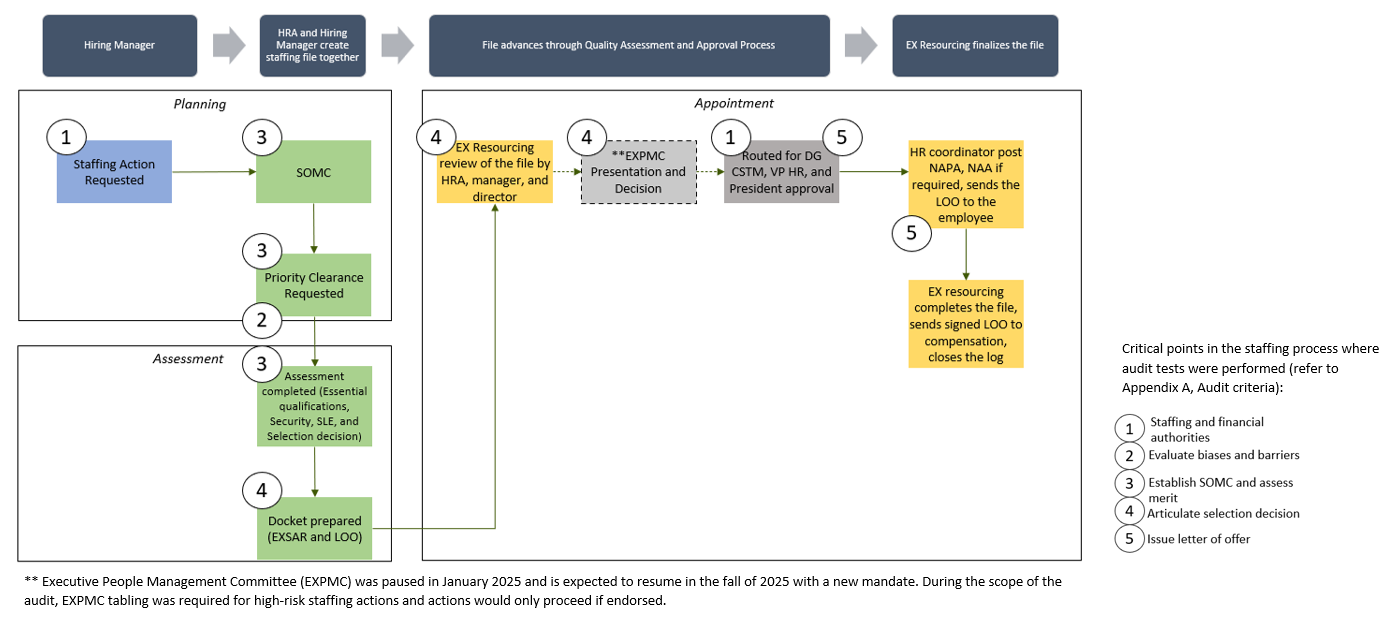
Image description
A flowchart of the key steps in the EX staffing process. The process is divided into three phases: Planning, Assessment and Appointment. The process is initiated when the hiring manager sends a staffing action request to the human resources advisor. The HRA and hiring manager build the staffing file together and ensure that it meets legislative, policy, and CBSA staffing framework requirements. The process continues through to the candidate assessment phase and is concluded when a selected candidate receives a letter of offer and the HRA finalizes and closes the file. Audit tests were performed at critical points in the staffing process (refer to Appendix A: Audit criteria and as noted in the phase descriptions below).
- Planning phase
-
The staffing action is requested by the hiring manager; the Statement of Merit Criteria is created and priority clearance is requested from the Public Service Commission.
Audit tests were performed in the planning phase at the staffing action request stage (to verify compliance with staffing and financial authorities), at the SOMC and priority clearance stages (to verify that priority clearance was granted based on the criteria included in the SOMC), and at the end of the phase (to verify that the evaluation of biases and barriers of the assessment tools was completed prior to candidate assessment).
- Assessment phase
-
Candidate assessments are conducted and completed (for example, essential qualifications, security, second language evaluation (SLE) and the selection decision). The docket for the selected candidate is prepared for approval (for example, EXSAR and LOO).
Audit tests were performed in the assessment phase at the assessment completion stage (to verify that the selected candidate met the pre-established merit criteria) and at the docket preparation stage (to verify that the selection decision was articulated prior to proceeding with docket approval).
- Appointment phase
-
EX Resourcing review of the file by the HRA, manager and director; then presented at the Executive People Management Committee (EXPMC), for decision; then routed for approvals through the DG of Classification Staffing and Talent Management (CSTM), the VP of HR and the President. HR coordinator posts the Notification of Appointment or Proposed Appointment (NAPA), Notice of Acting Appointment (NAA) if required, and sends the LOO to the employee. EX Resourcing completes the file, sends the signed LOO to compensation and closes the log.
Audit tests were performed in the appointment phase at the EX Resourcing review stage and the EXPMC stage (to verify that the articulation of the selection decision was approved by required parties), at the routing stage (to verify compliance with staffing and financial authorities, specifically for the letter of offer) and at the HR coordinator stage (to verify that the NAPA/NAA was posted prior to issuance of the letter of offer to the employee).
Note: EXPMC was paused in and is expected to resume in the fall of 2025 with a new mandate. During the scope of the audit, EXPMC tabling was required for high-risk staffing actions and actions would only proceed if endorsed.
Guidance, tools, and support
Overall finding: The CBSA has implemented guidance, tools and support that hiring managers and HRAs require to execute their EX staffing responsibilities in compliance with legislative, regulatory and policy requirements. Guidance and tools are accessible and available to stakeholders.
In order for staffing decisions to be inclusive, fair, transparent, and merit based as per the requirements of the Public Service Employment Act, Public Service Employment Regulations, and the PSC Appointment Framework, departmental staffing systems must meet and demonstrate a series of principles in each appointment. Departments develop and implement their own frameworks, tools, guidance, and support resources that enable hiring managers and HRAs to carry out their responsibilities. When effectively designed and implemented, internal policy instruments reduce the risk of non-compliance, promote informed decision making, and enable departments to exercise their delegated authorities with confidence, integrity, and consistency.
To assess the existence and completeness of tools, guidance, and support of EX staffing, the audit team reviewed documentation/tools from the CBSA's Staffing Framework (refer to Appendix B: Staffing Framework) as well as tools/guidance developed specifically for EX staffing actions. The audit team also conducted interviews with hiring managers and EX Resourcing HRAs.
- Agency frameworks, guides, and tools for EX staffing were assessed to ensure they are in alignment with legislative, regulatory and policy direction, are in an accessible location, and are being used by HRAs and hiring managers.
- Interviews were conducted with a subset of hiring managers and all current EX Resourcing HRAs who performed staffing actions in 2024, as part of the sample of 43 files selected for testing to provide coverage of key population characteristics such as action type, position level, branch/regions, HRAs, and hiring managers (refer to Appendix C: Sampling strategy).
When appointing people into jobs in the public sector, hiring managers are ultimately accountable for all elements of the staffing action and the decisions made during the process. To ensure that hiring managers carry out their roles in compliance with requirements, they receive the support of HRAs. At the CBSA, hiring managers for EX-level positions are generally VPs, DGs, or RDGs who have delegated authority to "Conduct" EX-staffing processes. The delegation to "Appoint" an executive (that is, final approval) rests only with the President, with the exception of acting appointments between 4 and 12 months which is sub-delegated to the DG of Classification Staffing and Talent Management (CSTM). HR expertise to support hiring managers is provided by the EX Resourcing Division. To fulfill their advisory roles, EX Resourcing HRAs also require functional support, guidance and tools.
We assessed the specific EX staffing guidance, tools and support the CBSA has put in place to ensure that both groups (that is, hiring managers and HRAs) apply their responsibilities in a compliant manner. Refer to Appendix B: Staffing Framework for the assessment, applicable to all types of staffing actions (EX and non-EX).
Hiring managers
Overall, CBSA hiring managers receive the tools and support required for compliance with legislative, regulatory and policy requirements directly from their EX Resourcing HRAs on an as-needed basis, when staffing actions are conducted.
- The 43 files sampled demonstrated that the HRAs provide the hiring managers with tools and support. The files displayed HRA correspondence throughout the staffing process, providing advice, templates and services, and documentation of staffing actions.
- The hiring managers interviewed expressed satisfaction and confidence in the quality of advice and services that EX Resourcing HRAs provide to ensure that staffing is compliant with legislative, regulatory and policy requirements.
Human resource advisors
EX Resourcing HRAs have a comprehensive set of tools available to them in a central, accessible location, so that they can support their clients with guidance and tools during the staffing process.
- EX Resourcing has introduced a fully renewed staffing toolbox and wiki, for their staff between and . The toolbox included standardized templates for all aspects of the process, from email communications to preparation of the letters of offer.
- Walkthroughs and the file review confirmed that the tools were actively used. All 43 sampled files evidenced the use of the toolbox templates such as checklists, SOMCs, EX staffing action request forms (EXSAR), and letters of offer.
- In interviews, all three HRAsFootnote 4 indicated observing significant improvements in EX staffing tools available over the last year.
Context: In the 2024 calendar year, the CBSA processed 242 EX staffing actions (not including short term actings of up to four months less one day). These were facilitated by 10 HRAs, who supported 47 different hiring managers.
Compliance
Overall finding: Generally, the agency's EX staffing appointments were well-documented and aligned with key legislative, regulatory, and policy requirements. Results of audit testing performed on 43 EX staffing files show that the agency's staffing activities are generally conducted in compliance with:
- sub-delegated staffing authorities
- establishment, assessment, and demonstration of merit for appointments
- requirements for articulation of selection decisions
Opportunities for improvement were observed with regards to:
- validity of delegated financial authority for approval of acting appointments between 4 and 12 months
- identification and removal of biases and barriers for employment equity (EE) seeking groups prior to assessment
- retroactive letters of offer for acting appointments, with one instance of potential non-compliance
To assess and conclude on whether the agency's EX staffing appointments were in compliance with legislative, regulatory and policy requirements, the audit performed a detailed review of a sample of 43 EX appointments that were completed during the 2024 calendar year. The sample of EX staffing files was selected to ensure coverage of all agency branches and regions, different types of appointments, and EX-levels (refer to Appendix C: Sampling strategy). Each staffing file was fully reviewed and assessed against delegated staffing and financial authority, identification of biases and barriers, merit, selection decision and letter of offer requirements (refer to Appendix A: Audit criteria).
Summaries of the individual audit tests performed on each of the 43 EX staffing files are provided in the following pages.
Staffing and financial authorities
To make an appointment, the hiring manager and the sub-delegated person exercising the "Appoint" authority must have both the delegated staffing and financial authorities. Per the CBSA's current staffing authorities sub-delegation instrument, for the hiring of executives, only the President can approve (sign) indeterminate appointments and acting appointments greater than 12 months (referred to as "Appoint" authority). VPs, DGs, and RDGs are hiring managers who are sub-delegated with a "Conduct" authority for their areas of the organization, which allows them to conduct the steps of a staffing action up to the final appointment decision. For acting appointments between 4 and 12 months, the "Appoint" authority is sub-delegated to the DG of CSTM.
The audit assessed compliance with the CBSA's staffing sub-delegation instrument for 43 staffing actions, as well as compliance with the delegation of financial authorities requirements, as each staffing action has an associated financial expenditure. Both staffing and financial authorities must be respected.
- All 43 staffing actions complied with the staffing sub-delegation instrument: they were conducted by hiring managers who had valid Conduct authorities, and the appointment was made by either the President or, in the case of acting appointments between 4 and 12 months, by the DG of CSTM. The 31 appointments signed by the President also met the financial delegation requirements.
-
For the 12 appointments signed by the DG of CSTM, approval did not comply with the Treasury Board Directive on Delegation of Spending and Financial Authorities. Though the DG had the staffing sub-delegation, they did not have a valid delegation of financial authority card (that is, a specimen signature card) for the cost centres impacted by the staffing actions, which is required to properly authorize the expenditure.
- A delegated financial authority does not come into effect without a delegation card approved by a designator and outlining the effective period, type, and level of authority of the delegation. As such, the DG of CSTM did not have valid expenditure and commitment authority for the staffing transactions since the specimen signature card required to activate the DG's functional delegation was not in place due to an administrative oversight.
- Although this practice is technically non-compliant from a delegated spending and financial authorities perspective, the hiring managers (that is, budget holders) were aware of the staffing actions and had essentially pre-authorized the related financial expenditures by signing off on the selection decisions. However, the process should be promptly rectified to ensure compliance with financial policy; failure to do so would place the agency at risk of continued misalignment with Treasury Board requirements.
Identification and mitigation of potential biases and barriers for employment equity seeking groups
Since , the Public Service Employment Act requires the identification and mitigation of biases and barriers in assessment methods to ensure disadvantaged persons of equity-deserving groups are given a fair chance to perform at their fullest potential in staffing processes. The [redacted] and [redacted] to mitigating biases and barriers in assessment provides further instruction to HR specialists and hiring managers including the requirement to retain such evaluations in each staffing file. Examples of elements that could be mitigated by using the checklist include qualifications that are narrow or beyond what is required for the position; insufficient time for candidates to prepare and respond; homogeneous or improperly trained assessment boards; or requiring recent, significant, or continuous government-specific experience.
Compliance tests were performed against this requirement on 31 of the 43 sampled EX staffing actions. The remaining 12 staffing actions were excluded from the audit tests because they had begun before , and were exempt from the new requirement. Testing results indicate that while 28 of 31 files contained a completed PSC checklist, 20 of those 28 were completed and signed on either the same day of the assessment, or after the assessment of the candidates had already taken place (refer to Table 1: Results of compliance testing of sampled EX staffing actions). Given that the PSEA requires the evaluation to take place before the assessment, assessing (or certifying the assessment of) mitigating biases and barriers after candidates are already selected would not ensure that biases and barriers were removed or mitigated in advance of the assessment and is not aligned with the spirit and intent of the PSEA requirement.
Evaluation of biases and barriers in assessment methods
Results of the compliance testing of sampled EX staffing actions are provided in the table below.
| Compliance test results | Yes, prior to assessment | Yes, but not prior to assessment | Not done | Not applicableFootnote * | Total sample |
|---|---|---|---|---|---|
| Number of sampled EX staffing actions | 8 files | 20 files | 3 files | 12 files | 43 files |
| Percent (%) of sampled EX staffing actions | 19% | 46% | 7% | 28% | 100% |
Hiring managers and EX Resourcing HRAs consulted as part of the audit indicated that completion of the checklist feels like a "checkbox exercise" and have doubts as to whether it is fulfilling its intended purpose. At the same time, both groups expressed the importance of, and commitment to, respecting EE goals in staffing and a desire to mitigate biases and barriers to disadvantaged groups. While completing the checklist meets PSC requirements, failure to undertake the associated reflection at the onset of the staffing process presents a missed opportunity to truly and meaningfully assess and subsequently mitigate biases and barriers that may prevent disadvantaged persons from being given a fair chance to perform at their best. Ensuring completion of this step early in the process would help the agency better align to the intent and spirit of legislative requirements, as well as enhance its efforts to meet EE objectives.
Merit criteria
The fundamental principle in the staffing legislation, regulations, and policy is that public service appointments must be made based on merit. For all indeterminate and acting appointments greater than four months, hiring managers must:
- establish a SOMC that defines the requirements for the position, and ensure candidates meet or exceed the minimum Qualification Standards for the Core Public Administration
- assess candidates against the merit criteria, maintain all assessment and evaluation results, and demonstrate how the merit criteria is met
- fairly and transparently apply the merit criteria though the staffing process, the priority clearance and notification processes (refer to Appendix D: Definitions)
The PSC Appointment Framework requires that records demonstrating each of these elements are maintained in the staffing file. The 43 sampled EX staffing files were assessed against these requirements.
All 43 files contained the merit criteria; used it consistently through the priority clearance, assessment and notifications processes; and the hiring manager attested that the candidate had met the requirements. Every staffing file included documentation for:
- essential experience requirements (HR, financial, and other executive or management functions)
- applicable official language requirements
- security requirements
- education requirements
In 7 instances, the hiring manager accepted a combination of education, training and experience in lieu of a post-secondary degree. In 4 of those 7 files, the rationale was not clearly substantiated and/or supporting credentials were not on file (for example, documentation to support training taken, education recognized, or professional certification). Accordingly, an opportunity for improvement exists in how hiring managers document their assessments of the education requirements, such as including rationales or maintaining additional evidence. This would improve transparency and accountability when "employer-approved alternatives" are used to determine merit in EX staffing actions.
Qualification standards for executives
- Experience
- Experience in managing human and financial resources.
- Education
-
At least one of:
- eligibility for a recognized professional designation in one of the provinces or territories of Canada
- graduation with a degree from a recognized post-secondary institution
- acceptable combination of education, training and/or experience (employer-approved alternative)
- Demonstration of key leadership competencies
-
- Create vision and strategy
- Mobilize people
- Uphold integrity and respect
- Collaborate with partners and stakeholders
- Promote innovation and guide change
- Achieve results
Selection decisions
The PSC Appointment Framework requires that the hiring manager articulate, in writing, their selection decision for each appointment. At the agency, the CBSA One | Staffing Policy, CBSA Guidance on Staffing, and the EXSAR template guide the articulation of selection decisions for EX appointments and aim to ensure a consistent and transparent approach to the staffing process.
The audit assessed whether EX staffing files contained an approved selection decision and found that all 43 staffing actions did. We assessed each decision to determine to what extent the guidance on selection decision rationales was followed and found that:
-
Since implementation of the EXSAR form in Winter 2024, all staffing actions considered the hiring branch or region's representation gaps for EE-deserving groups when making the appointment decision. The EXSAR form requires that if an EE gap exists and is not being addressed by the appointment, a rationale should be included in the selection decision.
- Testing results showed 29 cases where the hiring branch or region had an existing EE gap. In 10 of the 29, the decision was to appoint a non-EE deserving candidate. However, none of those selection decisions were accompanied by the required rationale related to EE. While this does not represent a violation of external policy requirements, it indicates inconsistent use of the EXSAR component, represents a missed opportunity to demonstrate transparency and to show meaningful commitment to EE.
- For all 11 advertised appointments in the audit sample, the selection decisions were based on the candidates' success in an advertised process, with additional information to rationalize the fit of and/or need for the specific candidate.
- For the 32 non-advertised appointments in the audit sample, selection decisions detailed HR planning considerations, the business needs and the specific organizational context, talent management, and rationale on how the use of advertised process or existing pool(s) were considered to explain the use of the non-advertised process.
Selection decision factors
- Merit
- Advertised process or pools
- Talent management
- Employment equity
- Organizational requirements
- Specialized skills
Letters of offer
When a LOO is signed by the sub-delegated person with "Appoint" authority and the appointee, the staffing action is concluded. The PSC Appointment Framework requires that departments keep a copy of the signed letter on file. The signed letter is then sent to compensation to set up the pay file.
For all 43 staffing actions in the audit sample, we assessed whether a valid LOO was on file. All but one file were processed with a signed LOO. For the one file without an LOO, the staffing action was concluded through a "compensation letter," which retroactively authorized compensation for an acting appointment extension that had been fully completed. This acting extension was part of a large backlog of acting appointment requests from 2023. The EX Resourcing Division and CBSA senior management jointly chose to exceptionally use compensation letters to formalize such after-the-fact appointments.
We also assessed whether the LOOs were signed before the effective date of the appointment:
- For the 20 indeterminate appointments in the audit sample, 18 were signed before the effective date. The two remaining staffing actions had mitigating circumstances.
- For 22 of 23 of the acting appointments greater than four months, the LOOs were signed after the effective date of the appointment.
It was noted that the timeliness of the sampled staffing actions improved significantly between 2023 and 2024, with the average delay between the effective date of acting appointment and the signed LOO dropping from 260 days in 2023 to 46 days in 2024.
While retroactive effective dates on LOOs are not prohibited, LOOs are intended to be signed before the effective date of the staffing action. Retroactive acting appointments could increase the risk of negative outcomes for both the appointee and for the agency. While unforeseen circumstances or operational emergencies may require occasional retroactive processing of LOOs, they should be minimized to the extent that is operationally feasible.
Case study: Retroactive acting appointment
While examining one of the staffing files in the sample, the audit team discovered a related staffing action which contained several issues of potential non-compliance. These included issues related to meeting official language requirements, an acting time period extending beyond the allowable timeframe, and potential non-compliance with sub-delegated staffing authorities. The acting appointment's paperwork was initiated retroactively, and given the various issues identified, the staffing action was not processed, which may have affected the employee's compensation.
This case illustrates the importance of ensuring that appointments are approved prior to the start date and that appropriate documentation is in place to support the selection decision. Failure to do so may result in violation of employment laws and regulations, grievances, legal costs, as well as eroded trust and damage to the employee-employer relationship and the agency's reputation.
Process timeliness
Concerns were raised by several hiring managers with regards to the overall lengthiness of the staffing process and a desire for predictability around when staffing actions will be completed.
The CBSA does not have a service standard for processing EX staffing actions. Out of the 43 sampled files, the median time to complete the files after receiving all necessary documentation from the hiring manager was 23 business days, and the range of completion time spanned from 1 to 300 business days.
The EX Resourcing Division is aware of the lengthy approvals process and shares the associated client concerns. They have developed options to streamline the process and shorten timeframes.
Management consideration: Senior Management should consider strategies to optimize staffing workflow from start to finish.
Recommendation 1
The VP of HRB, in collaboration with the VP of the Finance and Corporate Management Branch should ensure that staffing and financial delegations of authority are fully aligned and when necessary, supported with valid specimen signature cards.
Management response: The VP of HRB agrees and will reinforce accountability for financial management delegation in the EX Staffing process. She will proceed with the creation of a new Delegation of Spending and Financial Authorities card for the DG, CSTM restricted to a functional agency-wide staffing authority by the end of . She will also update the EX Staffing Action Request form to embed delegated financial management authority approval and communicate that this tool is the mechanism to formally exercise EX delegated and sub-delegated financial and HR authorities. This action will resolve the non-compliance noted in the report for acting appointments of 4 to 12 months and will appropriately align financial delegation with the EX staffing delegation.
Completion date:
Recommendation 2
The VP of HRB should strengthen the following specific processes required for EX staffing appointments by reinforcing stakeholder understanding, accountability, and responsibilities in accordance with policies and legislation, to ensure that:
- biases and barriers in assessment methods are assessed and mitigated prior to conducting candidate assessments
- assessment of education requirements are thoroughly documented and retained when employer-approved education alternatives are employed
- valid letters of offer are signed prior to the start date for acting appointments and retroactive appointments are minimized
Management response: The VP of HRB agrees and will take steps to strengthen EX staffing processes, specifically around equity, diversity and inclusion awareness in the staffing process, education documentation and effective dates in letters of offer.
There is currently mandatory training offered by the CBSA as well as foundational training offered by the Canada School of Public Service related to the identification and removal of bias and barriers. The VP of HRB is committed to ensuring that employees involved in EX staffing complete mandatory and supplementary training and apply what they have learned.
The VP of HRB is particularly pleased to see the overall high compliance in demonstrating and documenting how a candidate meets the requirements of the Statement of Merit Criteria, including educations requirements, and is committed to strengthening documentation of assessments of a "combination of education, training, and experience."
The VP of HRB is committed to Human Resources Planning and supporting hiring managers to work with the EX Resourcing team to facilitate the issuance of timely letters of offer for executives to the greatest extent possible. A report of ongoing EX staffing acting appointments is currently shared with VPs and RDGs to reduce untimely EX staffing.
Completion date:
Monitoring and oversight
Overall finding: The CBSA has established controls to ensure compliance and timely corrective actions over EX staffing processes, which are applied during each staffing process and through additional compliance monitoring.
Robust monitoring and oversight controls are essential to ensure transparency, fairness and accountability in the hiring of senior leadership, and to ensure that staffing actions align with the compliance elements. It is important for departments to apply such controls and prevent non-compliance before it happens, as well as to detect, address, and correct any systemic issues or irregularities in the staffing process.
At the CBSA, monitoring and oversight of EX staffing is applied at three separate levels (refer to Appendix E: Monitoring and oversight). Each of these groups plays a role in ensuring that files are complete, and staffing actions are compliant.
- Level 1
- Internal quality control, including compliance with key requirements and review of written selection decisions, is performed on each staffing file within the EX Resourcing Division.
- Level 2
-
Through the approvals workflow, oversight is provided on each file as it progresses through the sign-off process to the "Appoint" authority as follows:
- Acting appointments between 4 and 12 months are approved by the DG of CSTM.
- Indeterminate appointments or acting appointments greater than 12 months are approved by the President, after review and recommendation of the DG of CSTM and the VP of HRB. In addition, during the audit scope period (2024), when the staffing action was deemed high risk, the file was tabled at the Executive People Management Committee for collective discussion and endorsement.
- Level 3
- Through the Staffing Monitoring Program (SMP), the Corporate Staffing Unit of HRB provides additional monitoring of EX staffing by conducting sample testing of completed EX staffing files.
Level 1: Internal quality assurance
EX Resourcing is responsible for supporting hiring managers in complying with all applicable requirements. To achieve this, the division checks each file to ensure that it meets key compliance requirements and respects delegated staffing authorities.
The audit found that the Division has established an effective quality control process, which is applied to every staffing action prior to proceeding to approval by senior management. The process supports staffing file compliance with key requirements, including ensuring that relevant documentation is retained and that selection decisions are complete prior to files being routed for approval.
- All 43 sampled files used the "Integrated EX-staffing actions checklist" to facilitate the collection of evidence required for the staffing file.
- Upon completion of staffing file documentation by the HRA and the hiring manager, the file is reviewed by an independent peer reviewer and the Director of EX Resourcing.
- Direct evidence of review and/or corrective actions prior to proceeding to the approval was found in 30 of the 43 files. Given that there is no legislative or policy requirement to demonstrate internal review in the staffing file, this is not a compliance rate but rather an indicator of additional diligence. All 43 files also contained evidence of approval by the Director of EX Resourcing.
Level 2: Approvals workflow
A crucial component of monitoring and oversight, especially for actions and decisions of high importance, is the rigour applied by senior management and approval bodies during their decision-making process.
The audit assessed what oversight was applied for EX staffing appointments at the CBSA, and found that all 43 sampled files followed the prescribed approvals workflow, including:
- 12 acting files approved by the DG of CSTM, in accordance with the CBSA sub-delegation of authority matrix
- review and written recommendation for approval by the DG of CSTM and VP of HRB for the 31 files requiring President approval
In , HRB established an Executive People Management Committee, co-chaired by the VPs of HRB and Finance and Corporate Management Branch, and with membership of all VPs and RDGs, to promote and enable effective EX organizational and people management. One of their first priorities was to address the backlog of EX staffing actions and to provide additional oversight and transparency to staffing actions, prior to being recommended for approval to the President.
- 12 of the 43 sampled files were deemed high or medium risk by EX Resourcing and were presented to and endorsed by the EXPMC.
- The committee was paused at the end of 2024 since the backlog was largely addressed and there were fewer high risk staffing actions in need of committee review. HRB intends to resume the committee in the fall of 2025 with the intent to focus on strategic-level issues.
The EX Resourcing Division's internal quality control process at level 1, supplemented by senior management and approval bodies' monitoring and oversight at level 2, work together to ensure compliance and timely corrective actions over EX staffing processes.
Level 3: Staffing monitoring plan
To ensure the staffing process continues to meet compliance requirements and objectives, it is important to independently monitor it. The PSC's Appointment Policy requires that departments conduct such monitoring and ensure that appropriate remedial action is taken to address any deficiencies. At the CBSA, this function is applied by the Corporate Staffing Unit of the HRB. The audit assessed how the Unit conducts its monitoring over the EX staffing process by reviewing the Division's plans, assessment tools, and monitoring and reporting results.
We found that the Corporate Staffing Unit established and completed an annual SMP to monitor CBSA's staffing actions (for both EX and non-EX).
- Monitoring under the SMP assessed compliance of staffing activities with the PSC's Appointment Delegation and Accountability Instrument. Specifically, it covered samples of staffing files, using a detailed checklist with 96 tests including merit criteria, priority entitlement, official languages obligations, order of preference, accommodations, employment equity self declaration, and affirmation of Aboriginal affiliation, among others.
-
The monitoring allocated its coverage of EX and non-EX files using a risk-based approach.
- In 2023 to 2024, the final report did not distinguish results between EX and non-EX staffing. Of the 50 staffing files, 4 were at the EX-level. This represented 2% of the total number of EX staffing actions (approximately 203) for the period.
- In the 2024 to 2025 fiscal year, 6 EX staffing files were reviewed, which represented 3% of the total number of EX staffing actions (approximately 236) for the period.
-
The results of 2024 to 2025 monitoring of EX staffing actions were similar to the observations of this audit, for example:
- high compliance rates in areas of respecting sub-delegated staffing authorities and demonstrating merit
- existence of PSC biases and barriers checklist and that it is on file, but frequently that it is completed after candidates have been assessed
- The final reports of the monitoring under the SMP were reported to the VP of HRB and the President.
The CBSA has an established Staffing Monitoring Plan to monitor both EX and non-EX staffing files, providing additional assurance over legislative, regulatory and policy compliance.
Appendix A: Audit criteria
| Line of enquiry | Audit criteria |
|---|---|
| Tools and guidance | Sub-delegated persons and HRAs have required tools and guidance to execute their EX staffing responsibilities. |
| Compliance |
EX staffing processes comply with key legislative, regulatory, and policy requirements:
|
| Monitoring and oversight | Monitoring controls over EX staffing activities are in place to enforce compliance and ensure timely corrective actions. |
Appendix B: Staffing Framework
The CBSA has implemented a Staffing Framework applicable to all staffing types (EX and non-EX). The framework is available on the CBSA intranet and accessible to all stakeholders.
The Staffing Framework consists of the following main components:
- the PSC's Appointment Delegation and Accountability Instrument and CBSA Staffing Authorities Sub-Delegation Instrument, which outline staffing authorities and responsibilities for every stakeholder within the CBSA
- the CBSA's One | Staffing Policy, which provides further departmental policy statements on areas of selection, choice of appointment process, and selection decisions
- the Guidance on staffing document developed to support decision making and ensure a consistent approach for sub-delegated persons and HRAs when conducting staffing activities
- the CBSA Staffing and Monitoring Program, which also provides for oversight mechanisms
The audit team's analysis of these documents found that they reflected practical information for staffing and aligned with the principles, values, and requirements of the PSC's Appointment Framework.
Appendix C: Sampling strategy
- What was selected (sample size)
- A sample of 43 EX staffing files, which were completed during the period between , and .
- Data Source
- The sample was selected from an Excel extract of the EX staffing log maintained by the EX Resourcing Division. The staffing log contains all EX staffing actions with details such as process number, candidate name, staffing action type, key process dates, etc.
- Population and sampling approach
-
The population was comprised of the following three types of EX staffing actions, which were completed during calendar year 2024:
- acting appointments greater than four months
- advertised processes
- non-advertised processes
There was a total of 154 staffing actions in this population. A judgmental risk-based sampling approach was used to select the audit sample and to provide coverage of key population characteristics such as action type, position level, branch/regions, HRAs, and hiring managers.
The audit sample was also cross-referenced with the EX files included in Corporate Staffing's 2024 to 2025 Staffing Monitoring Program to avoid duplication in file selection.
| Type | Headquarters | Region | Total sample |
|---|---|---|---|
| Acting appointment | 11 | 12 | 23 |
| Internal non-advertised | 11 | 2 | 13 |
| Internal advertised | 3 | 3 | 6 |
| External advertised | 1 | 0 | 1 |
| Total sampled files | 26 | 17 | 43 |
| Level | Headquarters | Region | Total sample |
|---|---|---|---|
| EX-01 | 13 | 10 | 23 |
| EX-02 | 6 | 6 | 12 |
| EX-03 | 5 | 1 | 6 |
| EX-04 | 1 | 0 | 1 |
| EX-05 | 1 | 0 | 1 |
| Total sampled files | 26 | 17 | 43 |
Appendix D: Definitions
Priority clearance
The process through which the PSC ensures that persons entitled to a priority for appointment pursuant to the Public Service Employment Act (sections 39.1 to 41) or the Public Service Employment Regulations (sections 4.1 to 10) shall be appointed, in priority to all others, to positions for which they meet the essential qualifications.
Per the PSC's Directive on Priority Entitlements (section 8.2), prior to making an appointment for any indeterminate or specified term staffing action, regardless of proposed type (that is, advertised / non-advertise, internal/external), departments must:
- assess all persons with a priority entitlement who indicate their interest in being considered for the position before considering other persons
- obtain a priority clearance number that confirms that there are no persons with a priority entitlement eligible for that position
Notifications
Notifications that departments must post on the Government of Canada's Public service jobs website after the assessment of candidates is completed and prior to making an appointment pursuant to the Public Service Employment Act (section 48) and the PSC's Appointment Policy (sections 13-14). These notifications are required to inform persons in the area of selection about the appointment and to provide them with an opportunity for informal discussion and/or recourse (as applicable).
Depending on the type of staffing action involved, there are three types of notifications that may have to be posted:
- Notification of Consideration (NOC)
- The notifications organizations must post for internal processes when they are at the stage of considering a person for appointment to a position (hiring them for a job).
- Notification of Appointment or Proposed Appointment (NAPA)
- The notifications organizations must post for internal processes when they are at the stage of proposing a person for appointment or appointing someone, providing information regarding the rights and the grounds to make a complaint to the Federal Public Sector Labour Relations and Employment Board and the manner and time period within which it may be made.
- Notice of Acting Appointment (NAA)
- The notifications organizations must post for internal processes when they are at the stage of appointing someone to an acting appointment greater than four months, providing information regarding the rights and the grounds to make a complaint to the Federal Public Sector Labour Relations and Employment Board and the manner and time period within which it may be made.
Departments must also respect the specified waiting period per type of notification, prior to making an appointment.
Appendix E: Monitoring and oversight
Monitoring and oversight is performed at three levels with each group playing a role in ensuring that files are complete and staffing actions are compliant.
Figure 2: Monitoring and oversight process
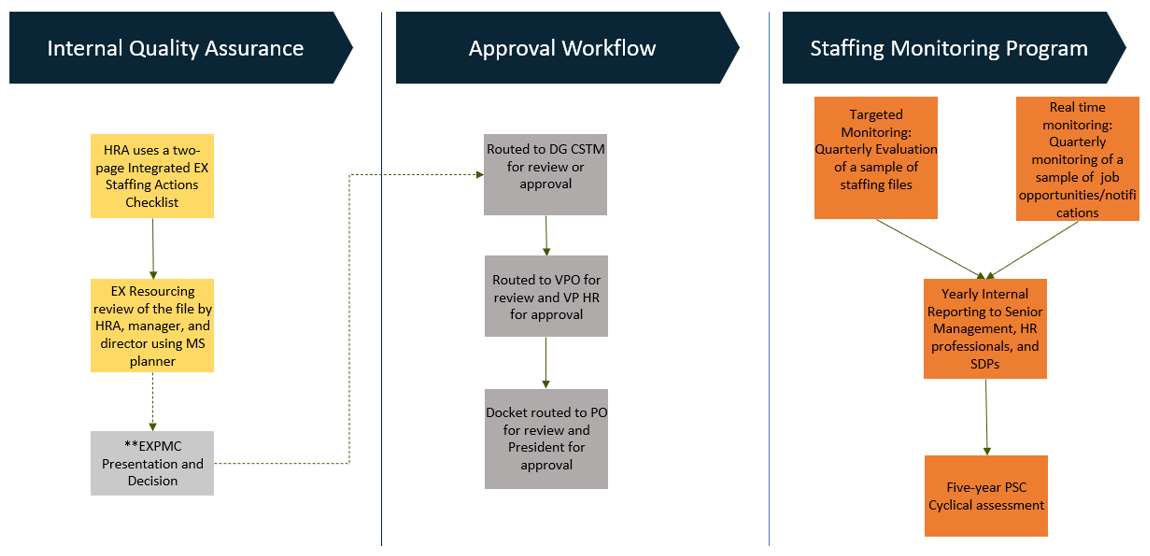
Image description
A flowchart of the key steps in the monitoring and oversight process. The three levels of the process are: Internal Quality Assurance, Approvals Workflow, and Staffing Monitoring Program.
- 1. Internal Quality Assurance
-
- The HRA uses a two-page Integrated EX staffing Actions Checklist to capture and document all requirements of the staffing file
- The quality and completeness of the files is reviewed by HRA, manager and director of EX Resourcing (this workflow is facilitated by Microsoft Teams Planner application)
- Staffing file is presented to the EXPMC for decision
Note: EXPMC was paused in and is expected to resume in the fall of 2025 with a new mandate. During the scope of the audit, EXPMC tabling was required for high-risk staffing actions and actions would only proceed if endorsed.
- 2. Approvals Workflow
-
The review and approval process moves in the following order, receiving review and/or approval at each level:
- Routing to the DG of CSTM
- Routing to the Vice President's Office of Human Resources
- Routing to the President's Office
- 3. Staffing Monitoring Program
-
This includes the following steps:
- targeted monitoring, which consists of quarterly evaluation of a sample of staffing files
- real time monitoring, which consists of quarterly monitoring of a sample of job opportunities/notifications
- yearly internal reporting to senior management, HR professionals, and sub-delegated persons (SDP) on the results of the targeted monitoring and the real time monitoring
- the annual results are compiled and reported as part of the five-year PSC cyclical assessment
Notes:
- 1. Internal Quality Assurance (QA)
-
The EX Resourcing Division performs internal QA on each staffing file, its compliance with key requirements, and the written selection decision.
- 2. Approvals Workflow
-
Oversight is provided on each staffing file as it progresses through different levels of senior management review and decision before approval by the "Appoint" authority.
- Acting appointments of between 4 and 12 months are approved by the DG of Classification, Staffing, and Talent Management
- Indeterminate appointments or acting appointments greater than 12 months are approved by the President
- 3. Staffing Monitoring Program
-
The Corporate Staffing Unit of the HRB conducts sampling of completed staffing files to ensure compliance of staffing appointments.
Appendix F: Acronyms
- CBSA
- Canada Border Services Agency
- CSTM
- Classification Staffing and Talent Management
- DG
- Director General
- EE
- Employment Equity
- EX
- Executive
- EXPMC
- Executive People Management Committee
- EXSAR
- Executive Staffing Action Request
- HRA
- Human Resource Advisor
- HR(B)
- Human Resources (Branch)
- LOO
- Letter of Offer
- NAA
- Notice of Acting Appointment
- NAPA
- Notification of Appointment and Proposed Appointment
- NOC
- Notice of Consideration
- PSC
- Public Service Commission of Canada
- PSEA
- Public Service Employment Act
- RDG
- Regional Director General
- SOMC
- Statement of Merit Criteria
- SMP
- Staffing Monitoring Program
- VP
- Vice-President
Page details
- Date modified: