
Audit of costing
Internal Audit and Program Evaluation Directorate
March 2026
Table of contents
- Introduction
- About the audit
- Significance of the audit
- Statement of conformance
- Audit conclusion
- Summary of recommendations
- Management response
- Audit Findings
- Appendix A: Audit criteria
- Appendix B: Terms and definitions
- Appendix C: Sample testing results
- Appendix D: Acronyms
Introduction
The Canada Border Services Agency (hereafter the CBSA or the agency) processes millions of travellers, shipments, duties and taxes every year, as part of its mandate to facilitate the free flow of legitimate trade and travel. The CBSA’s ability to deliver on its mandate, priorities, programs and services depends on its ability to effectively estimate, budget, manage, monitor, and control costs.
Costing is essential in the federal government because it underpins the stewardship of public funds, ensuring that programs, policies and initiatives are grounded in accurate financial information and clear assumptions. Costing involves identifying and predicting the financial resources needed to achieve a desired outcome. It provides the foundation for sound fiscal management, demonstrates accountability, supports effective resource allocation and helps the agency make informed decisions that withstand public oversight and scrutiny.
The Treasury Board Secretariat (TBS) Directive on the Management of Projects and Programmes prescribes that government projects and programmes are to be effectively planned, implemented, monitored, controlled, and closed to enable the realization of the expected benefits and results for Canadians.
Stemming from this directive, the TBS Guide to Costing explains costing in the Government of Canada (GC) and outlines the principles and process, along with the corresponding approaches and techniques, in order to develop credible costing information.
About the audit
The objective of this audit was to assess whether the CBSA costing activities are adequate, effective and costing activities for projects are in compliance with applicable TBS policies and directives to support credible cost estimation for projects and other types of investments.
Audit scope inclusions
The scope period spanned to and centered on the assessment of the following elements:
- Effectiveness of costing exercise, oversight activities, processes, controls and related policies for investments (Treasury Board [TB] funded and internally funded) to support credible cost estimation.
- Compliance with GC policy instruments and alignment with TBS expectations.
- Roles, responsibilities and accountabilities of stakeholders implicated in the costing activities.
- Early engagement and timely communication between all key stakeholders including internal and/or external stakeholders, as required for the development of a costing exercise, as well as obtaining feedback.
Audit scope exclusions
The audit scope excluded the following:
- Project Management processes, activities and governance beyond the preparation and oversight of project costing activities.
- Integrated Business Planning and Investment Planning processes
- Accuracy and reliability of costing estimates
- Financial coding of expenditures (slated for an upcoming audit)
- CBSA costing methodologies (evaluation of force generation model slated for 2026)
Refer to Appendix A for additional details on audit criteria and lines of inquiry.
Audit methodology
- 75+ CBSA stakeholders interviewed
- 500+ supporting documents reviewed
- 14 sample files reviewed (total value of $890 million)
The agency’s portfolio is complex with investments that can evolve into projects or initiatives or could be a combination of multiple investment types (project/initiative or pilot/project, etc.). The costing process is applicable to any investment type and requires evidence-based and credible cost estimates. The audit used data to select a sample of investment files focused on complexity of investment as well as the stage of advancement within the investment lifecycle.
The audit prioritised investments with inherently higher risk due to the necessity of planning and costing non-recurring activities. In contrast, investments operating in the volume-based permanent funding environment and leveraging standard CBSA-approved costing models and methodologies (Force Generation, Internal Services, Cost Analytical Model, Cost per Claimant, Staff Availability Factors, Standard Costs) represented a lower risk and were scoped out.
Significance of the audit
In 2024 to 2025, through the Government of Canada’s Border Plan, the CBSA received over $355 million to strengthen border security via additional personnel, new technology, and enhanced operational coordination. Concurrently, the agency advanced its modernization efforts through initiatives like Traveller Modernization, improved e-commerce processing, preparing the Gordie Howe International Bridge port of entry for operationalization, and launched the CBSA Assessment and Revenue Management (CARM) system.
Given the scale and complexity of the agency’s operations, as well as the investments it undertakes, it is essential that costing practices reflect a high standard of stewardship, integrity, and consistency.
In recent years, high-profile federal initiatives have drawn attention to the risks of weak costing practices, including budget overruns, unclear financial accountability, and diminished trust. Inaccurate or incomplete costing can lead to misinformed decisions, budget overruns, and eroded public confidence in the delivery of the projects to support the border of the future. Public confidence in government spending depends on the integrity and stewardship with which public funds are managed.
Statement of conformance
This audit engagement conforms to the Treasury Board's Policy and Directive on Internal Audit and the Institute of Internal Auditors' (IIA) Global Internal Audit Standards, as supported by the results of the quality assurance and improvement program. Sufficient and appropriate evidence was gathered through various procedures to provide an audit level of assurance. The agency's internal audit function is independent, and internal auditors performed their work with objectivity as defined by the IIA's Global Internal Audit Standards.
Audit conclusion
Costing process and related activities are fundamental in any organization where resources are consumed to produce goods, provide services, or manage projects. It helps track and assign actual expenses accurately to specific activities, aligning spending with the organization's strategic goals and priorities, as well as with applicable financial policies and accounting standards. Additionally, a carefully designed and implemented costing process provides for the effective management of financial inputs as a valuable corporate asset, ensuring that budgetary and regulatory requirements are met while enabling informed decision-making.
The audit found that CBSA’s costing maturity could be improved by addressing foundational elements in the areas of roles and responsibilities, training, guidelines, retention of documentation, and continuous improvement practices. Development of a robust costing process and direction from costing experts, paired with diligent review, validation and associated accountability mechanisms, will be required to improve the credibility of costs and funding decisions. The agency has recognized the need to improve in this area and has started to take steps to address the gaps through the CBSA Investment Plan 2025 to 2030. Sustained attention to resolving these gaps in the costing process is necessary to maintain sound financial stewardship and ensure robust financial management in the future.
Summary of recommendations
- Clarify and communicate roles, responsibilities, and accountabilities of all stakeholders involved in the costing exercise.
- Develop, implement, and communicate a Costing Framework to standardize costing activities, including methodology, evidence gathering/retention, challenge/validation processes, and continuous improvement mechanisms.
- Formalize and communicate costing learning material.
Management response
Overall, the Vice-President of the Finance and Corporate Management Branch (FCMB) is in agreement with the audit recommendations. The agency remains committed to improving project costing practices. In recent years, the agency has begun to develop in-house guidance, strengthened collaboration between the CBSA Costing Centre of Expertise and the Enterprise Investment and Project Management Office (EIPMO), and entered into a Memorandum of Understanding with the Office of the Comptroller General to provide additional advice and guidance. The recommendations build on work that is underway and align with improvements to be undertaken as identified in the agency’s investment plan. The FCMB will work with applicable stakeholders and leverage current government best practices to define costing roles and responsibilities, implement a Costing Framework, and to bolster guidance and learning.
Audit findings
The audit resulted in the findings below.
Costing requirements and resources
Centrally, GC guidance on costing is established by the TBS in the Directive on the Management of Projects and Programmes. The Directive, along with the accompanying Guide to Costing and Guide to Assessing Cost Estimates, mandates that federal government project and program plans must clearly outline costs for investments, and that these plans must align with strategic priorities.
The guidance prescribes a seven-step approach to costing. It helps ensure that all federal organizations follow a common, rigorous process when developing the cost information for all types of programs, policies and initiatives. The guidance also emphasizes the principles and techniques needed to develop credible cost estimates that are process-driven, evidence-based, risk-assessed, validated, and documented.
The TBS provides an independent challenge function on the agency’s investment spending proposals to ensure value for money and alignment with government priorities. This review helps ensure that investments are designed to realize their intended outcomes effectively and efficiently. As per the TB Submissions Overview, the TBS analysis supports ministers in their final decision to grant authorities (like access to new funding) and strengthens the overall oversight of federal expenditures.
The CBSA Costing Centre of Expertise (CCE), within FCMB’s Strategic Finance and Costing Division, provides costing expertise, direction and tools to ensure agency compliance with the TBS costing policies and associated guidance. The CCE is the authority on the development and application of the agency’s costing methodologies. Its mandate is to provide support and guidance in the development of cost estimates and to exercise a review and challenge function.
At the agency, costing requirements are typically triggered through the CBSA Investment Planning Process for digital and non-digital investments including real property, which could be internally and externally funded through a TB submission.
While the CBSA’s CCE is the functional authority, a costing exercise is a collaborative effort that involves multiple stakeholders with a range of knowledge and expertise. At the CBSA, the responsibility over the costing process, its control, and monitoring, relies on multiple stakeholders, beginning with the Office of Primary Interest (OPI) launching investments, supported by FCMB stakeholders who may provide guidance or challenge cost estimates, as well as governance committees responsible for monitoring and providing oversight on costing results. Specifically:
- The OPI (team leading a specific branch investment) defines the investment’s initial cost, schedule and scope, and gathers costing inputs from the offices of collateral interest.
- The Financial Management Advisors (FMA) review, challenge, validate and provide feedback on investment/costing templates and project artefacts across all investments throughout their lifecycle.
- The Strategic Finance Unit (SFU) supports management teams through the TB Submission process, acts as a liaison with TBS, OPIs and the CCE, and supports the CFO attestation when seeking TB Submission approval.
Roles and responsibilities
The TBS Guide to Costing prescribes roles and responsibilities with the expectation that organizations adapt them as appropriate. A matrix of roles and responsibilities were defined and endorsed by CBSA governance in 2021, delineating the responsibilities of the branches leading the CBSA costing activities. However, roles and responsibilities specific to costing life cycle activities are not fully articulated in the endorsed matrix as well as in the CBSA guidance. Communicating an updated process could improve clarity among stakeholders, reduce inconsistencies in practices, and result in better accountability for the quality of the cost estimates.
There is an opportunity to bridge the gap between the foundational TBS direction and the detailed application required to effectively address the agency’s unique complexities.
Recommendation 1
The Vice-President (VP) of the FCMB should clarify and communicate the roles, responsibilities and accountabilities of all stakeholders involved in conducting and reviewing the costing exercise, including the sequencing of activities, recommended timeframes for approvals and expectations to meet the criteria of a quality cost estimate as defined by TBS guidance.
Management response: The VP, FCMB, agrees with this recommendation as it will clarify expectations and ensure consistency across the organization and is in line with work underway. The FCMB will formalize the roles, responsibilities and accountabilities for stakeholders involved in costing exercises in alignment with TBS published guidance and in collaboration with implicated agency stakeholders. The FCMB will ensure the final documents are published and communicated. The FCMB sees this deliverable as complimentary to the Costing Framework to be developed, and will align the actions to be taken with those identified in Recommendation 2.
Completion date: December 2026
Guidance and methodology
Standardized tools and templates are essential for establishing a robust and consistent costing process across an organization. Standardized documentation ensures that all necessary data points are captured and tracked in a uniform manner, facilitating accurate analysis, reporting, and future use of data as a baseline.
At the CBSA, in recent years the CCE established a CBSA Costing Community and shares a number of guidance documents on the CCE intranet page, including the CBSA Costing Template and User Manual, and the Guide on risk, uncertainty and contingency, among others. Costing stakeholders reported difficulties using the guidance because it is not precise and offers limited instructions for practical application, noting it references the TBS guidance without providing agency-specific clarifications. Despite sessions provided by TBS to clarify expectations, CBSA still experienced challenges and require more specific guidance.
There is an opportunity to develop tailored guidance and tools to address specific organizational needs, improve clarity and consistency of practices.
Recommendation 2
The VP of the FCMB should strengthen the agency’s costing practices by developing, implementing and communicating a Costing Framework that mandates a standardized, rigorous approach to all agency costing activities by taking into consideration costing process methodology, evidence gathering and retention practices, challenge and validation processes, as well as continuous improvement mechanisms.
Management response: The VP, FCMB, agrees with this recommendation. It is in alignment with commitments identified in the agency’s Investment Plan and supports consistent costing activities. The FCMB will articulate a Costing Framework in alignment with TBS published guidance and will incorporate the work undertaken as per Recommendation 1. The agency is currently updating it’s Project Management Framework. Work will account for alignment to the Project Management Framework to the degree possible while it is under development.
Completion date: February 2027
Tools and costing information capture
The CBSA Costing Template (the Template) is the agency’s mandatory tool for costing federal budget requests, reprofile requests and internally-funded investments. Developed by the CCE, the Template fosters quality and reliability of the calculations, as well as consistency across costing exercises. Final cost calculations are auto-populated by the Template by combining data manually entered by the OPI with embedded CBSA costing methodology. FMA and CCE are responsible for ensuring that the Template is used and completed, as well as reviewing and challenging the numbers, which helps support comprehensive, reasonable and defendable estimates. Some gaps were noted in relation to the Template, namely:
- Absence of guidelines for using the tool because the associated user manual is out-of-date and updating it is ongoing. However, the CCE offers coaching on its use upon request.
- Though the Template is mandatory, stakeholders sometimes use their own workbooks or other government department (OGD) templates. These may lack critical elements, such as the CBSA’s standard costing methodologies, standard rates, etc.
- Through the audit’s review of costing files, it was noted that the Template was not always thoroughly filled out. This made it difficult to trace historical changes to estimates and understand the rationale behind specific assumptions and inputs.
These inconsistent practices and incomplete information capture, resulting from a lack of clear guidance and deviation from the use of standard templates, compromise the quality and comparability of outputs.
Documentation retention
The TBS Guide to Costing requires all costing documentation to thoroughly describe the full scope of the exercise and explicitly cover all prescribed steps. There is currently no process or requirement for the retention of key costing documentation in a standardized manner, which would help support compliance with TBS requirements.
Aside from the Template, versions of which are retained centrally, associated costing documentation was dispersed in various locations. The documentation was found to be inconsistent and insufficient to justify key assumptions and decisions supporting the costing exercise. This holds particularly true in instances where an investment spans many years or where teams experienced significant turnover, resulting in the loss or inaccessibility of corporate and historical knowledge related to the costing file (for example, missing documents, password-protected files, locally-saved versions). Issues with version control (such as failing to identify final copies) were also noted. As a result of gaps in documentation, it was difficult to understand or assess the depth and breadth of costing work and due diligence performed in the costing files reviewed as part of the audit.
Retaining documentation in a designated location is important to ensure transparency, accountability, and compliance with TBS expectations, and to support informed decision-making and future auditability.
Maintenance and continuous development of costing expertise
Within the GC guidelines, the CFO is expected to lead the establishment of a costing capacity and to strengthen expertise with the assistance of the CCE, which provides support through training, guidance, and tools. Due to the diverse investment portfolio, the agency’s costing is a complex process requiring a specific set of skills and knowledge. The agency costing activities extend to multiple types of investments, including digital, non-digital and real property. Costing digital investments, particularly those relying on emerging technologies (for example, AI, cloud computing) presents a challenge. CBSA stakeholders report insufficient expertise to reliably conduct in-house costing or to scrutinize externally provided estimates, such as those produced by OGD partners or other stakeholders.
The audit noted a wide variety of levels of costing expertise: some projects and agency branches have dedicated, in-house costing groups (for example, within Traveller Modernization, Strategic Policy Branch, Information Science and Technology Branch), while other OPIs must carry out the costing exercise with limited costing experience or knowledge, impacting their ability to plan costing activities and develop, substantiate and refine cost estimates. Similar observations were shared by TBS, emphasizing the importance for the CBSA to maintain and continuously develop enterprise costing capacity and expertise.
Though expertise in the domain can be reinforced by way of training/learning and raising awareness, the CBSA does not currently prescribe, provide or recommend any costing-related training for individuals undertaking costing activities.
The GC Costing Community of Practice webpage offers limited dedicated training, and the CBSA’s FCMB launched financial management training in 2025 but it does not address costing.
Providing targeted, costing-specific training or learning products presents a significant opportunity to strengthen the agency’s financial management practices by enhancing the rigour of the initial cost estimation planning exercise and subsequent phases of the costing lifecycle. Improving the availability of such products could mitigate key risks, including inaccurate cost estimates, scope creep, and inefficient resource allocations, ultimately leading to more robust accountability and sound, evidence-based decision-making.
Recommendation 3
The VP of the FCMB should formalize and communicate the requirements for costing-focused learning materials that are tailored to specific costing roles, to ensure all staff involved in costing exercises possess the necessary skills and knowledge required to produce robust and credible cost estimates.
Management response: The VP, FCMB agrees with this recommendation. This recommendation supports work already underway and is in alignment with commitments identified in the agency’s Investment Plan. The FCMB supports the need to increase knowledge and learning, and has undertaken actions to date including the establishment of a CBSA Costing Community with both GC and CBSA-specific guidance available, and provides advice and coaching. The agency will continue to bolster guidance and facilitate access to learning.
Completion date: February 2027
7-Step costing process
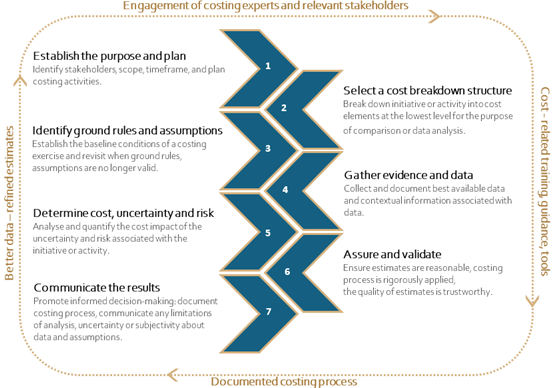
Costing is a critical discipline for ensuring that public funds are allocated responsibly and are developed using a sound, transparent, and consistent methodology. The TBS Guide to Costing prescribes an iterative process for costing which includes the following steps:
Figure 1: 7-Step costing process*
Text version
Figure 1 is a graph outlining key steps in the costing process. It includes seven core steps inside the graph that shows the costing process flow, surrounded by four enabling activities that apply throughout the process.
Step 1. Establish the purpose and plan by Identifying stakeholders, scope, timeframe, and plan costing activities.
Step 2. Select a cost breakdown structure by breaking down initiative or activity into cost elements at the lowest level for the purpose of comparison or data analysis.
Step 3. Identify ground rules and assumptions to establish the baseline conditions of a costing exercise and revisit when ground rules, assumptions are no longer valid.
Step 4. Gather evidence and data by collecting and documenting best available data and contextual information associated with data.
Step 5. Determine cost, uncertainty and risk by analysing and quantifying the cost impact of the uncertainty and risk associated with the initiative or activity.
Step 6. Assure and validate by ensuring that the estimates are reasonable, that costing process is rigorously applied, and that the quality of estimates is trustworthy.
Step 7. Communicate results to promote informed decision-making by documenting the costing process, as well as communicating analysis limitations, uncertainties, or subjectivities surrounding the data and assumptions.
The four enabling activities supporting the process include engagement of costing experts and relevant stakeholders, access to cost-related training, guidance, and tools, documentation of costing process, and reliance on better data that leads to more refined estimates.
*Graph developed by the Internal Audit Division, adapted from the TBS Guide to Costing.
Refer to Appendix C for detailed sample testing results.
Steps 1 to 2: Planning
Effective planning of the costing exercise is critical to ensure the accuracy, completeness, and relevance of the resulting cost information for effective decision-making. Cost planning involves defining the full scope of activities that the costing process entails, articulating objectives, timelines, specific cost elements to be included, identifying necessary stakeholders and subject matter experts (SME), and reviewing lessons learned from previous exercises. Audit consultations and a review of costing files revealed limited evidence of such planning before work begins.
Stakeholder engagement
The audit noted the absence of a prescribed process for initiating costing engagements or proactively guiding OPIs before work begins. Paired with a lack of clarity around roles and responsibilities, this leads to OPIs typically involving FMA and CCE experts after developing their cost estimates. Early and sustained stakeholder engagement, combined with timely and proactive communication of available CBSA costing tools and guidance, could help ensure OPIs perform an effective costing exercise planning. Without proper engagement of costing experts, the agency is exposed to risks such as inconsistent inputs, unexpected cost drivers, and insufficiently informed decision-making. These risks can be mitigated by using standardized tools and guidance, and engaging SMEs early. Proactive communication of costing resources helps ensure OPIs have the necessary support for developing and refining estimates throughout the investment lifecycle.
Cost breakdown structures
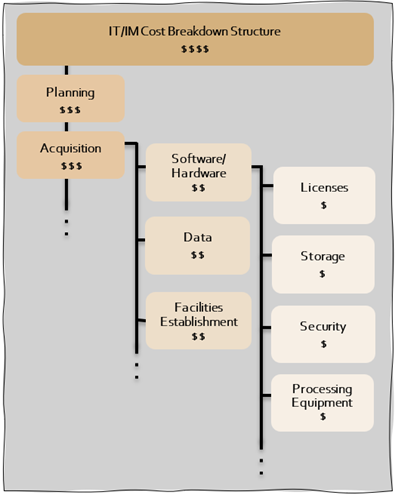
A key element in the planning stages is the development of a detailed cost breakdown structure (CBS), which is fundamental to a bottom-up costing approach (the agency’s adopted approach). It identifies costs at the lowest activity level and facilitates better tracking and analysis of spending variances over the life of the investment, and sets the stage for the analysis of comparable data from other investments to predict future costs. In the rare instances where agency costing files referenced a CBS, it was found to be generic or insufficiently detailed to account for investment specifics, risks, or evolving scope. A non-comprehensive CBS could lead to an under-estimation of the cost if cost elements are omitted.
Figure 2: Example of a cost breakdown structure*
Text version
Figure 2 presents a simplified example of a cost breakdown structure. The figure breaks down information technology and information management (IT/IM) costs from a high-level overview into specific operational components, using dollar signs to indicate cost tiers. The highest tier represents the overall cost for IT/IM expenses, which carries four dollar signs.
Two sub-level cost activities stem vertically from the main tier, labeled Planning and Acquisition, each designated with three dollar signs. Vertical ellipsis dots appear below these activities, implying further activities could exist.
Branching horizontally and down from the Acquisition cost activity are three cost components, labeled Software/ Hardware, Data, Facilities Establishment, each designated with two dollar signs. Another set of vertical ellipsis dots continues below this column to imply other categories of cost components.
Branching further down from the Software/ Hardware cost category are four subcomponents, labeled Licenses, Storage, Security, Processing Equipment, each marked with a single dollar sign. A final set of vertical ellipsis dots continues below this last column.
*Simplified example of a cost breakdown structure, developed by the Internal Audit Division, adapted from the GC Costing Community webpage.
Steps 3 to 5: Estimation and refinement
To ensure credibility throughout the costing process, robust estimations must incorporate quality data from reliable sources, reasonable costing assumptions, risk and uncertainty analysis, documented contingencies, due diligence activities, and regular monitoring. Audit observations show inconsistencies in the agency’s costing practices, which may undermine the reliability, transparency, and credibility of investment cost estimates. Gaps include a limited use of relevant data to inform the costing exercise, the absence of supporting documents to substantiate the costing figures, insufficient risk analysis and contingency planning, and a lack of evidence of estimate refinement over the investment’s lifecycle.
Using data
Per TBS guidelines, OPIs are expected to use evidence-based costing methods, drawing on actual data, historical benchmarks, expert input, and external sources. This practice helps support assumptions with empirically-grounded evidence, contributing to the accuracy and reliability of planned cost estimates and ultimately improving informed decision-making over the investment. TBS guidance expects historical data to be leveraged and a rationale should be provided for instances when such data is available but not used. The files reviewed as part of the audit showed limited evidence that such data sources were searched, examined, or leveraged. The audit also found that early reviews of similar investment costs were not consistently performed, a practice OPIs noted would have strengthened their cost estimates. This gap in practice was attributed, in part, to challenges with accessing a fulsome list of previous costing exercises, and to previous CBSA costing data being difficult to locate or leverage.
Documented substantiation
According to TBS guidance, in order for costing information to be credible, it must be traceable, transparent, and “documented in depth”. The OPI is expected to clearly document key costing information, supported by sufficient details, including costs that were not included in the costing exercise. In the CBSA files reviewed by the audit, costing assumptions, constraints, and key decisions and information (such as investment scope, costing methods, timelines, etc.) were often undocumented or too generic to link clearly to specific cost drivers. For example, in some costing files, the Template did not contain relevant information in the section designated for assumptions. Instead, these sections were frequently empty or contained "To Be Determined" statements. This lack of standardized tracking and inaccessible supporting data or documentation makes it difficult to support estimated numbers, trace changes, or validate the figures. Gaps in documentation also represent a missed opportunity in a context where the agency is expected to leverage historical data to inform costing of future investments.
Risk analysis and contingency planning
The TBS Guide to Costing defines contingency as a reserve of funds allocated to an investment budget to address unforeseen expenses or risks. Its purpose is to ensure financial resilience and allow the OPI to adapt to unexpected challenges without exceeding the overall budget. By systematically accounting for "known-unknowns" (that is anticipated risks, such as inflation), a contingency contributes to a more realistic budget and supports transparent risk management.
To ensure reliable estimates, credible costing information must incorporate the financial impacts of uncertainty and risk. In the files reviewed as part of the audit, a systematic risk and uncertainty analysis was generally missing. Contingencies were either omitted or based on arbitrary percentages without robust rationale. As noted by stakeholders, although internal guidance and CCE support exist, they are high-level and lack practical, specific instructions for performing a thorough analysis and developing realistic contingencies. Having recognized this gap, the agency established a Memorandum of Understanding with TBS in 2025 for costing support and guidance, including around risk and uncertainty analysis.
What is a contingency?
In a hypothetical scenario, to mitigate the risk of rising costs for building materials, a $5M construction project might calculate the need for a contingency fund ($500K). If the cost of lumber increases by $300K, the contingency fund will absorb the unexpected costs and prevent a potential project delay or budget overrun.
Case study: Recourse e-Portal
Originally planned to be completed within 6 months and a budget of $1.1M, the CBSA’s Recourse e-Portal project was discontinued due to unanticipated post-implementation costs after 3 years and over $2M in costs. Ongoing costs rose from the originally estimated $250K to over $840K per year. The investment was canceled nearing completion because expected benefits no longer justified the costs.
The audit found no evidence that a risk and uncertainty analysis was performed when cost estimates were initially developed. A 20% contingency was applied, as suggested by CCE, which did not account for project-specific risks, like dependencies on OGD partners.
The OPI closure review identified the following critical lessons that contribute to contingency planning challenges:
- setting realistic expectations and timeframes
- early and ongoing engagement with OGDs to ensure work prioritization
Estimate refinement
Initial cost estimates should be revisited and refined by the OPI and then challenged by experts (CCE and FMA) as the investment progresses, to increase accuracy, manage uncertainty and risk, and support informed decision-making. Over time, more details become known (such as specific deliverables or vendor quotes) and estimates should, accordingly, become more detailed and precise.
The agency traditionally managed the cost refinement process by using a simple percentage-based method, narrowing a broad initial range (for example +/-100%) to a more precise one (for example +/-10%). This aimed to establish a "baseline cost" for tracking spending and identifying overruns. However, through lessons learned exercises, some stakeholders concluded that this approach is not the most effective way to refine cost estimates.
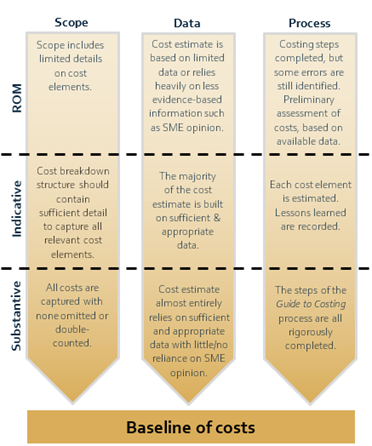
Recent guidance from the TBS promotes a more thorough, quality-driven approach to measure the quality of cost estimates focused on robust data and full process completion, including risk assessment. The TBS Framework outlines a progression of the quality of cost estimates, starting with "rough order of magnitude" (ROM) estimates, which use limited initial information and have a high potential for change. As refinement progresses, estimates then advance to "indicative" quality as sufficient data becomes available to reduce variability. The goal is to achieve "substantive" quality, relying on high-quality data that results in a low probability of significant future changes.
Figure 3: Estimate refinement process*
Text version
Figure three illustration outlines the maturation and improvement in the quality of cost estimate across three estimate levels. It features three downward- pointing vertical arrows representing three parallel streams: scope, data, and process. These streams are divided horizontally by dashed lines into three progressive estimate levels, labeled from top to bottom along the left side as rough order of magnitude (ROM), indicative, and substantive cost estimates. All three arrows converge at the bottom onto an output labeled “baseline of costs”.
At the ROM estimate level, the Scope column notes that the scope includes limited details on cost elements. The Data column indicates that the cost estimate is based on limited data or relies heavily on less evidence-based information such as SME opinion. Under the Process column, costing steps have been completed, though some errors are still identified, leaving a preliminary assessment of costs based on available data.
At the indicative estimate level, the Scope column states that cost breakdown structure that should contain sufficient detail to capture all relevant cost elements. The Data column transitions to having the majority of the cost estimates built on sufficient and appropriate data. For the Process column, each cost element is estimated, and lessons learned are recorded.
At the substantive estimate level, the Scope column specifies that all costs are captured with none omitted or double-counted. In the Data column, the cost estimates almost entirely relies on sufficient and appropriate data with little to no reliance on SME opinion. Finally, the Process columns states that the steps of the Guide to Costing process are all rigorously completed.
*Illustration developed by the Internal Audit Division to demonstrate improvement in the quality of estimates throughout the investment’s lifecycle, adapted from the TBS Guide to Assessing Cost Estimates (not an exhaustive list of considerations).
Audit consultations identified that the agency lacks the expertise and guidance to assess cost estimate quality. This gap hinders both the OPI in refining their estimates and the CCE and/or FMA in performing their challenge function. A review of costing files surfaced:
- limited evidence of cost refinement to reflect increasing precision over the investment’s lifecycle
- limited documentation retained on file to substantiate cost estimates
- cost estimates that heavily relied on SME opinion rather than being evidence-based and rooted in relevant data
Some of these gaps are due to the previously noted lack of agency-specific guidance for OPIs and for the CCE/FMA, and to the absence of fields in the Costing Template to include such information or evidence.
Failing to implement a robust, iterative costing process can lead to unreliable estimates, which in turn can cause material cost overruns and schedule delays. Building on the agency’s past experiences with cost management, regularly updating estimates with quality data would enable the OPIs to proactively identify potential impacts and quantify their financial effects, and develop appropriate contingency plans and mitigation strategies. This focus on robust, evidence-based costing and rigorous documentation is essential for ensuring successful investment outcomes and holding OPIs and other stakeholders accountable for delivery going forward.
Case study: Officer experience
An important part of the CBSA’s Traveller Modernization initiative, Officer Experience is a fulsome project worth over $100M.
Despite the project amount, the investment's cost refinement did not meet TBS quality requirements (that is, the quality of the estimates did not achieve the expected level of precision necessary to support the funding request), requiring the agency to request exceptions for the 2024 and 2025 submissions.
TBS raised concerns regarding cost uncertainty and potential fluctuations, insufficient cost breakdowns, and the need for better justification and elaboration of cost assumptions. Addressing these deficiencies is critical, as failure to do so risks poor financial management and an increased likelihood of project cost overruns. Without solid cost estimates and reliable spending data, effective control and tracking of finances become difficult.
Steps 6 to 7: Review, validation and challenge function
Challenge, validation and oversight
Review, validation, and attestation by experts are critical steps in the costing lifecycle, helping ensure the completeness and reliability of estimates. At the CBSA, this expertise is provided by the CCE and FMA. Consultations with stakeholders indicate that some agency costing exercises may not have been reviewed by CCE due to resource availability and prioritization, particularly during periods of resource shortage or when the CCE is notified of the costing exercise too late in the process. Conversely, FMAs do not view themselves as costing experts; however, the agency’s new 2025-2030 Investment Plan has committed to increasing FMA engagement in challenging cost estimates and documenting relevant concerns.
While the involvement of these experts is crucial for robust validation, their contributions are often not kept on file. Inconsistent documentation and informal communication channels for expert consultations present a significant risk to the accuracy and auditability of the costing process. A review of documentation, including Costing Templates and records of consultations with CCE, FMA and other stakeholders, showed that expert feedback is frequently shared informally (for example, via email or in discussions) rather than being formally documented and kept centrally. Furthermore, some formal assessment reports prepared to support governance approval requests were missing experts’ conclusions or details on the scope of the elements they examined. The lack of a formal, traceable record of expert reviews increases the risk of costing errors, compromised investment auditability and impact on informed decision-making.
To align with TBS expectations, the validation process should include an independent party assessment and reperformance (“reproduction”) of cost estimates using evidence submitted by the OPI. CBSA guidance does not stipulate such a requirement. Consultations with the TBS CCE on the agency’s costing practices indicated that the CBSA has not submitted independent assessments in recent years; this was flagged as a concern, since it is one of the key aspects required to achieve “substantive” cost quality. The CBSA’s CCE identified a lack of explicit guidance and/or tools for validating the quality of cost estimates, noting they were unsure how to affirm to the reliability of the estimates. The need for additional clarity on cost quality requirements, coupled with insufficient documentation demonstrating estimate refinement, may diminish confidence in the agency’s overall costing process. Recently issued TBS Guidance on Assessing Cost estimates is expected to better define classification of quality requirements for cost estimates.
Experts’ assessment reports are provided to CBSA governance bodies, along with reports and dashboards which include a cost health rating. The audit’s review of committee materials found that the information appears to be high-level and insufficiently detailed to support a thorough comparative analysis of planned and actual spending. To ensure meaningful oversight, it is essential to report all costing data needed for making sound decisions whenever investment conditions shift or funding received is less than anticipated. This includes showing how changes in costs or funding received alter planned activities and results—specifically highlighting any reduction in investment scope or loss of expected benefits.
Treasury board submission and CFO attestation
The CFO Attestation is a formal requirement for all Memorandum to Cabinet and TB Submissions. It provides independent assurance to decision-makers that the financial information is reliable, transparent, and based on robust due diligence. This attestation confirms the CFO’s confidence regarding the following areas, among others, following a due diligence review:
- quality of the cost estimates
- documentation and reliability of key assumptions and reasonableness of contingencies
- sensitivity of the financial requirements to changes in key assumptions
For investments seeking TB approvals, OPI costing information must be reviewed and challenged as part of the assurance reporting process that supports the CFO attestation. During the development of this assurance report, the CCE and SFU are required to conduct a mandatory assessment, attest to the OPI’s information's quality and reliability, and to raise concerns. Audit consultations with the CCE and SFU indicated that delays are common in receiving the OPIs’ submission of costing information for review. When experts are engaged late, they may lack sufficient time for thorough reviews, resulting in attestations that flag high-level concerns without detailed commentary on cost estimates' credibility and contingency planning, thereby failing to meet TBS standards.
Further, while the standard TB Submission process takes approximately six months, there are provisions for expedited timelines in exceptional circumstances, further compressing the time available for internal expert review. The fast-paced nature of some TB submissions can also impact the quality of the financial information. The robustness of the CFO's attestation increases with complete risk assessments, well documented assumptions and detailed estimates.
It is important to recognize that despite the agency’s growing portfolio and high volume of costing-related activities, the CCE’s capacity is limited. This constraint has progressively intensified in recent years, with the CCE currently operating with 4 full-time equivalents due to turnover.
Inaccurate or incomplete information may necessitate increased questions and exchanges with central agencies, extend the timeframes for approvals, and increase the probability of additional rounds of re-costing and/or conditions being imposed on the agency. Combined, these gaps can impact the agency’s ability to conduct the necessary due diligence for the CFO attestation.
Continuous improvement
A formalized and consistent lessons learned process is essential for the continuous improvement of costing methodologies. Upon examination of the lessons learned logs within the sampled files, as well the CBSA Lessons Learned Library, the audit found that consulting previous lessons learned is not a prevalent practice. Few OPIs formally record costing-specific insights throughout the investment lifecycle, and advice from the CCE is not consistently documented or centrally available. This absence of formal documentation and analysis of historical data and actuals, and expert knowledge, hinders effective collaboration, leads to recurring issues, and prevents the identification of root causes for cost variances. Addressing these gaps would foster consistency and continuous improvement in cost estimation practices.
Examples of costing lessons learned (identified by OPIs in their lessons learned logs)
- Lack of early or timely stakeholder engagement for gathering costing inputs and/or reviewing costing information.
- Inaccurate scope definition, when cost estimates accounted for deliverables that were outside the investment scope, or omitted costs for required components.
- Cost underestimation and insufficient/missing contingencies, resulting in subsequent investment scope adjustments (de-scope) to align with available budgets.
The agency has committed to specific changes in its recent Investment Plan to address continuous improvements, notably by instituting mandatory CCE consultation for all investments subject to the Project Management Framework and seeking governance approval. There is a further opportunity to apply these consultations to the entire investment portfolio from the earliest planning phases to reduce the risk of using unsubstantiated estimates from early costing activities. Additionally, the agency is evaluating different models for the costing function, such as embedded expertise in each branch, to enhance its capacity and the thoroughness of its costing function. Conducting a capacity assessment to map the required volume of activity against the capacity of the CCE team may also generate insights for determining the appropriate model for the provision of CBSA’s costing expertise.
To ensure the successful delivery of investment outcomes within approved budgets, the agency is proactively enhancing its financial management practices. Addressing current inconsistencies in the costing process will strengthen credibility with oversight bodies and reinforce commitment to sound stewardship of public funds.
Appendix A: Audit criteria
| Line of enquiry | Audit criteria |
|---|---|
| 1. Project Costing Compliance | 1.1 Roles, responsibilities, and accountabilities within the costing process are clearly defined, documented, understood and exercised in accordance with CBSA and TBS policy instruments. 1.2 CBSA costing activities, guidance and tools for project cost estimation are available, and compliant with TBS policy instruments and related expectations. |
| 2. Costing Processes and Controls | 2.1 Business processes and controls are in place, adequate and operating to support and oversee the development of credible cost estimates and assumptions. |
Appendix B: Terms and definitions
| Term | Definition |
|---|---|
| Costing exercise | Use of a standardized process and the application of costing approaches and techniques to determine costs. |
| Costing | Calculation of resources (for example, human, physical, financial) consumed to achieve a certain end. Costing is used to support decision-making, such as determining the cost of providing a service or the cost of acquiring capital equipment. |
| Ground rules | A prescribed set of conditions that provide guidance to the direction of a costing exercise. Ground rules often become constraints that define the boundaries and scope of the costing exercise. |
| Cost Driver | A variable that has a significant influence on the cost of an initiative or activity. From a cost-modelling perspective, cost drivers represent the input variables that have the greatest impact on the output cost. When applicable, cost drivers are used as the input parameters for cost estimating relationships. For example, machine hours and labor hours are common cost drivers in manufacturing. |
| Cost Breakdown Structure (CBS) | A hierarchical structure that is used to break down costs into lower levels of detail so that the total cost related to an initiative or activity can be produced. To construct a CBS, overarching cost elements are subdivided into smaller cost elements to produce multiple levels of hierarchy. |
| Contingency | An amount that is established in a costing exercise to allow for items, conditions, or events for which the state, occurrence, or effects are uncertain, and that experience has shown would most likely result in additional costs. The objective of establishing a contingency is to inform realistic budgets based on the risk assessment and the risk tolerance of decision-makers, which can vary by initiative or activity. |
| Cost refinement | Process of revisiting steps of the costing exercise, as it progresses or more information is obtained about the initiative or activity. For example, ground rules, assumptions, uncertainties and risks are assessed as they relate to prior initiatives or activities and as the current initiative or activity evolves. |
| Expenditure authority | Expenditure authority provides the specific authority to expend resources against a defined set of deliverables. It is to be sought from the appropriate governance level (e.g., project review committee, deputy head, minister or the Treasury Board). It must be secured prior to the expenditure of project resources. Expenditure authority may be sought for the total cost of the project, or any phase thereof, once fully defined and the cost estimates refined to the substantive level. It is distinct from project approval. |
| Indicative Cost Estimate | Cost estimates with a medium probability of significant change over time, when investment requirements have yet to be fully defined; and/or there could be limitations in applying certain steps of the Guide to Costing process. |
| Independent Third Party Assessment | The cost estimate results are validated using alternative costing techniques that include a credible independent estimate or benchmarking analysis by a group outside of the project lead’s influence. |
| Project approval authority | The threshold above which ministers are to seek project approval and expenditure authority from the Treasury Board. |
| Reprofile Request | Reprofiling provides for unused authorities (funds) from one fiscal year to be made available in subsequent fiscal years, to reflect changes in the expected timing of program implementation. A reprofile request is essentially asking for permission to use money later than planned. |
| Rough order of magnitude cost estimate | Cost estimates with a high probability of significant change over time, based on the availability of limited information, usually in the early stages of planning an initiative or defining its requirements. |
| Substantive Cost Estimate | Cost estimates with a lower probability of significant change over time, when all Guide to Costing steps are completed, including documented in-depth engagement of all key stakeholders, with cost breakdown structure capturing all cost elements (none omitted or double-counted), almost entirely relying on sufficient and appropriate data with little / no reliance on SME opinion, with a comprehensive assessment of risk, uncertainty and established contingency within a range of possible costs. |
Appendix C: Sample testing results
The following summarizes the results from costing files (10 TB funded projects and 4 internally funded projects) that were conducted as part of this audit.
| Defined roles and responsibilities | 10 out of 14 costing files included information on roles and responsibilities (for example, a RACI matrix) but not with regards to costing (for CCE and FMA specifically). |
| Proactive communication of guidance to OPI | 1 of 14 files had a record of CCE providing initial guidance on costing process and costing tools to be used. Additionally, 2 other files received costing support communications later in the costing lifecycle. |
| Costing exercise planning | None of the files contained a documented costing exercise planning process where timelines, sources or roles and responsibilities would be set up. 2 out of 14 costing files contained “so called” cost break down structure but the content/information was not meeting the TBS definition. |
| Data gathering and documentation | 8 of 10 sample files indicated relying on historical data (no evidence or clear references were found to support these statements in the files’ documentation). |
| Development of costing ground rules and assumptions | 14 of 14 had no cost-specific ground rules or assumptions comprehensively covering costed elements with respective reference to the analysis or data source originating the assumption. In the majority of cases reviewed, the Costing Template (which is the key costing document) did not contain relevant cost information in the section designated for assumptions. Instead, these sections were frequently empty or contained "To Be Determined" statements. |
| Risk and uncertainty analysis, developed contingencies | OPIs performed a risk and uncertainty analysis in 1 of 14 sample files, which resulted in contingencies. In other instances contingencies were established without any documented analysis or were based on overall percentage, without specifically assessing degree and likelihood of variability of individual cost drivers. |
| Usage and completeness of CBSA Costing Template | None of the 14 files had consistently updated Costing Templates which would include the dates, preparer and reviewer information, stakeholders consulted, challenging or providing input to the cost estimates. In 3 out of 14 costing files, the Costing Template was not used, where in 2 instances OPI opted to use their own costing workbooks; and in the remaining file the OPI used OGD Template. |
| Documentation of costing information challenge results | None of the 14 sample files retained documented evidence of review of scope of the costing exercise, including what elements were validated, recalculated, with respective links to analysis and cost refinement, as well as CCE completed checklists. |
| Attestation on costing |
13 of 14 files had governance committee oversight, and the audit expected to find FMA and CCE (as costing expert body) attestations for all 13 files when the OPI sought governance approvals. The remaining one file was at pre-planning phase and was not subject to governance oversight.
|
| Continuous improvements on costing practices |
7 of 14 sample files retained evidence of consulting previous projects lessons learned (although they were not costing related lessons). 13 of 13 files had lessons learned logs available, The remaining one file was at pre-planning phase and was not subject to lessons learned documentation processes. Costing lessons that were identified in the logs included:
|
Appendix D: Acronyms
- CBS
- Cost breakdown structure
- CBSA
- Canada Border Services Agency
- CCE
- Costing Center of Expertise
- CFO
- Chief Financial Officer
- FCMB
- Finance and Corporate Management Branch
- FMA
- Financial Management Advisor
- GC
- Government of Canada
- OGD
- Other Government Department
- OPI
- Office of Primary Interest
- ROM
- Rough order of magnitude
- SFU
- Strategic Finance Unit
- SME
- Subject Matter Expert
- TB
- Treasury Board
- TBS
- Treasury Board Secretariat of Canada
Page details
- Date modified: