
Evaluation of the Field Technology Support (FTS) program
Final Report
Program Evaluation Division
Internal Audit and Program Evaluation Directorate
Program overview
The Canada Border Services Agency's (CBSA or agency) Field Technology Support (FTS) programFootnote 1 is an enabling program that leverages science, technology, and engineering analysis and solutions to support the agency's mandate of facilitating the free flow of people and goods, while preserving the integrity of Canada's border. The program applies a scientific lens to business challenges in its advice to agency business lines, as well as to domestic and international partners. It also conducts research, development, and maintenance of border technology solutions, as well as analytical and forensic services.
Within the agency, the Information, Science and Technology Branch's (ISTB) Science and Engineering Directorate (S&E) delivers the FTS program across three divisions. In to , annual program expenditures totaled $43.2M.
Analytical and Forensic Services Division (59 Full-Time Equivalents (FTEs) in to ): Responsible for analytical and scientific advisory services related to the composition of goods, providing information on trends, advice, and guidance to domestic and international stakeholders, and conducting forensic analysis of documents (e.g., to determine authenticity). This team of scientists conducts their analysis in laboratory facilities at agency Headquarters (HQ).
Border Technology Division (54 FTEs): Develops engineering and scientific solutions to carry out the agency's mandate, advises the agency on next-generation technologies, and provides engineering and scientific operational support. This includes the operation of the Radiation Portal Monitors and of the Regional Satellite Laboratories (RSLs) in the regions. Manages all aspects of operational readiness and lifecycle management of existing detection technology equipment. This includes trace detection, non-intrusive inspection and the development of custom hardware and networking solutions.
Support and Operations Division (SOD) (19 FTEs): Responsible for corporate functions, such as strategic planning, human resources (HR) and financial planning; the Quality Assurance function for the Analytical and Forensic Services Division; and technical support and guidance for particular field operation equipment (e.g., closed circuit television (CCTV) and two-way radios).
Evaluation overview
This evaluation examined the extent to which recommendations from the evaluationFootnote 2 of the program resulted in measurable improvements, as well as the following three themes.
Theme 1: Relevance and Coherence
Extent to which the FTS program structure and services fit together and align with and are responsive to agency and Government of Canada priorities.
Theme 2: Effectiveness and Impact
Extent to which the FTS program achieved its intended immediate outcomes and produced measurable impacts, including the extent to which the advice and services provided by the program are used to support the agency's fulfillment of its mandate and its related decision-making.
Theme 3: Efficiency and Sustainability
Extent to which the FTS program's resource levels and operating models are adequate and sustainable.
The time period of activities and expenditures included in the evaluation period was primarily, but was not limited to, (data since last evaluation) to .
Partially out of scope:
- FTS performance measurement framework, as updates to the Performance Information Profile (PIP) were underway during the evaluation.
- Processes related to the procurement, purchase, acquisition and operation of detection technology (DT) and areas of detection technology outside the Office of Primary Interest's (OPI's) area of responsibility were out of scope.
- Laboratories Canada, the 25-year government-wide strategy led by Public Services and Procurement Canada (PSPC) to create new government science laboratories. CBSA has been included in Phase 1 due to the condition of current facilities. The evaluation considered FTS's readiness for this transition.
Fully out of scope
- IT infrastructure and software used for the FTS program
- Topics captured in recent, concurrent or upcoming reviews
Overall findings
The FTS program has contributed to the CBSA's ability to respond to emerging threats and priorities, and to Government of Canada (GoC) priorities. The program's evidence-based, science-driven advice has also contributed to decision-making in agency operations.
The program has advanced scientific capacity within the agency to enhance detection technology, enforcement and revenue integrity decisions, created new functions such as the Forensic Facial Identification (FFI) unit and Regional Satellite Laboratories (RSL) and continued accredited laboratory analysis and applied research and development (R&D) activities. The program is meeting the majority of its performance targets.
The program leverages a wide network of external stakeholders and partners to remain informed of new and emerging threats and potential solutions to these threats, which contributes to the program's capacity to provide timely advice to support operational needs.
The Quality Assurance Management system for the laboratories is effective and the program is actively inputting into the GoC Laboratories Canada initiative. Improvements have been made to the program's performance measurement framework and inclusion of Gender Based Analysis (GBA) Plus considerations in program planning and operations.
Opportunities exist to enhance the program's efficiency and effectiveness to support its long-term sustainability.
There is a need to clarify and document roles, responsibilities and accountabilities, especially for cross-cutting files (such as detection technology (DT) and hazardous chemicals). As well, there is a need to develop more comprehensive program documentation, a medium-term strategic plan as well as an approach to internal communication of services in order to enhance collaboration, effectiveness and efficiency.
The evaluation also found challenges with some existing governance structures. FTS leads the life cycle management of detection technology and radios, while the related program leads are CTB and Traveller's Branch, respectively. This split of accountabilities poses challenges to effective and efficient program management.
The program has an opportunity to examine its existing operating model considering its new functions and to streamline activities that may not be supporting the program's effectiveness or efficiency. This includes leveraging lessons learned from a recent pilot (e.g., Contraband LEAN) that explored ways to decrease processing times for some analyses. This could also include determining how to address the declining proportion of R&D spending compared to total program spending, as the declining efforts in this area could limit the program's innovation and preparedness for next-generation border technologies.
The program could also benefit from the development of a succession plan to manage its specialized workforce.
Recommendations
The program should articulate its strategic direction, priorities, and operating model, and should document its roles, responsibilities and accountabilities.
Roles, responsibilities and accountabilities related to the program are generally understood, but not always documented in formal policies or processes. Strengthening foundational documents and articulating strategic direction in line with the agency's Scientific Integrity Policy would help the program more proactively meet agency needs and reinforce its enabling role, and documenting the program's strategic priorities would clarify the program's direction and support its management. This could include improved documentation and strategic direction in the following areas:
- Two-way Radios: the program's management of the agency's radio function is not currently guided by comprehensive documentation nor a medium- to long-term plan.
- CBSA's Scientific Integrity Policy: the policy outlines principles for rigorous, transparent science but its applicability to the FTS program, and the program's related responsibilities, are not documented.
- Cross-functional areas: in some areas (e.g., detection technology and highly toxic substances) roles and responsibilities are not always documented, which can lead to gaps in understanding and limit opportunities to fully integrate scientific evidence into operational decision-making.
- Application of laboratories lessons learned: with the Regional Satellite Laboratories (RSL) model established with further expansion planned, and the pilot of a lean approach to laboratory sampling (C-LEAN), the program should review whether the current organizational structure and operating model best supports the delivery of cohesive and efficient laboratory services, aligned to operational needs.
- Program sustainability: The evaluation found some areas where the program has positions or functions that are being risk managed, including CCTV and forensic facial identification. There are also services provided to the CRA for which an updated MOU has not been approved by both organizations.
Recommendation 1: To enhance the strategic direction and provide clarity around the program, the Vice-President, ISTB, should develop a strategic plan for the program in line with the agency's Scientific Integrity Policy, and supported by documentation of policies, processes, services, and accountabilities. This plan should also consider organizational structure and operating model efficiency, as well as program sustainability.
The program needs to enhance internal awareness and communication around its offerings to provide clarity and to better enable a culture of science in the agency.
Program awareness within the agency, first raised in the evaluation, continues to be an issue. Internal clients should be aware of how the program can support operational needs and should understand the program's sole responsibility for researching and assessing emerging and innovative border technologies. The evaluation found several areas that could be enhanced by improved communication or program awareness:
- Program name change: the FTS program's name was changed in fall to the Science and Engineering (S&E) program and has not been rolled out in the agency or formally communicated to internal clients. Additionally, some former names continued to be used in documentation, such as Designated Safe Sampling Areas (DSSA) rather than the current Regional Satellite Laboratories (RSL).
- Service catalogue: There is a need for more comprehensive, client-facing documentation and engagement that provide specifics on the full range of scientific and technical services available, including the service standards to be expected. Communication and awareness could also be improved related to requests for accessible or adapted equipment.
- Communication of program roles and responsibilities: Improved communication is needed around the requirements of the agency's Scientific Integrity Policy, including FTS as functional authority on the Policy and in leading agency research and evaluation of emerging technologies and managing associated stakeholder relationships. The possible duplication of FTS's R&D work creates vendor and procurement risks and erodes the role of program. In addition, the communication of FTS's role in highly toxic substances could also be improved.
Recommendation 2: To enhance program support to agency operations and clarify key program responsibilities, the Vice-President of ISTB, in consultation with relevant CBSA stakeholders, should develop and implement a strategy to communicate the program's name, service offerings, and responsibilities across the agency, including its functional authority with respect to the agency's Scientific Integrity Policy. The strategy should include service offerings, service standards, as well as cross-functional areas and areas where there is potential confusion with other agency functions.
The program's performance measurement framework has improved since the previous evaluation, but work remains to be done.
At the time of the evaluation of FTS, the program's performance measurement framework was under development. Since, at the time of this evaluation, the program's Performance Information Profile (PIP) was under development, the evaluation did not assess it in-depth. However, over the course of the evaluation a number of areas for performance measurement improvement were identified:
Integration of agency's Scientific Integrity Policy: this policy requires a performance measurement plan, which has not yet been developed.
Data collection gaps: the program reports on six of its existing 13 KPIs, with no plan in place to collect data on the remaining KPIs. The PIP includes client satisfaction KPIs, but the program has not collected related data for the services of its Border Technology Division. This leaves an important gap in the ability to assess the program's effectiveness as an enabling function and the extent to which the program is meeting the operational needs of its clients.
Opportunities for horizontal alignment: the program is linked to or directly supports key outcomes of other agency PIPs as well as several other government department programs and strategies. The program's PIP could be reviewed to align to other agency PIPs with which it has linkages, and to ensure it fully reflects FTS's work supporting other organizations.
Recommendation 3: The Vice-President of ISTB, in consultation with relevant CBSA stakeholders and the Enterprise Planning, Risk and Results Division, should update the program's PIP to ensure that: KPIs are relevant to the full suite of the program's service offerings, and are all supported by regular data collection and reporting; the agency's performance measurement requirements under its Scientific Integrity Policy are met; and, responsibility for related data collection and reporting is assigned and documented.
In support of program management excellence, the program should conduct a review of how it allocates its resources in order to maintain capacity and align to strategic priorities. The evaluation found that while the program has been responsive to emerging needs and priorities, it could improve its strategic planning and alignment of resources in support of both short- and long-term program priorities, while maintaining administrative capacity.
Despite an increasing overall program budget over the seven-year evaluation period, the proportional share of investment on applied research and development (R&D) of emerging and future border technologies and solutions has trended downward from a high of 3.94% of the FTS budget in to to a low of 1.51% in to . The lack of program targets related to proportion of resources allocated to R&D compared to responsive service delivery prevents the program from identifying where program resources are being underutilized or oversubscribed and ensuring continued alignment between resource allocation and strategic plans. To support its capacity to conduct R&D and consistent with the agency's Scientific Integrity Policy, the staff's professional development needs should be considered in resource allocation.
The evaluation also found the program faces increasing employee retirement eligibility in the coming years, as well as numerous rotating acting assignments in management positions during the period evaluated. These issues, as well as positions supporting CCTV and forensic facial identification being risk-managed, highlight the importance for the program to develop succession and resourcing plans and develop senior capacity in areas of human, financial, and procurement management. In managing its specialized workforce, the program should ensure it applies an equity, diversity and inclusion lens to its planned staffing.
The evaluation also found a need to update existing Memoranda of Understanding for services provided to other organizations to ensure good governance and that the provided level of service the program provides, aligns to the funding received for those services.
Recommendation 4: In support of sound program management, the Vice-President of ISTB should develop a program resource strategy that prioritizes activities and aligns resources to service delivery, research and development and program management/administration activities. This plan should also consider succession planning, talent management and knowledge transfer in the program and apply an equity, diversity and inclusion lens to related planned activities.
Detailed findings
Finding 1 (Theme 1: Relevance and Coherence): The program, an enabling function within the agency, maintains its relevance by effectively responding to emerging threats and frontline needs, in alignment with agency and Government of Canada priorities. The program's capacity to adapt is key to its continued relevance.
The evaluation of FTS noted that as the agency operates in a complex and dynamic environment, the FTS program needs to be agile to meet current and future challenges. Program documentation, site visits, and key informants indicate that the program's scientific and technical capacity supports the agency to respond quickly to emerging threats and new enforcement expectations, and to supporting partner organizations. The FTS program mobilized its expertise to enable the timely deployment of detection and analysis solutions. Further detail on the evaluation of these activities can be found in Findings 4-10.
Analytical and Forensic Services Division
- Contraband Drug Analysis
- Alcohol, Tobacco and Cannabis Analysis
- Customs Analysis
- Forensic Documents Examination
- Forensic Facial Identification
The examples of the program's relevance:
- Providing ongoing technical and scientific expertise in the identification and safe handling of dangerous drugs and precursor chemicals
- Conducting science-based evidence for tariff classification and compliance supporting revenue mandate
- Identifying new chemical compounds and sharing trends and intelligence with domestic and international stakeholders
- Reviewing alcohol content of hand sanitizers ensuring that Canadians had a safe supply during early months of the pandemic
- Conducting science-based evidence and testimonies thereof before the administrative tribunals for tariff classification and trade compliance supporting revenue mandate
Border Technology Division
- Detection Technology Field Support
- Detection Science and Engineering (imaging, radiation detection, trace detection)
- Technology Support
- Trace Detection and Field Drug Analysis
The examples of the program's relevance:
- Conducting applied research and development to identify technological solutions that respond to emerging and ongoing border threats and operational realities (e.g., vehicle thefts)
- Providing 24/7 technical and scientific support to the agency's radiation portals screening all marine containers entering Canada
- Managing new operating models regional satellite laboratories to embed science-based decision-making into front-line operations
Support and Operations Division
- Common Laboratory Support
- Quality Assurance
- Technical Support and Integration (CCTV, Radios, etc.)
The examples of the program's relevance:
- Managing the accelerated deployment of new radios and providing technical expertise on the closed-circuit television (CCTV) for the Gordie Howe Port of Entry (POE) to ensure officers' protection and safety during operational activities
- Collaborating with other government departments (OGDs) providing going input into the design and operating model of new laboratory facilities under the Laboratories Canada initiative
- Leading the Quality Management System (QMS) to hold high standards for auditing laboratories techniques
Finding 2 (Theme 1: Relevance and Coherence): The program has improved its integration of GBA Plus in planning and operations. The program would benefit from documenting guidelines and procedures related to GBA plus to improve awareness of these, particularly on how to access accessible equipment. Gender-Based Analysis (GBA) Plus is an intersectional approach to examining how government policies, programs, and services can affect people differently due to diverse identity factors, including but not limited to gender.
The evaluation's GBA plus assessment focused on the extent to which end-user accessibility needs and official languages were considered in the program's research and procurement of detection technology. It also examined accessibility in the context of the program's existing laboratory facilities and contributions to future laboratory facility design as part of Laboratories Canada.
Overall, use of GBA plus in the program has progressed, and the program has documented how it incorporates GBA plus in its planning and operations. That said, the program would benefit from documenting the GBA plus considerations relevant to key activities in order to maintain this progress over time.
Official languages: Program-related technology, tools, and training were found to be available and generally adequate in both official languages. Some key informants mentioned that French materials are sometimes lower in quality than the English versions, due to challenges in translating technically complex materials (e.g., laboratory reports and technical fact sheets). While the evaluation team did not have the technical expertise to assess the quality of French materials, the program could review and adjust them as needed.
Research and acquisition of Detection Technology (DT): Accessibility is considered in DT research and assessed through an evidence-based, user-informed approach. User surveys and Border Services Officer (BSO) feedback was incorporated in pilots and Requests for Proposals (RFPs) for DT specifications (e.g., accessibility features such as auditory/visual cues, font size, and weight), where it was feasible. The evaluation team examined recent RFPs, which included requirements related to official languages, accessible signage, and usability features.
Accessible scientific equipment, DT and radios: There was a lack of documentation of how FTS staff could request accessible scientific equipment, and how agency end-users could request accessible DT or radios. Key informants generally reported receiving accessible equipment after indicating their needs; timeliness was raised by one key informant. The program has an opportunity to be proactive on accessibility matters to ensure timely access to accommodations in all cases. See Finding 3, on roles and responsibilities related to detection technology of the program, Commercial and Trade Branch (CTB) (who leads relationship with regions on DT) and regional management.
Laboratories Canada and universal design: Laboratories Canada's 25-year vision aims to modernize and replace existing GoC science infrastructure with accessible, sustainable laboratories. CBSA employees (including FTS staff) are involved in designing the new facility, which is embedding accessibility through universal design principles and a Repeatable Design Framework, a structured process to guide teams through projects. The project includes participation of CBSA accessibility specialists to ensure alignment with federal commitments to inclusivity.
Finding 3 (Theme 1: Relevance and Coherence): While there is a general understanding of the program's roles and responsibilities within the agency, they are not always clearly defined or documented, especially with respect to some cross-functional areas.
The program lacks formal documentation on program policy, operations and strategic direction. The CBSA's Scientific Integrity Policy (effective , updated in ), a requirement of the Government of Canada's Open Science commitment, establishes the key principles of rigour, transparency, objectivity, ethics, accountability, openness, and freedom from political or commercial interference in scientific work and communication for agency science activities generally. The policy is not specific to the FTS program.
The program has a Performance Information Profile (PIP) but no other formal foundational program documentation or recent strategic plan. The program's PIP does not outline all the roles, responsibilities and accountabilities for the program's various activities. The ISTB's to Integrated Business Plan (IBP) has few details on FTS program. The evaluation of FTS found there was a lack of strategic direction to guide the program's priorities and activities and suggested establishing a more robust governance structure to ensure the program is better positioned to respond to the agency's core and strategic business priorities.
The quality assurance management function for the HQ laboratories and the program's role supporting the implementation of Laboratories Canada, are well documented and have strong frameworks in place.
Program awareness among internal stakeholders has improved, but continues to be an issue. The program is referred to by multiple names (FTS, CBSA Labs, Science and Engineering) by both program staff and internal stakeholders, which could contribute to the lack of clarity about the program. The evaluation suggested a name change and a change from FTS to ‘Science and Engineering' was operationalized in . While it appears BSOs are no longer sending samples to Health Canada or Royal Canadian Mounted Police (RCMP) labs—a noted issue in the evaluation—awareness within the agency of the full range of services offered by the FTS program could be enhanced. In response to a evaluation recommendation, a service catalogue was developed; however, has not been updated since nor is it currently accessible to staff outside FTS. Increased awareness of the program's service offerings would give a better understanding of the actual demand for its services to better support program planning and prioritization. It could also better communicate how agency operations can impact demand for the program's services, ensuring advance notice to the program.
The agency's approach to closed circuit television (CCTV) is guided by the Policy on the Overt Use of AV Monitoring and Recording Technology, which clearly defines roles and responsibilities for implicated groups, including the S&E Directorate.
The FTS program manages the two-way radio program for the agency, for which no related policy has been developed. A National Radio Strategy has not been updated in a decade. Key informants and documentation identified that a radio policy and strategic direction would support the program in advancing its objectives in this area.
The division of roles, responsibilities and accountabilities related to Detection Technology (DT) between the Science and Engineering Directorate and the Commercial and Trade Branch are generally understood. Documenting roles, responsibilities and accountabilities could enhance clarity in some cross-functional areas and could create opportunities for collaboration and mutual understanding. Under the agency's functional management model (FMM), FTS is an enabling function that supports business lines (commercial, travellers, and intelligence/enforcement) and frontline operations. Documentation and key informants noted a strong collaborative relationship between the S&E directorate and CTB's Commercial Compliance Division in the Commercial Programs Directorate), in managing DT as a shared responsibility, with CTB as the Business Lead and S&E as the Technical Lead. As business lead, CTB leads business planning (including identifying business need), funding proposals, and decision-making related to the geographic location of DT assets. The S&E directorate provides technical and scientific expertise to support CTB's business planning and is also responsible for the research and development of new technology solutions, as well as the complete lifecycle management for the agency's existing detection technology, including managing its acquisition and maintenance contracts (through procurement processes).
While these distinct roles were generally understood by interviewed key informants, detection technology is included in both programs' Performance Information Profiles, and neither refer to it as a shared responsibility. Regional interviewees noted they are not always aware of the distinction between FTS and Commercial Facilitation and Compliance roles and responsibilities related to detection technology, potentially leading to inefficiencies and confusion over who to contact on specific issues. A few HQ key informants indicated that joint documentation of both groups' roles, responsibilities and accountabilities related to all aspects of detection technology would be beneficial to improve clarity.
Highly Toxic Substances (HTS) is a cross-cutting agency issue that would benefit from clearer roles and responsibilities. Led by CTB, Highly Toxic Substances (HTS) is a cross-cutting file on which FTS staff provide scientific expertise. The agency's evaluation study on the FMM, noted at the time that “chemical drug precursors [now known as HTS] impact multiple BLs [business lines], and discussions have been underway to define accountability” to enhance horizontal integration. FTS key informants were unaware of a Responsible, Accountable, Consulted, or Informed (RACI) matrix or other documentation that confirmed their roles or accountabilities on HTS, and no such documentation was found over the course of the evaluation.
FTS is responsible for researching and advising on emerging border technology solutions. During evaluation interviews, some regional key informants reported conducting their own research into detection technology solutions. They also reported having contact with international partners and potential vendors about technology options. This both duplicates FTS's role, and introduces several risks, including related to technology security and procurement practices.
This signals a need for FTS's role to be more clearly communicated to the regions and to improve communication on how regional input is considered in the advice it provides on detection technology options. This could help ensure that technology development and tested solutions are more closely aligned with on-the-ground realities and local needs.
Finding 4 (Theme 2: Effectiveness and Impact): The program's laboratories provides credible and reliable sample analysis, including the identification of unknown substances. While timeline targets for sample analysis were met for the last three years, there are mixed perceptions among some operational staff regarding the HQ laboratory's timeliness.
The laboratories generally provide credible, reliable and timely services. In terms of service standards and case prioritization, the lab generally follows a ‘First In, First Out' approach where BSOs fill out a form (Y15C) indicating urgent or regular request, noting POE limitations (e.g., storage in marine mode). This form does not communicate the turn around times (urgent being 7 calendar days and regular being 60 days) and it directs clients to an outdated link (decommissioned CBSA wiki).
FTS Immediate Outcome 1: Operational services and other government departments are provided with analysis, data and evidence to make accurate technical decisions in an objective and timely manner.
KPI currently reported publicly through the CBSA Departmental Results Report:
- KPI 1: % of analytical and forensic samples analyzed within service target
- KPI 2: # of analytical and forensic samples processed
- KPI 3: % of proficiency tests that are successful
- KPI 8: Stakeholders surveyed are “satisfied” and “very satisfied” with Science and Engineering services
Table 1
| Target | to | to | to | to | to | to | |
|---|---|---|---|---|---|---|---|
| KPI 1 | At least 80% | 77%Footnote 3 | 72%Footnote 3 | 77%Footnote 3 | 89% | 86% | 85% |
| KPI 2 | At least 16,000 (set in ) |
8,911 | 16,203 | 16,869 | 19,633 | 16,065 | 18,813 |
| KPI 3 | At least 95% | N/A | N/A | N/A | N/A | 99% | 94%Footnote 4 |
| KPI 8 | At least 80% | 93% | 91.8% | 93.8% | 90.2% | 95% | 93% |
Source: Departmental Results Report (Infobase) and ISTB FTS program Dashboard provided by the Support and Operations Division in Science and Engineering Directorate
While KPI 1 has been met for the last three years, there are mixed perceptions on the timeliness of the labs. In key informant interviews and site visits, front line personnel often suggested that it takes “six months” for the lab to come back with results. These sentiments may be residual from the pandemic where restrictions reduced the number of chemists on-site or the persistent backlog experienced in to (examined in the evaluation). In contrast, in their annual quality assurance report, client feedback suggests that majority of clients are positively satisfied with the lab. Taken together, given the mixed perceptions, the program should enhance the communication and transparency of its service standards.
Anecdotal estimates from key informants have suggested that less than 5% of enforcement actions have a need for a Certificate of Analyst suggesting that the HQ lab might be overproviding quality compared to operational need. In response, the program has been exploring new operating models, including the RSLs (Finding 5) and a hybrid operating model leveraging lean six sigma methods (Finding 12) to address this issue.
The CBSA laboratory has a strong quality assurance (QA) function that includes first line of defense audits and external oversight. The CBSA lab has several techniques that are International Organization for Standardization (ISO) accredited, which provides internationally recognized credibility for the quality of its work. This also means that should an enforcement action go to a court case, a resubmission of the sample to Health Canada lab is not required as CBSA Lab is qualified to produce a “Certificate of Analyst,” meaning that the techniques are of high enough standard to be accepted in a court of law. While the program did not meet KPI 3 target in to , this is an example of a meaningful KPI that provided a timely signal to the program and enabled them to take action.
Finding 5 (Theme 2: Effectiveness and Impact): The Regional Satellite Laboratories (RSLs) have enhanced the frontline's ability to make real-time, science-based admissibility and enforcement decisions, safely.
RSL network established following successful pilot. The RSL initiative was launched in as a pilot at Vancouver's International Mail Centre in response to the escalating opioid crisis and the risks for BSO safety. Following the pilot, three RSLs were constructed at high-risk ports and were equipped with secure laboratory spaces, proper containment systems and trained chemists, enabling rapid on-site identification of substances while providing enhanced protection to frontline officers. Three RSLs are now in full operation with a service standard of ‘same day' but can typically process a sample in less than an hour. These won't replace the need for the HQ lab as they are a screening tool, leveraging existing chemical libraries. Referrals to HQ will be needed to identify unknown substances or to receive a certificate that can hold up in a court of law.
Table 2
| RSL Location | Initial Target | to | to | to | to |
|---|---|---|---|---|---|
| Vancouver Air Cargo | Each location to reduce the number of samples being shipped to the central Laboratory by 1,000 per location per year |
2,142 | 5,521 | 4,681 | 4,606 |
| Toronto Mail Centre | 1,608 | 2,202 | 2,428 | 3,119 | |
| Montreal Mail CentreFootnote 5 | 973 | 985 | 1,214 | 1,143Footnote 5 | |
| Off-site testingFootnote 5 | N/A | N/A | N/A | 527Footnote 5 | |
| Total | 4,723 | 8,708 | 8,323 | 9,395 |
Source: Science and Engineering Quality Management Service (QMS) Reports
The RSLs have lessons learned as the model matures and has expansion plans. Since their establishment, the number of samples processed have increased, surpassing the initial target of 1,000 samples per site. Given the model's success, the FTS program set its overall lab volume target (KPI 2) to 16,000 samples/year. In comparison, before RSLs, the CBSA's lab analysed a maximum of 6,000 samples/year, regularly reported 1,000 in backlog).
Impact and benefits:
- Improved BSO safety and efficiency with chemists testing high-risk substances on-site, reducing frontline exposure and reducing the cost and risk of sending samples to HQ in postal mode and allowing faster enforcement actions.
- Reduced shipments to HQ has eased backlogs enabling HQ to focus on more complex cases.
- Enhanced agency credibility, and scientific reputation—earning recognition from domestic and international law enforcement partners.
Challenges and lessons learned:
- While Vancouver can receive samples from all modes, Toronto and Montreal RSLs can only receive samples from postal mode due to being in a Canada Post (CP) facility which does not allow external samples to be brought on site. Future RSLs locations will not be located in CP facilities.
- The lab may only operate with two chemists on site for health and safety reasons. Initial staffing levels didn't take into account operational realities (illness, training, vacation) resulting in occasional lab closures. The RSLs now have funding in place for a third chemist to address this issue.
- Each RSL manages its own location including ordering supplies and scheduling maintenance of its equipment. As the network expands, administrative centralization may be more efficient.
Next steps: The program should ensure it is collecting adequate data in order to strategically advise the agency on how to maximize this model (e.g., leveraging existing facilities, cost-benefit of regions sending samples to HQ lab versus creation of new RSL).
Finding 6 (Theme 2: Effectiveness and Impact): Program-provided border technology is generally available for operational use to support frontline officers in investigating potential threats. Delays in maintenance and replacement of some tools create challenges in their availability for operational use.
FTS Immediate Outcome 2: Operational services leverage available tools to make evidence-based decisions.
FTS Immediate Outcome 3: Operational services leverage available tools to ensure the safety of BSOs, clients and the public.
The program currently reporting on two of five KPIs related to tool use:
KPI 4: Operational availability of deployed detection technology (excluding health and safety tools)
KPI 7: Operational availability of health and safety tools
Table 3
| Target | to | to | to | to | to | to | |
|---|---|---|---|---|---|---|---|
| KPI 4 | At least 90% | N/A | 90.0% | 92.2% | 89.5%Footnote 6 | 88.4%Footnote 6 | 91% |
| KPI 7 | At least 90% | N/A | 94.9% | 95.3% | 94.3% | 97% | 97% |
| Pre- KPI: Availability of border technology as a percentage of planned availability | At least 90% | 91% | 92% | 93.8% | 92% | N/A | N/A |
Source: Departmental Results Report (Infobase) and ISTB FTS program Dashboard provided by the Support and Operations Division in Science and Engineering Directorate
The program did not collect data against three border technology-related KPIs during the period evaluated, limiting a full assessment of effectiveness:
- KPI 5: Percentage of times where Operational Services uses tools during an examination, investigation or enforcement. The evaluation identified data limitations in the Integrated Customs Enforcement System (ICES) system that impact the ability to assess this. The program has not implemented alternative methods to collect data that would support this KPI and the KPI is not currently being reported on.
- KPI 6: Capability of POEs to investigate threats, as assessed by client satisfaction that the DT provided contributed to evidence-based decisions. The program did not conduct client satisfaction surveys with border technology clients.
- KPI 8: Solutions meet stakeholder need – The program did not conduct client satisfaction surveys with border technology clients.
Results from the DT survey of regions led by CTB in reported that of survey respondents: 58% of BSOs, 56% of chiefs and superintendents and 73% of regional program officers disagreed or strongly disagreed with the following statement: “Detection tools are always functional or have minimal disruption in service.”
While KPI data show high availability, document review and key informants found issues with tool reliability, downtime/repair times and outdated technology. There are categories, including fixed and mobile Large-Scale Imaging (LSIs), that are being used beyond their lifespans (15-20+ years) vs.10 years and experience more frequent downtime, and reduced availability of repair parts. Some key informants expressed frustration that some newly procured tools are unsuitable for local conditions or a particular mode. Others suggested that the methodology to calculate ‘operational availability' KPI doesn't represent regional experience of downtime. While many praised their technicians, some expressed frustration about the ticketing system. The program is encouraged to leverage technological solutions to increase automation and reduce manual reporting in order to increase administrative efficiencies and improve program data collection (see Finding 14).
Since the last evaluation, 83 POEs now have a Designated Safe Examination Area (DSEA) and three have a Regional Satellite Laboratory (RSL). The FTS program operates the RSLs and maintains the fume hood and Ion spectrometer in the DSEAs. CTB manages the DSEAs, including the Standard Operating Procedures (SOPs) for their use. CTB also decides where RSLs will be located, in consultation with regional operations and FTS.
DSEAs provide a controlled environment where officers can safely examine goods before referring for lab analysis, if necessary. For safety reasons, BSOs are not allowed to have direct contact with substances (e.g., powders, liquids).
RSLs work alongside the front-line operations by providing rapid on-site chemical identification, which can enable more efficient and timely frontline enforcement or release decisions.
BSOs cannot safely breach the final layer to access unknown powders nor sample unknown powders in DSEAs, as the ductless fume hoods are not suitable for direct handling of hazardous substances. As well, DSEAs co-located in areas with office space require those workstations be vacated for DSEA equipment use.
While a comprehensive review was not conducted as part of this evaluation, several key informants mentioned their DSEA was used only a few times per year.
Regional Satellite Laboratory
Purpose: Scientific sampling and real-time chemical analysis - Done by on-site chemists.
Equipment:
- Lab-grade detection equipment FTIR spectrometers with 100,000+ chemical reference library, Ion Scan 500 DT, Raman spectrometer
- Ducted fume hood (lab-grade, externally vented fume hoods with higher safety standards)
- Ventilation System (lab-grade – supports chemical sampling).
Designated Safe Examination Area
Purpose: Permits safe examination of goods (no direct contact) - Done by BSOs.
Equipment:
- Basic detection equipment (Ion mobility spectrometers –500DT)
- Ductless Fume hoods (provides basic protection filtering out dust, vapours or small amounts of hazardous substances before recirculating the air)
- Ventilation System (safe for checking goods)
Finding 7 (Theme 2: Effectiveness and Impact): Over the period evaluated, the proportion of the program's budget dedicated to research and development fluctuated and appears to be decreasing over time. The program should examine whether this is in line with its strategic priorities and should set a target for the proportion of its budget dedicated to R&D.
FTS Immediate Outcome 4: CBSA assesses emerging and innovative technologies and solutions to respond to new and evolving threats and business challenges
This outcome has two associated KPIs:
The first, KPI 9, is that services/products meet business need, as assessed by client satisfaction. The program did not conduct client satisfaction surveys with border technology clients during the period evaluated. Results against this KPI could therefore not be assessed.
The second related KPI, KPI 10: Percentage of total FTS budget dedicated to R&D, measures the extent of the applied research and development (R&D) the program conducts on emerging and innovative technologies. This KPI is not currently reported publicly, has no target set, and the percentage fluctuates year-to-year as seen in the following table:
Table 4
| Fiscal year |
Fiscal year |
Fiscal year |
Fiscal year |
Fiscal year |
Fiscal year |
Fiscal year |
|
|---|---|---|---|---|---|---|---|
| R&D Total ($) | $1,214,280 | $1,453,787 | $760,983 | $965,840 | $1,052,353 | $1,016,278 | $715,838 |
| % of FTS budget | 3.94% | 2.94% | 1.84% | 1.84% | 1.79% | 2.38% | 1.51% |
Source: Data provided by the Support and Operations Division in Science and Engineering Directorate
The program leverages the information and intelligence it receives through its extensive network to identify and assess emerging and innovative technologies and solutions to respond to new and evolving threats and business challenges. For example, the program:
- Coordinates with agency stakeholders such as Intelligence and Enforcement Branch (IEB) (information on new precursor chemicals, derivatives or smuggling methods) and CTB (planning and response on DT priorities);
- Participates with domestic stakeholder groups (e.g., OGDs, enforcement agencies, academia and private sector) to share timely intelligence and learn about advancements in science and technology solutions to address border security risks;
- Engages with international stakeholders to enhance global collaboration and intelligence sharing on emerging threats and technology solutions. For example, Forensic Facial Expert Working Group (FFEWG), Clandestine Laboratory Investigating Chemists Association (CLIC), World Customs Organization (WCO) Scientific Subcommittee.
FTS has an evidence-based approach to conduct applied research to test and assess emerging and innovative technology solutions, as demonstrated through the Handheld Raman Technology Field Use Assessment example:
Purpose: Conduct field assessment of handheld Raman spectrometers with BSOs as end user to test usability, effective scientific support for needs, and optimal deployment locations.
Testing: BSOs tested three different devices using pre-selected samples. Ensured hands-on experience to assess advantages, limitations, and operational fit (including GBA plus considerations such as weight). Collected feedback via questionnaires and verbal input.
Recommendation: Assessment determined Raman technology can fill detection gaps (e.g., designer drugs). BSO feedback informed mandatory specifications for RFP (currently underway).
Finding 8 (Theme 2: Effectiveness and Impact): The program's network of external stakeholder relationships and partnerships has contributed to the agency's delivery of timely results in response to emerging priorities, such as stolen vehicles. Documenting and prioritizing the program's external working relationships would support their effective management and efficient attribution of resources to their maintenance.
The program's extensive interagency and international partnerships support collaboration and information sharing. Documentation and discussions with key informant found that the FTS program maintains extensive relationships across agency, federal and international-levels.
Strong collaborations exist in specialized areas, such as alcohol, tobacco and cannabis (ATC), document examination, facial recognition, and nuclear and radiological safety, through participation in interdepartmental committees, technical working groups, and professional networks. Key informants and documentation noted the frequency of meetings differs by working group. For example, the ATC group interacts with the Canada Revenue Agency (CRA) on a regular basis, while the Forensic Facial Expert Working Group meets monthly and the INTERPOL Face Expert Working Group and Facial Identification Scientific Working Group meet twice annually.
The program also maintains relationships with several professional communities (e.g., forensic sciences, law enforcement, chemistry), which enable knowledge exchange, as well as alignment with standards and best practices.
CBSA-RCMP partnership to combat auto thefts:
- The agency's Backscatter Examination Pilot was undertaken in response to increasing vehicle theft in Canada. This drew on the CBSA's history of collaboration with the RCMP and the agency's technical expertise to provide a rapid, coordinated public safety response to the issue.
- A decade ago, the RCMP procured a mobile backscatter van, with the help of the FTS program's technical expertise. FTS officials reminded the RCMP of this technology during a working group call on the federal response to rising vehicle thefts. Drawing on their long institutional experience, they worked together to propose a solution for examining outbound cargo containers. The CBSA gave technical guidance and worked with the RCMP to retrofit the van for a new purpose to respond to the federal effort to combat stolen vehicles. Agreements for training and access to the van were in place by . CTB also played a significant role in ensuring this pilot occurred.
- The collaborative, results-focused working relationship with the RCMP contributed to the success and timeliness of the pilot. This pilot enabled the CBSA to assess the effectiveness of the backscatter van technology, prior to investing into their own.
With hundreds of external stakeholder relationships currently being managed by the program, an inventory along with a deliberate engagement strategy could help the program identify the highest-priority stakeholder partnerships and dedicate the appropriate level of participation and effort based on priority level, strengthening key relationships and maximizing the impact of external partnerships.
Finding 9 (Theme 2: Effectiveness and Impact): The program contributed to advancing whole-of-government priorities during the timeframe evaluated, including curtailing the illegal drug trade, protecting Canadians from highly potent drugs and their precursors, and supporting the government’s response to the COVID-19 pandemic.
The HQ laboratory's identification of precursor chemicals supports agency enforcement and Health Canada regulatory efforts. The illicit drug market has increasingly shifted to importing precursor chemicals that can be easily modified into controlled substances once in Canada. This evolution has made interdiction more complex, as detection technology, chemical libraries and regulatory scheduling of controlled substances need to keep pace with the development of new molecular compounds.
When new chemical analogues are identified through the HQ laboratory's analysis of unknown samples, CBSA shares this information with domestic partners, including Health Canada who assess the results for potential inclusion on the list of regulated chemicals under the Controlled Drugs and Substances Act or for a temporary scheduling order. The laboratory also collaborates with international partners to exchange real-time data on emerging substances, reinforcing global monitoring and response efforts.
The analysis of an unknown substance leading to the identification of a previously unknown chemical compound can take from a few weeks to several months, depending on the complexity of the substance and available reference data.
By consistently identifying new chemical analogues, the program's HQ laboratory enables early detection of emerging synthetic substances, precursors and pre-precursors, helping to protect communities from highly potent drugs and directly supporting Health Canada's Canadian Drugs and Substances Strategy and Chemical Management Plan.
Figure 1:
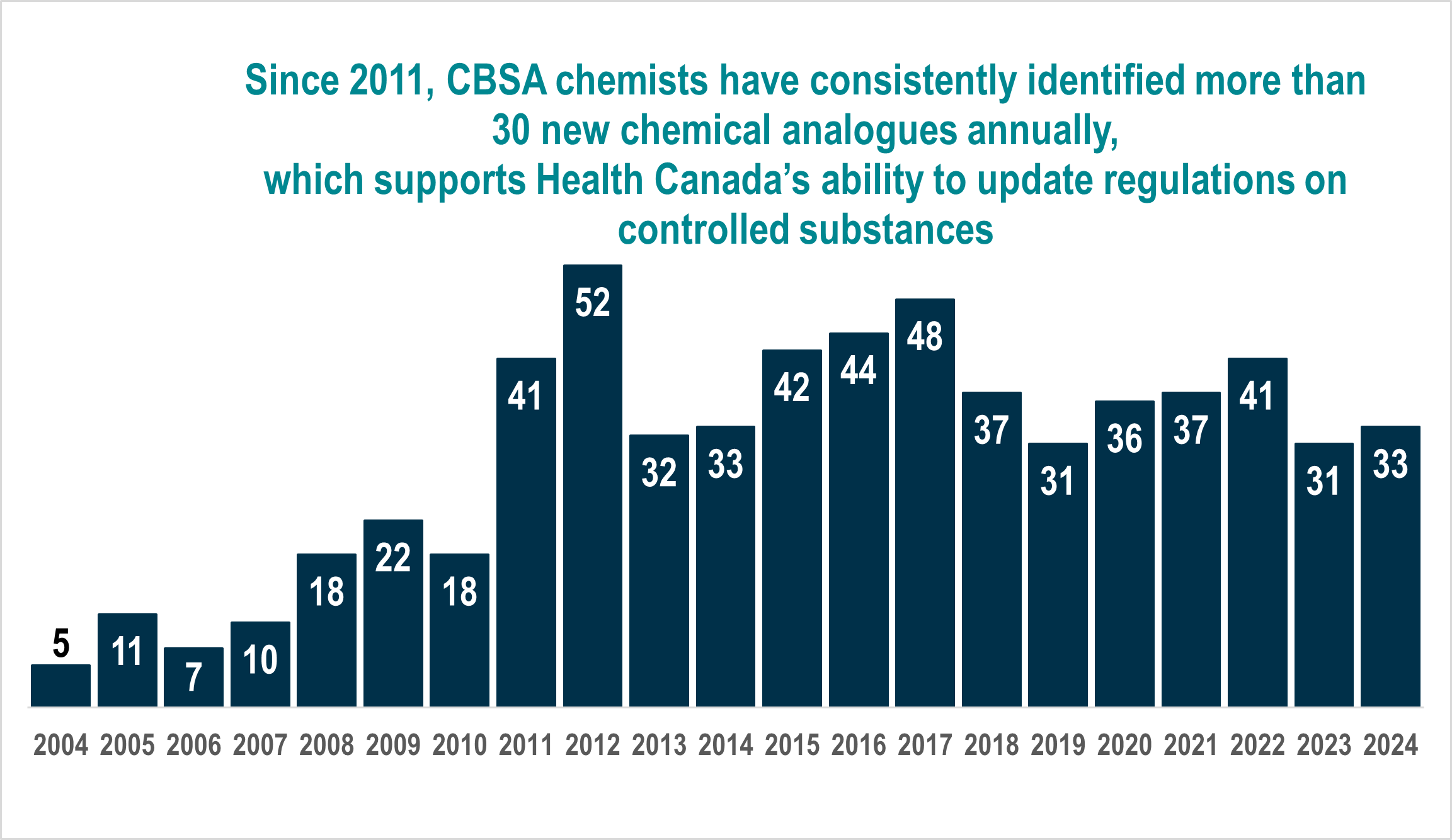
Image description
Figure 1 is a vertical bar chart showing the number of new chemical analogues identified annually by CBSA chemists from to . The horizontal axis lists years, while the vertical axis shows the annual count of identified analogues. Each bar is labeled with its numeric value.
From to , annual totals are relatively low, ranging from 5 to 22. Beginning in , there is a clear increase, with the number of new chemical analogues identified consistently exceeding 30 each year. The highest value occurs in , with 52 new analogues identified.
After , annual totals fluctuate but remain above 30, generally ranging from the low 30s to the high 40s through . This sustained higher level of activity contrasts with earlier years and supports the accompanying statement that CBSA chemists have consistently identified more than 30 new chemical analogues annually since , contributing to Health Canada's ability to update controlled substances regulations.
The FTS program supports other government departments to advance Government of Canada priorities:
- Following the establishment of the CBSA in , the agency assumed ownership of laboratory facilities formerly shared with the Canada Revenue Agency (CRA). In exchange, CRA funds program FTEs through A-base funding to provide them forensic and analytical services (e.g., excise duty samples) on an ongoing basis.
- FTS supported Public Safety Canada's Initiative to Take Action Against Gun and Gang Violence (ITAAGGV) and its National Action Plan for Stolen Vehicles through the acquisition of new detection technology to better restrict illicit trafficking.
- The program's Forensic Document Examination (FDE) and Forensic Facial Identification (FFI) units support Immigration, Refugees and Citizenship Canada through their examinations of travel and identification documents and facial images for immigration admissibility cases and fraud investigations, including files that proceed to court.
- The FTS program is actively involved in the design of new laboratory facilities and government science collaborative frameworks as part of Public Services and Procurement Canada (PSPC's) Laboratories Canada initiative.
The FTS program maintained critical service delivery and supported the government's response during the COVID-19 pandemic:
- The FTS program maintained service delivery during the pandemic, with key informants noting contributing factors included the program's scientific equipment being connected to an independent network (not competing for VPN traffic with rest of agency), and early adoption of Microsoft Teams which enabled FTS employees to transition to remote and hybrid work with minimal disruption.
- The program put rotational in-person staffing in place to maintain some service level while aligning to health guidance. While delays in meeting turnaround targets were noted during this timeframe, staff maintained critical services by continuing to provide expert scientific advice.
- The FTS ATC unit contributed to the government's rapid response to ensure Canadians had access to hand sanitizer at the beginning of the pandemic, through their fast-track review of hand sanitizer formulations in order to ensure an expanded, safe supply of products for Canadians.
- The shift to digital record-keeping and remote data review was maintained in the program post-pandemic, reducing manual and paper-based processes.
Finding 10 (Theme 2: Effectiveness and Impact): The program has enabled the agency to make science-backed, evidence-based decisions in the fulfillment of its mandate. There are opportunities for the program to more broadly enable a culture of science within the agency.
The program provides scientific evidence and advice to support credible and defensible agency decision-making. Some examples:
- Regional Satellite Laboratories (RSL): Following a successful pilot, three RSLs established between and embed scientific analysis that supports evidence-based, real-time frontline decision-making.
- Forensic Facial Identification (FFI) unit: Evolving from the agency's forensic document analysis unit (the only one of its kind in Canada), the FFI unit provides expert scientific support for immigration and fraud cases. Its evidence-based assessments and expert testimony strengthen the agency's credibility and recommendations.
- Laboratory analysis of goods supports accurate duty classification: Through scientific analysis of imported goods, the Customs Analysis section supports accurate tariff classifications and fair revenue collection decisions.
Performance plan related to the agency's scientific policy is not complete. The CBSA Scientific Integrity Policy, effective and updated in , defines clear principles for the agency's conducting and using science responsibly. The policy reinforces transparency and ensures that all research and scientific activities meet the highest standards of integrity and responsible conduct. While the program supports evidence-based decision-making, it has not developed the key monitoring and performance evaluation requirements as required by the Scientific Integrity Policy. As the functional authority for the Policy, the program has not articulated how it will:
- Identify and track required performance indicators related to scientific integrity;
- Collect, annotate, curate, and maintain data on these indicators;
- Establish performance baselines and assess changes over time; and
- Ensure that relevant monitoring data are submitted annually.
Challenges exist that may limit the extent to which the program is able to enable a culture of science in the agency and how it measures impact
- Internal communication of suite of services: Documentation and key informant evidence suggest there is limited capacity in the program to engage in promotional activities of their science services internally, and that there is limited awareness of the program's full suite of services across the agency. This could result in missed opportunities to integrate scientific evidence into business decisions.
- Promotion of scientific advice within the agency: Some OGDs (e.g., Department of National Defence) promote a science-based culture internally by appointing a Science Champion, Chief Science Officer and/or Chief Scientific Advisor who provide strategic scientific advice to senior leadership and have dotted reporting lines to each organizational business line.
- Measuring impact: Several key informants highlighted the challenge of identifying and assessing program impacts as the program is an enabling function that do not always see the end-result of how their work is used. The FTS team commissioned the Defence Research and Development Corporation (DRDC) to develop an economic model to measure the impact of DT, which shows promise but needs refinement before broader application.
Finding 11 (Theme 2: Effectiveness and Impact): The FTS performance information profile would benefit from an update of its Key Performance Indicators (KPI) to focus on those that will support prioritization and decision-making, and that will assess the program's effectiveness as an enabling function. It could also be updated to align with those of other agency programs where FTS plays a supporting role.
There are gaps in the program's performance measurement data collection. The program currently reports on six of the 13 KPIs currently listed in its PIP Footnote 7 with no plans on how it will collect data on the remaining KPIs, which are primarily on client satisfaction. Reducing the total number of KPIs could keep reporting useful and manageable. Consistent with Findings 6 and 7, client satisfaction with the services provided by the Border Technology Division is not collected, limiting the program's ability to assess perceived utility across its full client base. In addition, the data supporting this KPI is based on a relatively small number of respondents (approximately 50 to 60 per year). The program should review its client satisfaction methodology and find ways to increase response rates and automate feedback requests to reduce manual data collection and reporting activities. The evaluation also found gaps in performance management related to research and development (R&D) (see Finding 7). While applied R&D is central to assessing emerging technologies, the program has not set targets for R&D spending, and KPI 10 is neither publicly reported. This limits the program's insight into how R&D activities are prioritized.
The FTS program could consider aligning its PIP horizontally with relevant PIPs in the agency, to identify data collection opportunities or gaps. The FTS program is an enabling function that serves all agency business lines and that supports key outcomes of other agency programs such as Buildings and Equipment for CCTV. The FTS PIP could better describe its roles and responsibilities related to other agency programs, and those of other agency groups relevant to the FTS program. For example, since DT is jointly managed between CTB and FTS, related outcomes are split between two PIP, which warrants attention.
Performance monitoring for CBSA's Scientific Integrity Policy is not yet in place. CBSA's Scientific Integrity Policy requires a performance monitoring and performance evaluation plan. As communicated in the annual policy compliance survey to the government's Office of the Chief Science Advisor, the CBSA noted it is in the planning phase of developing its plan and is looking for expertise from colleagues in OGDs to help inform its development. See Finding 10 which refers to these requirements in more detail.
FTS work contributes to OGD results. The FTS program is implicated in several whole-of-government strategies, such as PSPC's Laboratories Canada initiative as well as Health Canada's Canadian Drugs and Substances Strategy and its Chemical Management Strategy, among others.
The program provides laboratory services to the CRA, but it is currently unknown how the program supports the CRA's achievement of outcomes.
In developing its new PIP, the program should ensure KPIs and targets are identified for its work in support of OGDs and outreach. This could impact the program's prioritization and resource allocation.
Finding 12 (Theme 3: Efficiency and Sustainability): The Contraband LEAN (C-LEAN) analysis approach piloted by the program balances rigour and timeliness and could be leveraged to assess its applicability more broadly. Closer working and organizational ties between the Headquarters and regional laboratories could enhance program coherence and efficiency.
There is a demonstrated demand from operations for laboratory services to provide results of analysis quickly. The success of the RSLs in delivering real-time results highlighted the demand for rapid testing options beyond the traditional 60-day full lab analyses. That said, the RSLs are limited to scanning for substances in existing chemical libraries and cannot provide a Certificate of Analyst required for court cases. In , the lab piloted a lean model in its contraband unit (C-LEAN), which offered an alternate, balanced operating outlined in the table below:
Full lab analysis: Substances are fully analyzed, detailed report, QA, peer reviewed, can provide Certificate of Analyst for court. Service Standard: 60 days (7 days for rush).
RSL analysis: Faster and limited analysis and documentation, no QA, not possible to provide Certificate of Analyst. Service Standard: 1 calendar day.
C-LEAN analysis: Simplified processes, QA, faster peer review, sample retained in case a Certificate of Analyst is required later. Service Standard: 15 days.
The program should consider how this pilot approach could be used more broadly to support how the program prioritizes which samples proceed to full lab analysis.
Other considerations for operating model efficiencies:
- Within the current operating model, FTS chemists specialize in a particular unit, e.g., alcohol, customs. Cross-training chemists between units could allow additional resources to be leveraged when volumes fluctuate between units.
- The program could consider a triage system to prioritize some analyses, such as unknown and high-harm substances.
Enhancing alignment by centralizing laboratory reporting structure
RSLs have reported to the Border Technology Division (BTD) since their initial launch, as BTD already provided direct front-line support. While this was an effective way to test the RSL model, now that the model has been successfully rolled out in three regions, the program may want to revisit this reporting structure. Having RSLs reporting to the Analytical and Forensic Services Division could create a more coherent and efficient operating model by aligning all labs and could enhance the HQ laboratories’ understanding of operational realities through this integration. Of note, the U.S. Customs and Border Protection (US CBP), which adopted the RSL model, has their RSL equivalents report into an HQ lab - the program could gain insights from the US about the benefits of this organizational approach.
Lessons learned for the operating models of the forensic units
In addition to the HQ laboratories, the Analytical and Forensic Services Division has two forensic units that are unique in Canada, with personnel trained to internationally recognized forensic standards. The operating model for Forensic Document Examination unit has been stable over the last several years, while the newer Forensic Facial Identification unit has moved to embed resources with frontline experience into its team structure, which appears to be effectively supporting the unit's operations. Given the lack of domestic comparables, the forensic units should consider if there are lessons learned resulting from the lean exercises the analytical laboratories conducted that could be applicable to them.
Finding 13 (Theme 3: Efficiency and Sustainability): The operating models for the acquisition and maintenance of radio equipment and detection technology generally worked well during the period evaluated, but adjustments could improve efficiency and value for money.
Detection Technology by the numbers (Asset Value $220M)
541 units, including:
- 16 Large Scale Imaging (LSI) machines
- 194 Small Scale Imaging (SSI) machines
- 250 Ion mobility spectrometers
- 71 Handheld x-ray machines
- 10 Remote Operated Vehicles (ROV)
The shared responsibility for detection technology in the agency creates some challenges for its acquisition. Accountabilities related to the acquisition of new detection technology are split between: CTB, who identifies business needs and manages the relationship with regions; and the FTS program in ISTB, who are the technical lead for procurement and who lead the research and assessment of new technologies that support operational needs.
CTB is responsible for defining detection technology requirements before bringing them to the program for technical solutions. CTB also leads all B-based funding requests for FTS. This means that while FTS has autonomy in researching and assessing technologies, decisions on technologies to acquire and their deployment rest with CTB.
However, the evaluation found that being responsible for both the R&D as well as the full lifecycle management of DT, FTS needs a more active role in the DT strategy, including discussions with other business leads and regions so that operational realities and needs are adequately reflected in their R&D activities. Taken together, the current split of accountabilities means FTS does not have full control over the technology acquisition lifecycle, making it more challenging to operate the program efficiently when responsibilities are divided across two branches.
The program's in-house DT maintenance function operating model appears to work well, reflected in the skill level of technicians and consistently positive feedback from DT users. While outsourcing is often presented as a lower-cost option due to reduced overhead, research often shows that potential savings are offset by indirect costs such as reduced program control, high contractor turnover, weaker organizational loyalty and loss of corporate memory, which can result in higher long-term costs and risks for mission-critical functions. These literature findings were concurred by key informants. All regional key informants highly praised their CBSA maintenance technicians who have been consistently reliable and creative in solving challenges to help the agency extend the life of existing equipment—some by 5-10+ years past their end-of-life date.
Several key informants noted that maintenance represents a substantial share of total cost of ownership underscoring the importance of predictable lifecycle planning. Delays in maintenance or repair appear to primarily stem from the limited availability of replacement parts for outdated equipment.
Once new detection technology is approved, FTS leads the procurement process. Document review and multiple key informants expressed that the recent change to centralize ISTB procurement created challenges given the differences between detection technology procurement and general IT procurement. It was noted by the program that some FTEs will be returning to the FTS from the centralized ISTB unit.
Radio program by the numbers
- 7,100+ radio units
- 70+ infrastructure installations
- 20 service contracts
- Portfolio value $45.5M
- Annual budget $11.5M
The operating model for the lifecycle management of two-way radios runs lean but require adjustments to be more efficient and sustainable in the long-term. Document review and key informant interviews found that the increasing complexity of two-way radios require the FTS program technicians to have an advanced level understanding of digital technology in order to ensure they are secure, encrypted and compatible with other first responders and law enforcement agencies.
The acquisition and lifecycle management of two-way radios is led in-house in the program, with five technicians who manage the more than 7,100 units across the agency. Unlike DT, which receives capital funding through TB submissions, radios are primarily agency-funded.
The Accelerated Radio Deployment Program (ARDP) was a 30-month agency-funded modernization initiative ( to ) that deployed nearly 4,000 digital, encrypted radios through 16 major projects across more than 25 public safety radio systems. Document review and key informants emphasized that sustaining a strong two-way radio program beyond the ARDP would require ongoing operational support at both HQ and in the regions, stable funding for network and airtime costs, which increase over time, strengthened governance and oversight, and proactive lifecycle management to avoid the need for large one-time replacement expenses. The program's and radio investment proposals ($5 and $3 million per year, respectively), were not approved.
Of note, the cost of digital radios can be up to five times higher compared to the previous analogue model, due not only to the digital units being more expensive but also to the need for associated infrastructure (repeaters, servers) software, airtime or subscription feeds (to subscribe to public safety radio systems) as well as higher training and support needs given their added complexity. Also, a review of documentation and site visits conducted as part of the evaluation found that in some POEs and in more administrative roles, radios may not be highly used.
Given the operating costs for digital radios (and in line with Finding 3) the program should develop a radio strategy that considers value for money regarding radio allocation so that radios are assigned based on demonstrated operational need, including identifying opportunities to reduce or reallocate radios. It should be noted that currently, Travellers Branch owns the radio policy statement and Standard Operating Procedures for two-way radios. The program may wish to consider how the governance may need to evolve in order to sustainably manage the two-way radios program.
Finding 14 (Theme 3: Efficiency and Sustainability): There is a need to clarify the program's administrative management priorities to strengthen its effectiveness, efficiency, and sustainability.
Management Excellence: A program must understand its accountabilities and responsibilities related to business planning, financial management, human resource management, procurement and contract management, as well as information management. The evaluation assessed the FTS program's operating models, funding structures, and resourcing.
Administrative capacity has declined and hindered the administrative management of the program. The program management cadre includes senior technical specialists primarily in the CH and ENG occupational groups, and program executives from similar backgrounds. The Science and Engineering Program Management unit within the Support and Operations Division also provides administrative support. Given the mainly technical/science/engineering background of the program's management cadre, and the number of rotating acting assignments at these levels (see finding 16), the program should consider training opportunities for incoming managers on the elements of management excellence.
A ISTB realignment established a centralized division in ISTB for corporate functions such as HR, procurement and taskings. This reduced the S&E Program Management unit by six FTEs (from 11 to five FTEs) at the time of this evaluation. Document review and key informants noted the ISTB central planning division does not always appear to fully understand the directorate's business, which is distinct from that of the rest of the branch. Even before the realignment, however, the evaluation found that the program previously had not maintained up to date program strategic and planning documents, service catalogues or other documentation that would support program-specific prioritization or coordination (see Finding 3).
Consequently, the program may need to reassess its allocation of resources for administrative management of the program, both in terms of management activities and related administrative support.
FTS resources dedicated to the Laboratories Canada initiative. CBSA has not received funding to support the design and ongoing coordination work related to the development of the Laboratories Canada Regulatory and Security Science hub. A level of effort exercise estimated that 4.5 non-senior management FTEs are dedicated to supporting Laboratories Canada-related activities (e.g., workshops, attending one of 40 active working groups and committees). The program should review how many FTS resources are focused on Laboratories Canada-related work, to ensure resource allocation aligns to the highest priority work for that initiative and for the program.
FTS's Quality Management System is strong. As highlighted in Finding 3, the program's QA framework for ISO-accredited laboratories is comprehensive and well-documented, contributing to consistency, reliability, and credibility in the program management of laboratory operation. This framework could serve as a model for other program areas requiring improved documentation.
Finding 15 (Theme 3: Efficiency and Sustainability): The program's budget has been consistent, but a lack of predictability can create efficiency challenges. The lack of full recapitalization funding is a risk to program sustainability.
The program has received funding from more than 15 initiatives and projects over the last seven years. The program's primary funding source is A-base funding, followed by two control funds, which are separate funding envelopes used to maintain or recapitalize border technology and radio equipment.
The program also periodically receives temporary funding for specific federal priorities such as opioids and guns and gangs, including for DT to address priorities. Equipment replacement has often been through one-time initiatives, such as the Accelerated Radio Deployment Project.
Table 5
| FTS expenditures ($M) | Fiscal year to |
Fiscal year to |
Fiscal year to |
Fiscal year to |
Fiscal year to |
Fiscal year to |
|---|---|---|---|---|---|---|
| A-BaseFootnote 8 | $11.08 | $12.32 | $10.55 | $10.95 | $9.45 | $11.68 |
| Strengthening the National Immigration Detention FrameworkFootnote 9 | $0.25 | $0.06 | $0.38 | $0.06 | $0 | $0 |
| Guns and GangsFootnote 10 | $0.15 | $0.87 | $1.02 | $0.95 | $0.77 | $0.36 |
| Opioid / FentanylFootnote 11 | $0 | $1.40 | $0.37 | $1.60 | $1.58 | $1.67 |
| Accelerated Radio Deployment ProjectFootnote 12 | $0 | $0 | $7.70 | $7.99 | $4.84 | $0.01 |
| Innovative Solutions CanadaFootnote 13 | $0 | $0 | $0.22 | $0 | $0 | $0 |
| Immigration and Citizenship ConsultantsFootnote 14 | $0 | $0 | $0 | $0.11 | $0.10 | $0.10 |
| Gordie Howe International Bridge PoEFootnote 15 | $0 | $0 | $0 | $0.05 | $0.21 | $0.15 |
| Rationalization and OptimizationFootnote 16 | $0 | $0 | $0 | $0.29 | $0.21 | $0.25 |
| Firearms SmugglingFootnote 17 | $0 | $0 | $0 | $0 | $2.67 | $0.03 |
| Cannabis LegalizationFootnote 18 | $0 | $0 | $0 | $0 | $0.55 | $0.77 |
| Cannabis Excise TaxFootnote 19 | $0 | $0 | $0 | $0 | $0 | $0.59 |
| Other projects and initiativesFootnote 20 | $0 | $0 | $0 | $0 | $0 | $0.12 |
| Detection Technology Control Fund | $8.90 | $11.83 | $9.30 | $10.10 | $12.10 | $18.3 |
| Radios Control Fund | $5.26 | $6.67 | $4.82 | $5.25 | $7.74 | $9.16 |
| Total | $25.65 | $33.14 | $34.51 | $37.34 | $40.15 | $43.20 |
Source: FTS Expenditures, provided by FCMB, source data Max. Totals may not add due to rounding
The program funding model is fragmented, creating a lack of long-term predictability and hindering strategic planning. With a mix of A-base funding and two control funds that rely on annual decisions by agency management, supplemented with periodic, but often short-term B-base funding, not all program funding is predictable in the medium- to long-term, which reduces the program's capacity to manage assets in a proactive, strategic manner. The consequences of a fragmented funding model including reactive funding decisions that address short-term needs without considering the entire portfolio over the long-term.
The lack of full recapitalization funding is a risk to long-term program sustainability.
Table 6
| FTS Control Fund Expenditures ($M) | Fiscal year to |
Fiscal year to |
Fiscal year to |
Fiscal year to |
Fiscal year to |
Fiscal year to |
|---|---|---|---|---|---|---|
| Radio Control Fund | $8.90 | $11.83 | $9.30 | $10.10 | $12.10 | $18.03 |
| Detection Technology and Labs Control Fund | $5.26 | $6.67 | $4.82 | $5.25 | $7.74 | $9.16 |
| Total | $14.16 | $18.50 | $14.13 | $15.23 | $19.79 | $27.46 |
Source: Figures provided by FCMB FMA. Source data MAX Totals may not add due to rounding.
The program manages two control funds, which set aside funding for maintenance and replacement of FTS equipment. Control fund spending decisions are approved by Executive Committee annually. Key informants note that recent multi-year nominal budget allocations have enabled planning for or funding commitments to subsequent funding years, which is seen as critical for purchasing long-lead equipment (> 12 months) to avoid lapsing funds. While the evaluation team did not have the expertise to assess the risk or financial valuation of the FTS control funds, document review and key informants suggested potential issues as to their financial sustainability in the long-term.
The 10-year DT capital plan is not funded for full recapitalization. Document review and key informants suggest that budget asks are driven by the highest immediate risk, rather than looking at the entire FTS suite of services with a long-term, sustainable approach.
The program may wish to review how comparable OGDs like Department of National Defence (DND) or major police forces (RCMP, Toronto) manage their DT and radios assets to inform how the program could be more sustainable and efficient in this regard, and to work with their CTB DT colleagues on any efforts that could support program sustainability in this way.
The Border Action Plan provided FTS with half of the needed ongoing funding, limiting its impact
As part of the Border Action Plan FTS will receive $134.5M in one-time, and $12.6M in ongoing, funding. This new funding does not include full recapitalization for new DT.
Table 7
| FTS Expected Future Funding ($M) | Fiscal year to |
Fiscal year to |
Fiscal year to |
Fiscal year to |
Fiscal year to |
|---|---|---|---|---|---|
| A-Base | $9.88 | $10.15 | $10.14 | $10.14 | $10.14 |
| Border Action Plan | $5.69 | $30.68 | $32.86 | $30.27 | $34.98 |
| Rationalization and Optimization | $0.31 | $0 | $0 | $0 | $0 |
| Stolen VehiclesFootnote 21 | $2.80* | $0 | $0 | $0 | $0 |
| Cannabis legalization and excise tax | $1.60 | $1.57 | $1.67 | $1.68 | $1.69 |
| Gordie Howe International Bridge POE | $0.31 | $5.1 | $0 | $0 | $0 |
| Guns and gangs | $0.97 | $0.97 | $0.97 | $0.97 | $0.97 |
| Firearms smuggling | $0.40 | $0.33 | $0.33 | $0.33 | $0.33 |
| Other projects and initiatives | $1.88 | $1.88 | $1.88 | $1.88 | $1.88 |
| Vaping Tax | $0.38 | $0.38 | $0.39 | $0.40 | $0.40 |
| Radio Control Fund | $13.05 | $9.43 | $9.31 | $9.31 | $9.31 |
| Detection Technology and Labs Control Fund | $27.45 | $9.27 | $9.27 | $9.27 | $9.27 |
| Total | $64.72 | $69.76 | $66.82 | $64.25 | $68.97 |
Source: Figures provided by FCMB FMA. Source data Max as of . Totals may not add due to rounding.
The program risk manages some functions and has experienced unintended costs. The program risk manages its resources supporting CCTV activities and the FFI unit. As detection technology continues to evolve, an unintended consequence of program success is the increase in the intercepted goods that require storage and disposal. For example, costs for the disposal of precursor chemicals were noted by both HQ and regional key informants to have increased significantly and a internal audit found insufficient budget for disposal. The Agency may need to take this into account when costing the program.
Multiple realignments have affected the program’s capacity. Over the seven-year evaluation period, FTS has 13 net new FTEs, but has lost some capabilities, e.g. advanced analytics, border innovations and administrative functions, which moved to other branches or directorates. FTS has also assumed new responsibilities related to cannabis, vaping, forensic facial identification, RSLs and preparations to support Laboratories Canada.
In , the program conducted a ‘right sizing’ exercise to determine how its current and upcoming planned FTEs should be allocated across the FTS to deliver on its mandate in the short- to medium-term. Given the evaluation’s findings, the program will need to consider how it will optimize its resources to deliver on new commitments, while balancing some of the existing FTE challenges they face (strengthening program management, see Finding 14) and those that are currently being risk-managed (CCTV position and FFI unit).
Table 8
| FTEs by Division | Fiscal year to |
Fiscal year to |
Fiscal year to |
Fiscal year to |
Fiscal year to |
Fiscal year to |
Fiscal year to |
|---|---|---|---|---|---|---|---|
| Director General's Office (DGO) | 2.49 | 2.68Footnote 22 | 1.97Footnote 22 | 1.88 | 1.89 | 1.81 | 1.86 |
| Analytical and Forensic Services (AFSD) | 44.43Footnote 23 | 52.97Footnote 23 | 54.04Footnote 23 | 57.09 | 55.75 | 58.85 | 58.75 |
| Border Technology Division (BTD) | 46.81 | 46.23Footnote 24 | 32.31Footnote 24 | 46.56Footnote 24 | 53.86Footnote 24 | 56.21 | 53.98 |
| Support and Operations Division (SOD) | 26.69 | 29.05Footnote 25 | 21.86Footnote 25 | 23.83 | 26.57 | 26.40Footnote 26 | 18.93Footnote 26 |
| TotalFootnote 27 | 120.41 | 130.92 | 110.17 | 129.36 | 138.08 | 143.27 | 133.52 |
Source: FTS FTEs by Cost-Centre, provided by FCMB FMA. Source data MAX.
The program funding model includes cost-recovered services and funding to support the CRA. FTS is occasionally asked to perform ad hoc services to support other federal and provincial organizations on a cost-recovery basis. As the only units of their kind in Canada, the FFI and FDE forensic units are most often approached to provide such services.
When the CBSA was established in , an MOU between the CBSA and the CRA was drafted whereby the CBSA would perform analytical services for the CRA following the separation of the two organizations. These services are funded through the program's permanent A-base funding rather than on a cost recovery basis. That said, an updated MOU has been drafted but not approved between the CBSA and the CRA. Finalizing this MOU is essential to ensure good governance and alignment of FTS services with operational capacity and the terms of its agreement with the CRA.
Table 9
| Cost Recovery | Fiscal year to |
Fiscal year to |
Fiscal year to |
Fiscal year to |
Fiscal year to |
Fiscal year to |
|---|---|---|---|---|---|---|
| Total FTS cost recoveries | $660,876 | $613,330 | $465,325 | $578,633 | $1,005,591 | $48,852Footnote 28 |
Source: FTS FTEs by Cost-Centre, provided by FCMB FMA. Source data MAX.
CBSA support for the Laboratories Canada initiative faces resource pressures. CBSA has not received funding from PSPC to support Laboratories Canada and all costs for related planning and coordination have had to be absorbed to date with the agency contributing FTEs in-kind. One-time funding will be required to move and recalibrate of FTS equipment to the new Regulatory Security Sciences site once ready (planned for ). As well, an operating funding gap has been identified for the eventual move to a larger facility, as operating funding is provided on a fixed square footage basis.
Finding 1 (Theme 3: Efficiency and Sustainability): While employee retention was high during the period evaluated, a succession plan could reduce the risk of the program losing specialized corporate knowledge and increase its readiness to recruit and develop talent as needed.
Some recruitment challenges exist. The evaluation found that the program faces challenges in recruiting highly specialized professionals, and key informants suggested this remains the case. Of all staffing from to 87% resulted in the appointment of internal candidates.
The program may wish to work with its government science partners to find ways to streamline recruitment processes, expand talent pools, and explore shared or coordinated hiring approaches to better meet staffing needs.
Program has a high retention rate but succession planning needed. Retention of specialized staff remains strong, with an average attrition rate of 4.5% over the last four years, to (in comparison, ISTB's was 8.6% during this timeframe).
Succession planning has not kept pace with recent retirements and with 22% of FTS staff being eligible to retire without financial penalty within the next five years. The program frequently uses long-term or rotating acting appointments and rotations between different divisions, which can affect continuity in groups in which there are a number of temporary appointments. This approach also has the potential to introduce unintended bias in acting and non-advertised opportunities. More structured succession planning would not only strengthen talent management but also support efforts to maintain a representative and diverse workforce.
Classification and pay levels may pose recruitment and retention issues. The program's 130+ non-executive FTEs occupy positions across 11 different occupational categories, which could create an administrative burden for people managers and could limit talent management of employees in less frequently used occupational categories, e.g., CR, SE-RES, GT. Streamlining these could potentially simplify program workforce planning.
Similar roles in comparable organizations may be classified differently than in the FTS. As the program prepares for the roll-out of Laboratories Canada, it could be worthwhile to work with partners on a benchmarking or classification harmonization exercise to support workforce readiness and consistency across government laboratories and science and engineering roles.
Developing a structured succession plan would help ensure continuity in specialized areas where expertise currently resides with a small number of experienced staff. This could help streamline recruitment, formalize development pathways, and implement structured knowledge transfer practices to ensure specialized expertise is consistently sustained.
Women in Science, Technology, Engineering, and Mathematics (STEM) fields. Established in , the agency's Women in ISTB network is an employee resource group that aims to empower women within STEM fields by promoting their professional development, advocating for gender equality and providing a forum for discussion. Member feedback has noted there is insufficient sponsorship and professional development programs for women in STEM fields.
In , 42.3% of Science and Engineering Directorate employees were women. This proportion has been trending downward from 47.5% in to , although the overall percentage remains close to workforce availability. That said, it's noted that workforce availability rates do not represent particular classification groups and the program may have challenges drawing from a smaller pool of female candidates. Nevertheless, the program may wish to explore how it can ensure representation of women in the directorate's leadership roles, including considering mentorship and sponsorship opportunities to support women in STEM roles. Applying an equity, diversity and inclusion lens to succession and talent management plans could ensure that representation is considered in order to maintain workforce representation in the long-term.
Formal professional development programs may be necessary to effectively manage the specialized talent needed to advance the FTS program. Specialized workforces often have distinct professional development needs, (e.g. training and maintaining certifications). The agency's Scientific Integrity Policy sets out expectations related to professional development, including the development and implementation of a scientific integrity mentorship program. The FTS program also has informal ‘Career Progression Frameworks' to support development and advancement as employees gain experience and expertise, such as through non-advertised promotions for chemists from the CH-02 to CH-03 levels. While program key informants felt these informal approaches have improved retention, they are not formalized professional development programs at the agency level.
In comparison, ISTB has several formalized professional development programs for IT specialists, such as the IT Professional Development program, the Equity, Diversity and Inclusion Talent Management program, and the IT Apprenticeship program for Indigenous Peoples. Not only do these programs support talent management, but they also reflect efforts to ensure a representative and diverse workforce. The FTS program may wish to consider formalizing its career frameworks and adding an equity, diversity and inclusion lens (which would also support the agency's women in STEM).
Annex A: Acronyms
- AFSD
- Analytical and Forensic Services Division
- ARDP
- Accelerated Radio Deployment Program
- ATC
- Alcohol, Tobacco and Cannabis
- BL
- Business Lines
- BSO
- Border services officer
- BTD
- Border Technology Division
- CBSA
- Canada Border Services Agency
- CCTV
- Closed-circuit television
- CER
- Comprehensive Expenditure Review
- CFIA
- Canadian Food Inspection Agency
- CLIC
- Clandestine Laboratory Investigating Chemists Association
- COMET
- Contraband Outfitted Mobile Examination Truck
- CP
- Canada Post
- CRA
- Canada Revenue Agency
- CTB
- Commercial and Trade Branch
- DND
- Department of National Defence
- DRDC
- Defence Research and Development Corporation
- DT
- Detection Technology
- DRF
- Departmental Reporting Framework
- DSEA
- Designated Safe Examination Area
- DSSA
- Designated Safe Sampling Area (see also Regional Satellite Laboratories, RSLs)
- DTFS
- Detection Technology Field Support
- EC
- Executive Committee
- EDI
- Equity, Diversity, and Inclusion
- FCMB
- Finance and Corporate Management Branch
- FDE
- Forensic Document Examination
- FFEWG
- Forensic Facial Export Working Group
- FFI
- Forensic Facial Identification
- FMM
- Functional Management Model
- FTE
- Full-time Equivalent
- FTS
- Field Technology Support
- FY
- Fiscal Year
- GBA Plus
- Gender-Based Analysis Plus
- GoC
- Government of Canada
- GTA
- Greater Toronto Area region
- HC
- Health Canada
- HCVM
- Heimann Cargo Vision Mobile
- HQ
- Headquarters
- HTS
- Highly Toxic Substances
- HR
- Human Resources
- IBP
- Integrated Business Plan
- ITAAGGV
- Initiative to Take Action Against Gun and Gang Violence
- ICES
- Integrated Customs Enforcement System
- IEB
- Intelligence and Enforcement Branch
- ISO
- International Organization for Standardization
- ISTB
- Information, Science and Technology Branch
- KPI
- Key Performance Indicator
- LSI
- Large-Scale Imaging
- MOU
- Memorandum of Understanding
- MRAP
- Management Response and Action Plan
- OGDs
- Other Government Departments
- O&M
- Operations and Maintenance
- OPI
- Office of Primary Interest
- PAC
- Pacific region
- PARM
- Planning, Analytics and Resource Management Division
- PIP
- Performance Information Profile
- POE
- Port Of Entry
- PSPC
- Public Services and Procurement Canada
- QA
- Quality Assurance
- QUE
- Quebec Region
- QMS
- Quality Management System
- RACI
- Responsible, Accountable, Consult, Inform
- R&D
- Research and Development
- RCMP
- Royal Canadian Mounted Police
- RFPs
- Requests for Proposals
- RGS
- Refocused Government Spending
- ROV
- Remote Operated Vehicle
- RSL
- Regional Satellite Laboratory
- RSS
- Regulatory and Security Science
- S&E
- Science and Engineering Directorate
- SOD
- Support and Operations Division
- SOP
- Standard Operating Procedure
- SSI
- Small-Scale Imaging
- TB
- Travellers Branch
- US CBP
- United States Customs and Border Protection
- VPN
- Virtual Private Network
- WCO
- World Customs Organization
Annex B: Program logic model and performance measurement framework
CBSA Mandate: The agency is responsible for providing integrated border services that support national security and public safety priorities and facilitate the free flow of persons and goods, including animals and plants, that meet all requirements under the program legislation.
Core Responsibility: Border Management
Program-level Outcomes
Ultimate
- The CBSA and other government departments effectively leverage science, technology and engineering solutions and services in order to help facilitate unimpeded and legitimate trade, revenue generation and travel while preserving the integrity of our border.
- KPI 13: Stakeholders surveyed are “satisfied” and “very satisfied” with Science and Engineering services. Question: How satisfied were you with this aspect of our service/product? – Did the advice, analysis and services obtained from the Program facilitate unimpeded and legitimate trade, revenue generation and travel while preserving the integrity of our border.
Intermediate
- Operational services and other government departments effectively leverage science, technology and engineering tools and evidence-based analysis.
- KPI 11: Stakeholders surveyed are “satisfied” and “very satisfied” with Science and Engineering services. Question: How satisfied were you with this aspect of our service/product? The client's ability to effectively leverage science, technology and engineering tools and evidence-based analysis
- CBSA pilots new technological solutions to solve border management evolving threats and business challenges.
- KPI 12: Stakeholders surveyed are “satisfied” and “very satisfied” with Science and Engineering services. Question: How satisfied were you with this aspect of our service/product? – Did the information and data obtained from the pilot allow you to make decisions on the technology/product evaluated.
Immediate
- Operational services and other government departments are provided with analysis, data and evidence to make accurate technical decisions in an objective and timely manner.
- KPI 1Footnote 29: % of analytical and forensic samples analyzed within service target
- KPI 2Footnote 29: # of analytical and forensic samples processed
- KPI 3Footnote 29: % of Proficiency test that are successful
- Operational services leverage the available tools to make evidence-based decisions.
- KPI 4Footnote 29: Operational availability of deployed detection technology (excluding health and safety tools)
- KPI 5: % of times where Operational Services uses tools during an examination, investigation or enforcement
- KPI 6: Capability of POEs to investigate threats (Stakeholders surveyed are “satisfied” and “very satisfied” with Science and Engineering services. Question: How satisfied were you with the provided Detection Technology equipment to make evidence-based decisions?
- Operational services leverage available tools to ensure the safety of BSOs, clients and the public.
- KPI 7Footnote 29: Operational availability of health and safety related tools
- KPI 8Footnote 29: Solutions meet stakeholder need (Stakeholders surveyed are “satisfied” and “very satisfied” with Science and Engineering services. Question: Question: How satisfied were you with this aspect of our service/product? - I received relevant solutions with regards to my needs.
- CBSA assesses emerging and innovative technologies and solutions to respond to new and evolving threats and business challenges.
- KPI 9: Services/products meet business need
(Stakeholders surveyed are “satisfied” and “very satisfied” with Science and Engineering services. Question: How satisfied were you with this aspect of our service/product? - The level of Technology provided to meet your business requirements - KPI 10: % of FTS budget (A-base, control funds, and other) dedicated to R&D
- KPI 9: Services/products meet business need
Outputs:
- Analytical and forensic reports that support evidence-based decision making under program legislation.
- Expert testimony to support reports, advice and guidance.
- Expert guidance and advice.
Activities:
- Conduct analytical and forensic analysis including suspected contraband, documents, images, trade commodities, excise instruments and radiation detection to support program legislation and BSO health and safety.
- Provide scientific and technical expertise, advice and training.
- Develop and maintain laboratory capability and ISO/IEC 17025 accreditation to provide reliable services.
Pillar: Analytical and Forensic Services
Outputs:
- Effective and well-maintained deployed border technologies and tools (e.g., x-rays, radiation portals, two-way radios, etc.)
- Expert guidance and advice.
- Social performance data collection to measure social impacts of deployed technologies and tools.
Activities:
- Support the agency as Technical Authority on Detection Technologies and tools under its Life Cycle Management Framework (e.g. technical requirements gathering, technical specification, configuration, integration, in service support, disposal).
- Enhance BSOs and Canadian citizens’ safety by managing CBSA's radiation portals and alarm adjudication.
- Contribute to ensuring BSO safety by providing CCTV specifications, inspection tools, P25 Radios and Personal Radiation Devices.
Pillar: Operational Readiness and Life Cycle Management
Outputs:
- Science, technical, and engineering solutions to business challenges (i.e. enhanced threat detection, DSSAs).
- Expert guidance and advice.
Activities:
- Research, test, evaluate, and recommend border technologies and tools.
- Develop prototype and pilot, and implement effective science and engineering solutions.
- Provide the agency with leading edge information on science, technology and engineering by performing applied and pure research to advance Canadian border security.
Pillar: Border Technology Research and Solutions
Annex C: Methodology
Evaluation evidence was using multiple methods. To increase the reliability of the evaluation's findings and recommendations, and to minimize the limitations of any single method, evidence was triangulated across many sources.
Key Informant Interviews: To gather perceptions about the program, 17 interviews with 35 individual key informants were conducted. Key informants from the CBSA (including ISTB, CTB and Pacific region (PAC), Quebec region (QUE), GTA regions), the Canadian Food Inspection Agency (CFIA), and Public Services and Procurement Canada (PSPC) were included.
Performance, Administrative and Financial Data Review: The program's documentation, financial and performance data were examined to assess progress towards achieving expected outcomes and to review program operating models for relevance, coherence, effectiveness, efficiency and sustainability, including:
- Program documentation (policies, procedures, trackers, reports etc.)
- Expenditure and resourcing data from the Costing and Analytical Model (CAM) and MAX
- Program performance and reporting data (KPIs)
Other Data, Documentation and Literature:
- Strategic or priority-setting documents, e.g., Federal, CBSA, branch-level
- Agreements, e.g., Memoranda of Understanding (MOUs), contracts
- Recent surveys, e.g., CTB survey on detection technology () (n=534); FTS Gender Based Analysis Plus survey (); Public Service Employee Survey
- Related reviews, evaluations, audits and studies (CBSA and OGDs)
- Public documentation such as media articles, research reports, B5 partner websites
Site Visits:
- CBSA Labs (HQ)
- Ottawa Air Cargo (Northern Ontario Region)
- Regional Satellite Laboratory (QUE)
- Marine and Rail Inspection (QUE)
Case Studies: Three areas of the program were chosen for a focused review to assess program impact:
- Regional Satellite Laboratories (RSLs)
- Partnership with RCMP to access backscatter van
- Readiness for move to Laboratories Canada Regulatory and Security Science hub
Annex D: Management Response and Action Plan (MRAP)
Recommendation 1
To enhance the strategic direction and provide clarity around the program, the Vice-President, Information Science and Technology Branch (ISTB), should develop a strategic plan for the program in line with the Agency's Scientific Integrity Policy (SIP), and supported by documentation of policies, processes, services, and accountabilities. This plan should also consider organizational structure and operating model efficiency, as well as program sustainability.
Management response
The Vice-President of ISTB agrees with the recommendation and will work with the Commercial Trade Branch, Intelligence and Enforcement Branch, and Travellers Branch to outline a 5-year Science Strategy and develop an governance-approved S&E Operational Plan, to be updated annually and appended as an Annex to the Branch's annual Integrated Business Plan (IBP). In consultation with the Regions, Canada Revenue Agency, and other CBSA stakeholders, the S&E Program will establish service offerings and service levels, annually as part of the IBP Process, optimized to align with capacity and the needs of operations.
| Management action plan | Completion date | Lead(s) | Support |
|---|---|---|---|
1.1 Outline a 5-year CBSA Science Strategy, to describe the potential for enhanced integration of science into CBSA Operations and contributions to whole of government priorities. 1.1.1 Develop a Vision Statement for the Science and Engineering program that articulates how Science and Engineering could enable CBSA Operations into the future. |
ISTB (Science and Engineering) | N/A | |
1.2 Develop a to S&E Operational Plan, in consultation with key Agency and Other Governmental Departments stakeholders, which outlines: the program's major activities; established service levels; key stakeholders; resource requirements. 1.2.1 Develop a to Operational Report, summarizing accomplishments and performance against the plan. |
ISTB (Science and Engineering) | N/A | |
1.3 Develop an Annex to the ISTB's Integrated Business Plan, presenting the Science and Engineering Operational Plan on an annual basis. |
ISTB (Science and Engineering) | N/A |
Recommendation 2
To enhance program support to Agency operations and clarify key program responsibilities, the VP of ISTB, in consultation with relevant CBSA stakeholders, should develop and implement a strategy to communicate the program's name, service offerings, and responsibilities across the Agency, including its functional authority with respect to the Agency's Scientific Integrity Policy (SIP). The strategy should include service offerings and service standards, and cross-functional areas and areas where there is potential confusion with other Agency functions.
Management response
The VP ISTB agrees with this recommendation and will develop promotional materials and a communication plan to increase awareness of Science and Engineering in CBSA Operations, roles and responsibilities relating to front-line activities, functional authorities, and the Agency's SIP. The S&E Program will also develop a dashboard for key stakeholders to see, in near-real time, the status of service requests and performance against defined standards.
| Management action plan | Completion date | Lead(s) | Support |
|---|---|---|---|
2.1 Promote the 140-year history of science supporting Canada Customs, share information across the Agency on the Program’s updated name, and highlight activities of current S&E Lab. |
ISTB (Science and Engineering) | Communications, Parliamentary and Public Affairs Branch | |
2.2 Conduct a review of Program roles and responsibilities, along with Agency stakeholders, related to front-line support activities (e.g., Detection Technology, Highly Toxic Substances, Radio) in the context of existing governance and policies. 2.2.1 Develop or update documents accordingly based on review of program roles and responsibilities. |
ISTB (Science and Engineering) | N/A | |
2.3 Develop a stakeholder engagement strategy, in consultation with the Communications Directorate, to promote awareness of S&E Program, including authorities, roles and responsibilities, and intake processes. 2.3.1 Develop client facing dashboard, showing near-real time service status, and Service Standards. Consult with Corporate Communications on opportunities to complement the S&E program's stakeholder engagement activities to raise awareness of this tool. |
ISTB (Science and Engineering) | Communications, Parliamentary and Public Affairs Branch |
Recommendation 3
The VP of ISTB, in consultation with relevant CBSA stakeholders and the Enterprise Planning, Risk and Results Division, should update the program's Performance Information Profile (PIP) to ensure that: Key Performance Indicators (KPIs) are relevant to the full suite of the program's service offerings, and are all supported by regular data collection and reporting; the Agency's performance measurement requirements under its SIP are met; and, responsibility for related data collection and reporting is assigned and documented.
Management response
The VP ISTB agrees with this recommendation and will work with FCMB and key stakeholders to update the S&E Program's PIP and KPIs to reflect the three pillars of services rendered, recent guidance from TB and requirements under the SIP. S&E Program will demonstrate, to CTB and other stakeholders, the value of automatic operational reporting by piloting the collection of data directly from deployed systems.
| Management action plan | Completion date | Lead(s) | Support |
|---|---|---|---|
3.1 Update S&E Program Information Profile (PIP) with a focus on immediate outcomes and revised KPIs based on service standards and addressing evolving border challenges, ensuring data availability for each KPI and full coverage of major program activities. 3.1.1 Document responsibility for and frequency of collecting and reporting on KPI results for S&E program. |
ISTB (Science and Engineering) | N/A | |
3.2 S&E Program will review the performance measurement requirements in the CBSA's Scientific Integrity Policy (SIP) and establish a monitoring plan to evaluate the extent to which it is meeting its objectives. |
ISTB (Science and Engineering) | N/A | |
3.3 S&E Program will pilot automatic usage reporting from deployed technologies (e.g., through the Border Technology Network) to reduce manual reporting and improve data integrity in performance metrics. |
ISTB (Science and Engineering) | N/A |
Recommendation 4
In support of sound program management, the VP, ISTB should develop a program resource strategy that prioritizes activities and aligns resources to service delivery, research and development and program management/administration activities. This plan should also consider succession planning, talent management and knowledge transfer in the program and apply an Equity, Diversity and Inclusion (EDI) lens to related planned activities.
Management response
The VP ISTB agrees with the recommendation and will develop a succession plan for leadership positions and strengthen career supports to manage the Program's specialized workforce. S&E will work with Human Resources Branch and Finance and Corporate Management Branch to ensure that staffing strategies and career progression frameworks include consideration for EDI and development and retention of technical experts.
| Management action plan | Completion date | Lead(s) | Support |
|---|---|---|---|
4.1 S&E Program will develop a succession plan for all leadership positions (e.g., EX minus 2 and up), including any gaps or training requirements to ensure business continuity in the event of departures. |
ISTB (Science and Engineering) | N/A | |
4.2 S&E Program will strengthen employee career supports, including: Career Progression Frameworks, Training and Mentoring programs, and staffing strategies, introducing pathways to develop and recognize Technical Expertise and incorporating input from Equity, Diversity, and Inclusion. |
ISTB (Science and Engineering) | N/A |
Page details
- Date modified: